Couples: When to Add Wedding Drone Photography ($400–$1,000)
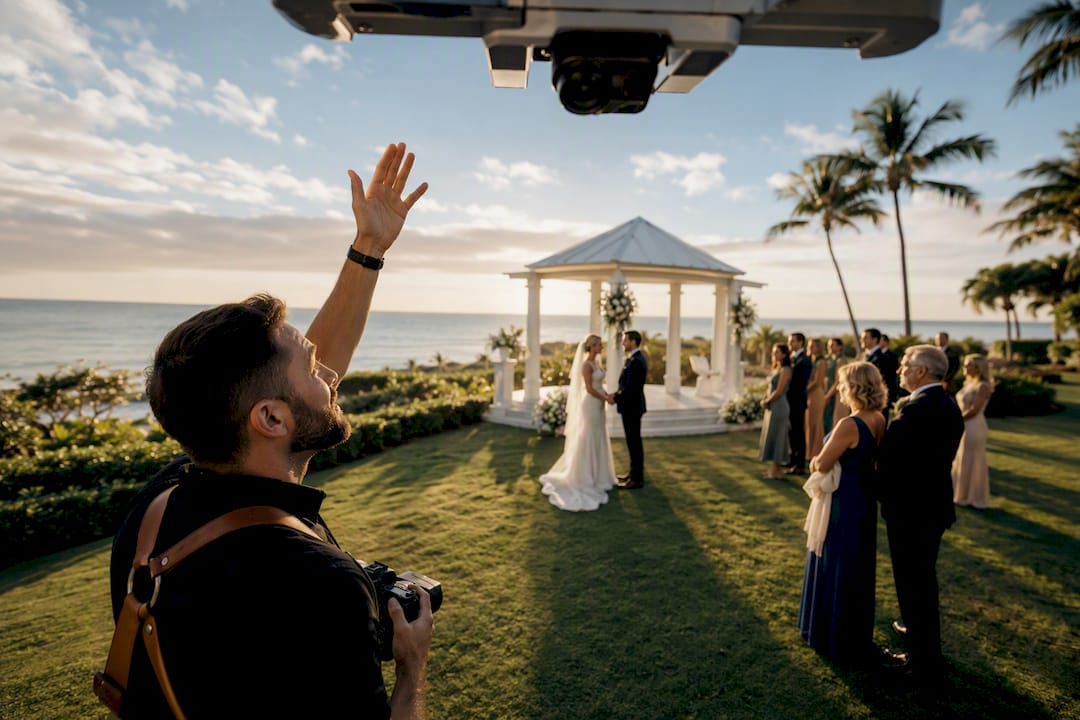
Drone photography is worth the investment when your wedding is outdoors and the venue or landscape genuinely adds to the story: a beach, a vineyard, a mountain estate. It’s usually not worth it for small, indoor, or parking-lot-adjacent venues where there’s nothing scenic to reveal from above. The tradeoff is permits and weather risk against a handful of images no ground camera can produce, so the smart play is a few short, planned flights rather than nonstop coverage.
TL;DR:
Drone coverage is most worth it at scenic outdoor venues like beaches, vineyards, and mountain estates, but not for indoor or urban settings with limited views.
Aerial shots should focus on landscape context and group formations, complementing but not replacing ground-level photography during key moments.
Costs typically range from $400 to $1,000 as an add-on, influenced by pilot experience, equipment quality, flight time, travel, and permit requirements.
Legally, drone pilots must hold FAA Part 107 certification, have venue and airspace approval, insurance, and adhere to weather and flight safety regulations.
Limiting drone use to two short flight windows around your venue setup and portrait sessions provides high-value footage without disruption or excessive cost.
Table of Contents
What Wedding Drone Photography Actually Adds
A drone shows scale a ground camera physically cannot. It pulls back far enough to put your entire ceremony inside the landscape it’s happening in, whether that’s a cliffside in Big Sur or a citrus grove in central Florida. Ground-based shots capture faces and moments; aerial wedding photos capture context, geography, and the shape of the day itself.
Drones work best as a complement, not a substitute. A Photo-Logica guide on the practice notes that the most defensible aerial images are venue overviews, landscape context shots, and graphic group formations that only read clearly from above. Think:
A single overhead frame showing your entire guest circle around the altar
A slow pull-away reveal as you exit the ceremony, showing the full property
A couple’s portrait where the landscape, not just the two of you, tells the story
None of that replaces the photographer standing three feet away during your vows. It adds a second visual register your gallery wouldn’t otherwise have.
Which Venues Actually Benefit From Aerial Coverage
Aerial wedding photography earns its cost at venues with something worth flying over. Coverage tends to pay off most at these venue types, per guidance from Wezoree’s drone photography roundup:
Beach and coastal venues, where shoreline curves and water color read only from height.
Vineyards and farms, where row patterns and rolling acreage become the visual subject.
Mountain or cliffside estates, where elevation changes are the whole point of the location.
Large historic estates or plantations, where grounds and architecture sprawl beyond what a 35mm lens can frame.
Rooftop or skyline venues, where the city itself is part of the backdrop.
Before booking, check four things: your ceremony is outdoors, the surroundings are genuinely scenic (not just a lawn), the venue is likely to approve flights in writing, and your timeline has a realistic five-minute window for it. Skip the drone if you’re getting married in a ballroom, a downtown rooftop with a strict no-fly policy, or anywhere the “view” is a hedge and a parking structure.
What Does Wedding Drone Photography Cost?
Pricing for wedding drone photography typically runs as an add-on to your main photo and video package rather than a fully separate line item, though some couples hire a dedicated aerial operator by the hour. Based on figures reported by Rachel Sue Photography, single-service aerial add-ons often fall somewhere in the $400 to $1,000 range, though that swings with your market and the operator’s experience level.
What actually moves the price:
Pilot certification and experience with wedding-specific timing
Equipment quality (4K vs. cinema-grade sensors, obstacle avoidance)
Total flight time requested and number of separate windows
Travel distance to a destination or remote venue
Local permit requirements, especially near airports or parks
Prestige or destination locations tend to cost more purely from travel and permitting overhead, according to Wezoree. Always ask for an itemized quote rather than a flat “drone package” number.
Is a Drone Operator Legally Required to Be Certified?
Yes. Anyone flying a drone commercially, meaning they’re being paid to shoot your wedding, needs an FAA Part 107 remote pilot certificate. This isn’t a formality: it’s a federal licensing requirement that involves an actual knowledge test, and operating without it for paid work is illegal. Rachel Sue Photography recommends couples simply ask to see the certificate before booking.
Beyond the license, confirm three more things:
Venue and airspace clearance. Many properties require written pre-approval for drone flights, and some sit inside restricted airspace near airports where flights need FAA authorization regardless of venue permission.
Proof of insurance. A legitimate operator carries liability coverage and will hand it over without hesitation when asked.
Weather minima and a launch plan. Wind limits, no-fly conditions, and a designated launch/landing zone away from guests are standard industry practice, per Ted’s Cameras.
Pro Tip: Ask your venue coordinator directly whether they’ve hosted drone flights before. A venue that’s done it before usually has a faster, cleaner approval process than one figuring out the policy on your wedding day.
How to Hire a Drone Photographer: Questions and Red Flags
Vet a drone operator the same way you’d vet any vendor handling something irreplaceable: your wedding day.
Ask to see their FAA Part 107 certificate and proof of insurance, and get both in writing before signing anything.
Request full wedding edits, not just highlight reels. A Rachel Sue Photography insight worth repeating: highlight reels hide how aerial footage actually blends into a full gallery.
Ask how many batteries and backup drones they bring, and what their weather contingency looks like if wind or rain grounds the flight.
Confirm exactly when they plan to fly and how that coordinates with your main photographer’s shot list, so nobody’s competing for the same five minutes of light.
Ask about noise and guest impact during the ceremony specifically, since most operators avoid flying directly overhead during vows.
Pro Tip: Get venue approval, insurance limits, and cancellation terms written into the contract itself, not just discussed on a phone call. A verbal “yes, that’s fine” from a vendor means nothing if the venue objects on the wedding day.
Red flags: an operator who can’t produce a certificate quickly, one who’s vague about backup equipment, or one who wants to fly continuously “for content” instead of scheduling deliberate windows.
Best Drone Shots to Request for Your Wedding
The strongest aerial wedding photos come from a short list of moments, not from flying the whole day. Photo-Logica’s shot guide points to a handful that consistently deliver:
Venue establishing shot before guests arrive, showing the space empty and whole.
Couple portraits during your dedicated photo session, walking a path or standing where the landscape frames you, similar in spirit to a sunset portrait session.
Group or guest-shape formations, spelling initials or standing in a heart, which only read from directly overhead.
Cocktail hour flyovers, capturing the party atmosphere outdoors without interrupting conversation.
Skip requesting drone coverage directly over the ceremony itself unless your venue explicitly allows it and conditions are calm. The noise and shadow of a drone hovering during vows tends to distract more than it adds.
What to Expect From Equipment and Timing on the Day
Most consumer and prosumer drones run 20 to 30 minutes per battery, according to Ted’s Cameras, which is why a professional operator brings multiple batteries and plans short, deliberate flights rather than one long session.
Expect this on the ground:
A compact launch and landing zone, away from guests and away from anything that could interfere with a controlled landing
Flight windows tied to your actual schedule, not open-ended time
Overcast skies and low wind as ideal conditions; heavy rain or gusty wind usually cancels the flight entirely
Aerial clips delivered as raw footage that your editor cuts into the final wedding video and photo gallery, matched to color and pacing
Drone Photography: What You Gain, What You Give Up
The upside:
Scale and context no ground lens can capture
Genuinely unique keepsakes: overhead group shapes, landscape reveals
Cinematic footage that elevates your wedding video
The tradeoff:
Added cost on top of your main package
Weather can cancel the flight with zero notice
Noise can distract guests if timed poorly
Permit and venue approval hurdles add planning steps
The rule that holds up: plan two or three intentional flight windows around your best light and your best backdrop. Skip the idea of continuous aerial coverage. A few strong frames beat an hour of hovering every time.
How Pixel Groves Approaches Drone Coverage
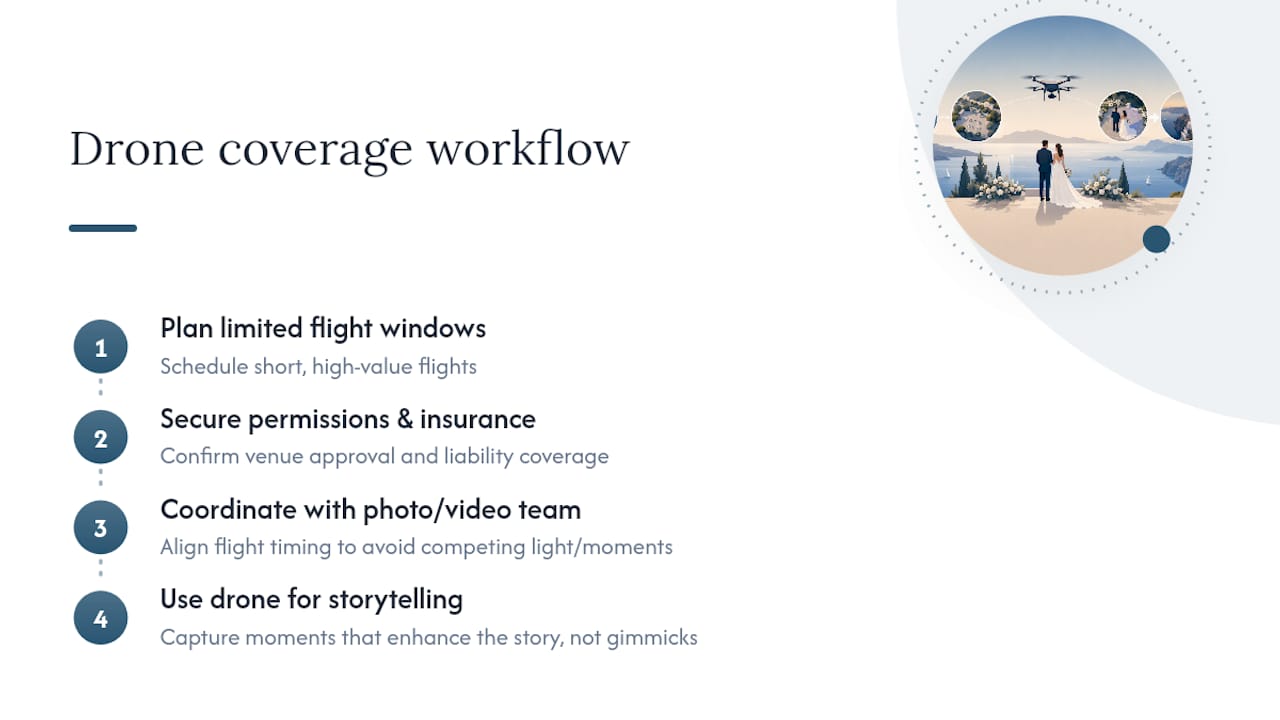
Pixel Groves treats aerial footage as a storytelling tool, not a gimmick. That means scheduling limited, high-value flight windows rather than running a drone all day, confirming venue permission and insurance before takeoff, and coordinating flight timing directly with the primary photography and video team so nothing competes for the same light or the same moment. It’s the same attention to detail that earned Pixel Groves the 2025 Best of Florida Wedding Photographer Award, applied to a camera that happens to fly.
A Quick Recommendation From Kellie
If you’re on the fence, schedule two flight windows: one 3 to 5 minute window for the empty venue before guests arrive, and one during your couple portraits. Skip anything longer.
Ask to see full wedding edits before you book, not a highlight reel, and put venue approval and insurance in writing. Your guests’ experience matters more than a dramatic overhead shot, so if the venue coordinator hesitates, take that seriously.
— Kellie
Ready to Add Aerial Coverage to Your Wedding Package?
Drone-inclusive coverage can be built into a photo and video package designed around your actual timeline, not a generic shot list bolted on at the last minute. This approach aims for one team to handle permissions, insurance, and flight windows alongside your ceremony and reception coverage, rather than coordinating separate vendors and schedules.
[
Every couple’s venue and timeline is different, which is why Pixel Groves quotes drone-inclusive packages individually rather than off a fixed menu. Browse wedding photography styles to see how aerial coverage fits into full-day documentary, editorial, or light-and-airy packages, then check pricing and packages to request a quote for your date and venue.
Sources
For FAA licensing rules, review the Part 107 certification breakdown. For shot planning, see Photo-Logica’s drone usage guide and creative aerial shot ideas. For timeline planning, check your wedding day photography schedule.
Recommended
Comments