Couples' Night Photos: Photographer Tested Shot List and Timeline Tips
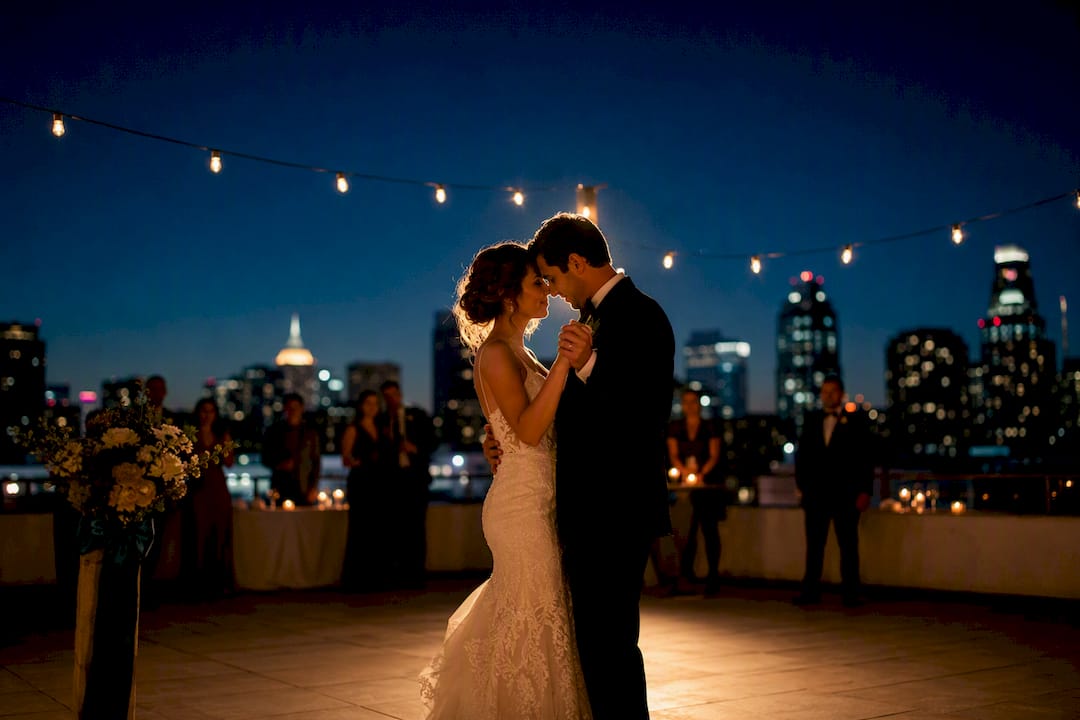
Night wedding photos are worth building into your timeline, and the difference between a forgettable shot and a striking one almost always comes down to light control, not luck. Whoever is shooting needs to bring, bend, or borrow light on purpose. Budget some extra time after the reception winds down for this part of the day.
TL;DR:
Night wedding photos rely heavily on intentional light control, with extra planning needed for lighting setups like off-camera flash or continuous LED lights.
Successful night shots depend on timing, requiring at least 15 to 30 minutes booked immediately after the reception or during a natural lull before guests leave.
Gear essentials include fast prime lenses, tripods, backup batteries, and white balance adjustments to maintain natural skin tones in low-light conditions.
Location scouting at night is crucial to identify lit features, water reflections, and skyline views, with optimal timing during sunset, blue hour, or full night depending on desired effects.
Clear communication and a short shot list from couples to their photographer significantly improve the quality and quantity of night wedding photos.
Table of Contents
Why Night Wedding Photos Are Worth Planning For
The images couples end up loving most, years later, are often the ones taken after the sun went down. Sparklers arcing over a dance floor, a backlit first dance, a skyline glowing behind the couple, even a clear night with stars overhead. These frames carry a mood that daylight portraits can’t touch. Bridal Guide’s gallery of night wedding photos makes the case visually: couples consistently name their after-dark shots among their favorites from the entire album.
Part of that comes from contrast. Daytime photos tend to look similar from wedding to wedding, same soft light, same green lawn. Night photos look different every time depending on venue, weather, and what’s glowing nearby.
A few reasons couples keep asking for them:
They create a visual bookend to the day, moving from bright ceremony light to dramatic evening tones.
Sparkler exits and dance-floor shots capture raw, unposed joy that formal portraits rarely get.
Skyline or string-light backdrops turn an ordinary venue into something cinematic.
Creative Night Photo Ideas: A Shot List To Request
Hand your photographer a short wish list instead of hoping they read your mind. Here’s a starting point organized by type, plus when each one actually works.
Sparkler exit. Line up guests in two rows, light sparklers on cue, and shoot as the couple walks through. Works best in full darkness, not blue hour, since sparkler light needs a dark background to pop.
Backlit confetti or petal toss. Position a light source (flash, string lights, even car headlights) behind the couple so confetti or petals catch the glow as they fall.
Skyline or venue silhouette. Shoot the couple as dark shapes against a lit horizon or illuminated building. This is a blue-hour favorite because the sky still holds color.
Backlit veil shot. Place a light behind the bride so the veil glows at the edges. Works in both blue hour and full night with the right flash placement.
Window or doorway framing. Use a lit doorway or window as a natural frame for a quiet portrait. Great for venues with warm interior lighting spilling outside.
Light-painting. An assistant traces light in the air with a small LED or sparkler during a long exposure, drawing shapes or writing initials into the frame. Full-night only.
Dance-floor motion blur. Slower shutter speeds turn spinning dancers into streaks of color and light. This one leans on venue lighting doing the work.
Star trails or Milky Way shots. Rare without a dark-sky venue, but stunning when the location allows it. Wedding Chicks documented one wedding that leaned fully into this look, using the night sky as the entire backdrop.
Pro Tip: Save the sparkler exit and light-painting shots for last. They need total darkness, and once you’ve done them, there’s no reason to keep guests waiting around in the cold.
Lighting and Gear That Make or Break Night Shots
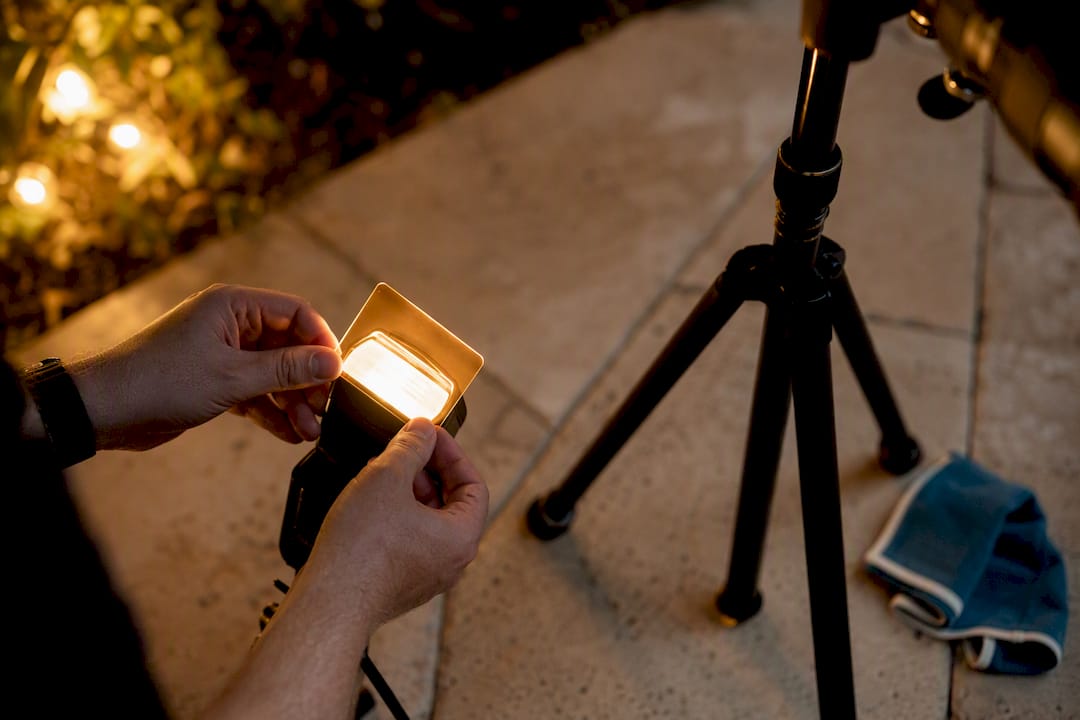
Every one of those shots above depends on the photographer’s light setup, not the camera brand. Two approaches dominate: off-camera flash and continuous light.
Flash freezes motion and adds punch, ideal for sparkler exits, portraits, and anything with movement. Continuous light (an LED panel, for instance) lets the photographer and couple see the effect in real time, which matters for precise poses like the backlit veil shot. Most photographers carry both and switch depending on the moment.
A few settings basics worth knowing, even if you’re not the one holding the camera:
Wide apertures (think f/1.4 to f/2.8) pull in more light without cranking ISO too high.
Shutter speed needs to stay fast enough to avoid blur on handheld shots, unless blur is the point (like dance-floor motion).
Shooting in RAW format preserves far more detail in shadows and highlights than JPEG, giving far more room to fix exposure and white balance later.
Orion Photo Group’s guide to nighttime wedding photography recommends fast prime lenses and backup batteries or a second camera body as standard practice for low-light coverage, since night shoots drain batteries faster and leave no room for a missed moment.
Tripods and monopods matter more than people expect. Long exposures for light-painting or star shots are impossible handheld without one. And color temperature deserves attention too: warm venue lights (string lights, candles, sconces) can turn skin orange if a photographer doesn’t correct with a flash gel or adjust white balance to match. Matching gels to ambient light is one of the simplest tricks for keeping skin tones natural instead of jaundiced or blue.
Scouting Locations and Timing the Shoot Right
A location that photographs beautifully at 3 p.m. can look completely different, sometimes flatly dark, at 9 p.m. Photographers who scout venues at night, not just during the day, catch details a daytime walk-through misses: which signs light up, where water reflects streetlights, whether a skyline is visible from the right angle.
Timing breaks into three windows, each with a different payoff:
Sunset delivers warm, golden portraits with soft shadows, the easiest window technically.
Blue hour (the 20 to 30 minutes after sunset) gives you a deep blue sky that pairs beautifully with venue lights and silhouettes.
Full night is where sparklers, light-painting, and star shots become possible, but it demands the most gear and planning.
Before booking any of this, confirm venue rules on sparklers, open flame, and how late photography is permitted outdoors. Build in a rain or wind backup plan too, since a windy beach wedding photos session that looked perfect on paper can turn chaotic fast without a plan B location indoors or under cover.
Posing and Wardrobe Choices That Read Well After Dark
What you wear and how you stand changes more at night than most couples expect. Fabrics with heavy shine can blow out under flash, turning into a distracting white glare in photos. Solid, mid-to-deep tones on the groom’s side hold detail better than pale gray or light blue under artificial light, while ivory or off-white on the bridal side catches highlights beautifully when backlit.
Posing matters too, especially for anything using a slower shutter. Long-exposure shots demand real stillness for a second or two, longer than it feels natural to hold a pose. Silhouette shots work best when the couple keeps space between their bodies so each shape reads clearly against the light.
Stick to matte finishes on skin. Shine that looks fine in daylight can turn glaring under flash.
Setting spray helps makeup hold through humidity and hours of dancing.
Avoid busy patterns; they read as noise once light gets more dramatic and shadowed.
Pro Tip: Ask whoever’s holding the light to count down before a long-exposure shot. Knowing exactly when to freeze makes it far easier to hold still than guessing.
A Simple Checklist for Booking Night Photo Time
Getting these shots isn’t complicated, but it does need a plan on paper, not just a hope that it happens.
Block 15 to 30 minutes specifically for night shots, ideally right after the last dance or during a natural lull before guests start leaving.
Pack backup batteries, a spare pair of shoes for walking outside, and warm layers if the venue sits somewhere cooler after dark.
Confirm sparklers are allowed and designate one person (a groomsman or planner, not the couple) to hand them out and light them quickly.
Assign someone to round up guests fast for an exit or group shot, since scattered guests eat into your limited window.
Have a lighting assistant ready. Even a phone flashlight held at the right angle can save a shot when nobody planned for it.
What Pixel Groves Photographers Learn From Shooting After Dark
An assistant holding a small continuous LED can save a photographer from fumbling with flash settings mid-shot, especially during a fast-moving exit. When light drops fast and there’s no time to recalculate, a reliable fallback (something like f/2, 1/125 shutter, ISO 3200 as a starting point) keeps the shoot moving instead of stalling on trial and error.
Pixel Groves brings that kind of practiced instinct to Florida weddings, backed by:
Specializing in wedding photography and videography across documentary, editorial, and light-and-airy styles
Recognition as the 2025 Best of Florida Wedding Photographer Award winner
If you want night shots on your day, say this to your photographer early: “I want at least one dedicated block for night portraits and a sparkler exit, can we build that into the timeline?” That one sentence, said months before the wedding, is often the difference between squeezed-in shots and ones that actually get planned for.
Why Building Night Photos Into the Day Actually Pays Off
The strongest argument for night wedding photos isn’t just that they look dramatic. It’s that they capture a part of the day daylight photos structurally can’t: the shift from ceremony formality into pure celebration. By the time the sun sets, guests have relaxed, the couple has stopped performing for cameras, and the mood on the dance floor is looser and more real.
That’s also when some of the best candid material shows up. End-of-night detail shots, a half-full champagne glass, a discarded bouquet, undone bow ties, tell a part of the story that posed portraits skip entirely. Photo editors consistently flag these as some of the most requested images when couples review their galleries months later, precisely because they’re unscripted.
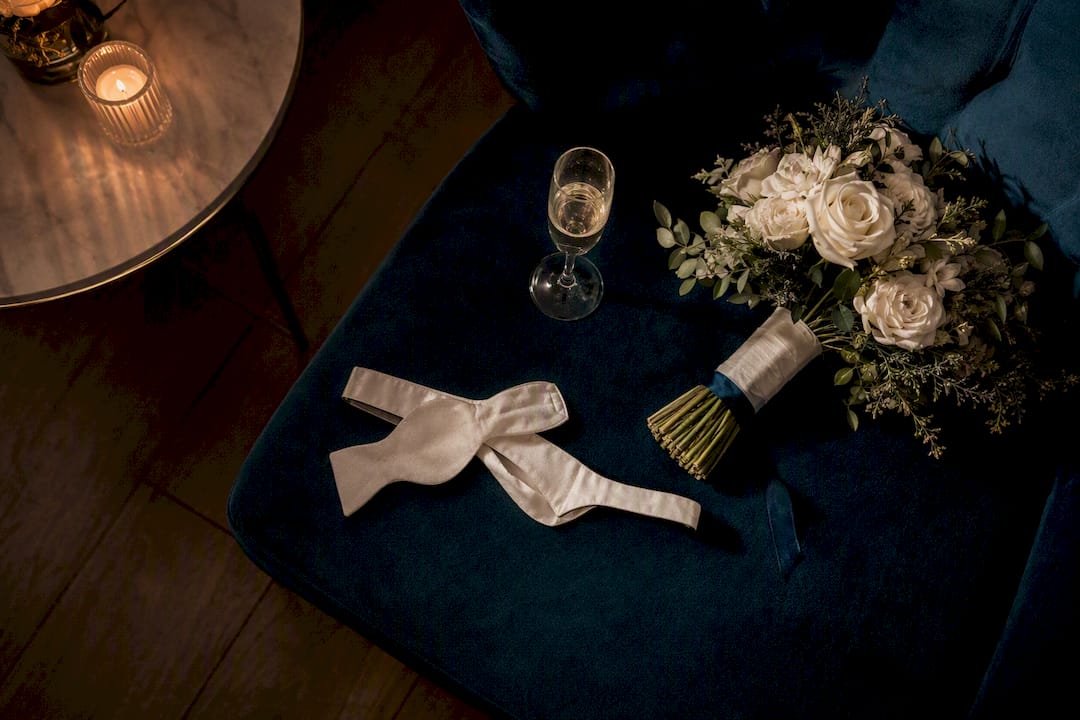
There’s also a practical upside: night shots extend your usable coverage without extending the ceremony or reception itself. You’re not adding a new event, just capturing what’s already happening under different light. For couples debating whether to spend extra photography minutes on formals versus candids, night coverage often answers that question by delivering both in one block.
The Case for Simplicity Over a Technical Checklist
Most guides to night wedding photography drown couples in camera jargon they’ll never use, aperture charts, ISO tables, lighting diagrams meant for photographers, not clients. That’s backwards. You don’t need to understand flash sync speed. You need a short list of shots you want and the confidence to ask for them.
The conventional advice treats night photography like a technical problem couples must study to solve. It isn’t. It’s a scheduling and communication problem. The couples who get the best night shots aren’t the ones who researched lighting theory, they’re the ones who told their photographer, in plain language, what they wanted and when.
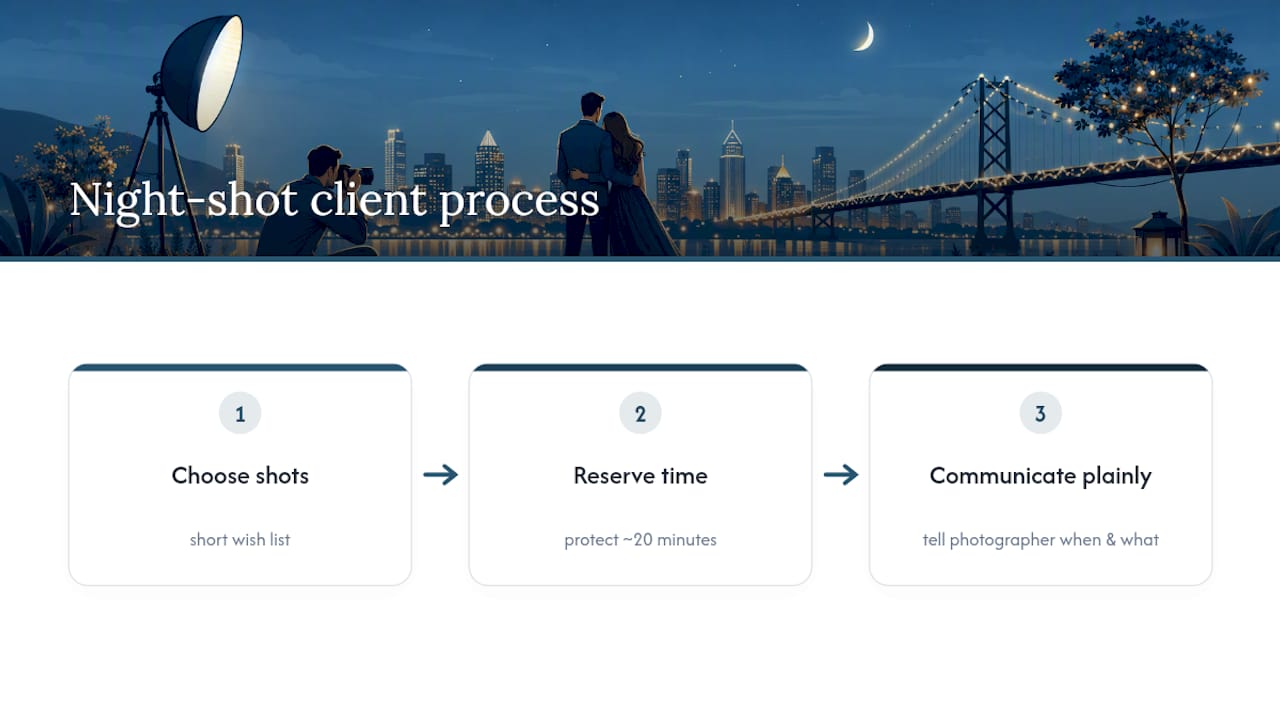
If there’s one thing to prioritize, it’s timeline, not gear. A photographer with average equipment but a protected 20 minutes and a clear shot list will consistently outperform one with premium lenses who’s rushing between a DJ’s last song and a venue’s curfew. Ask your planner where night shots sit in the run of the day before you ask your photographer what lens they’re bringing.
Idea-first beats manual-first here. Bring a short wish list. Let the professionals handle the technical execution.
— Kellie
Booking Night Coverage With Pixel Groves
If you already love the ideas above, sparkler exits, skyline silhouettes, backlit dance shots, the next step is making sure your photographer has time and gear budgeted for them. Night coverage is often included in full-day wedding photography packages, featuring various photographic styles depending on your preference.
[

When reviewing your contract, ask specifically about extra coverage minutes at the end of the night, whether an assistant will be on hand to help with lighting, and whether any lighting-kit fee applies for sparkler or light-painting setups. These small details are what separate a rushed five-minute afterthought from a real night-shot session. Browse Pixel Groves’ wedding photography styles to see which approach fits your vision, check pricing and packages to see what’s included, and reach out to talk through your timeline before you finalize your wedding-day schedule.
Sources
Recommended
Comments