Why Wedding Reviews Reveal Your Photographer's True Quality
- 4 hours ago
- 12 min read

Wedding reviews are one of the most reliable signals of photographer quality because they expose the traits that matter most on your wedding day: consistency, reliability, communication, and composure under pressure. A portfolio shows you a photographer’s best work. Reviews tell you whether that quality shows up every single time.
Before you read further, here is what to scan first in any review set:
Volume and recency: Look for a substantial number of detailed reviews, including some posted recently.
Specific anecdotes: Reviews that describe how a photographer handled a late ceremony, difficult family dynamics, or bad weather are far more predictive than generic praise.
Delivery timelines: Multiple reviewers mentioning on-time or early delivery is a strong pattern signal.
Reviewer-supplied photos or tagged images: These confirm the reviews are tied to real weddings.
Vendor responses to criticism: A calm, professional reply to a negative review tells you how this person handles conflict.
One honest limit: if a photographer is newer and has fewer than 10 reviews, lean harder on reference calls and uncurated full galleries rather than review volume alone.
Table of Contents
Which specific review cues actually predict photographer quality?
How many reviews do you need, and where should you find them?
What are the red flags that signal fake or unreliable reviews?
How do you combine reviews with portfolios and contracts to make the final call?
What does the research actually say about review thresholds and testimonial reliability?
Your pre-booking checklist: hire, ask more, or keep looking?
Why reviews reveal what a portfolio never can
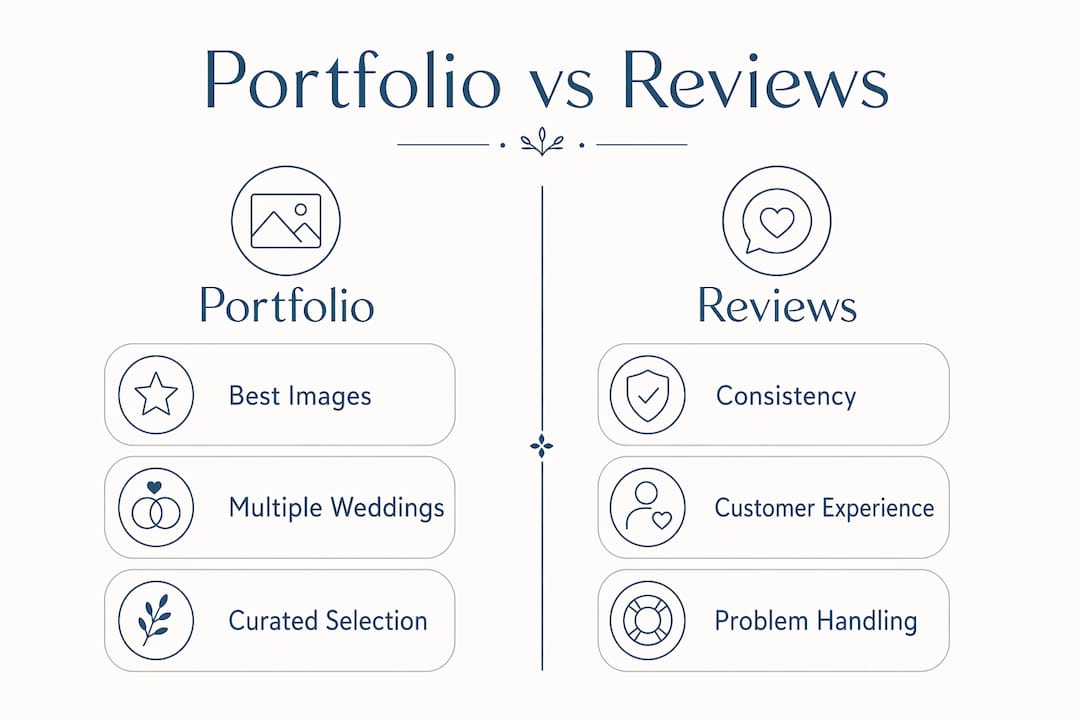
A portfolio is a sales tool. Every image on it was hand-picked because it is stunning, which makes portfolios both useful and slightly misleading. What they cannot show you is whether that quality holds across 600 images from a single wedding, or whether the photographer stayed calm when the ceremony ran 45 minutes late.

Testimonials communicate what portfolios structurally cannot: consistency across venues and conditions, delivery timelines, professionalism under pressure, and emotional intelligence. A photographer who has shot many weddings can curate a portfolio of perfect images. Reviews from those clients tell you what the other images looked like, and how the day actually felt.
Reviews also act as risk mitigation. Recurring mentions of communication, punctuality, and professionalism identify repeatable service, not just a one-off great gallery. A single glowing review could be a lucky day or a close friend. Fifteen reviews all noting the same calm, organized presence? That is a pattern you can hire against.
Statistic callout: Couples on wedding platforms typically read multiple reviews per supplier before deciding. Scanning that many with a clear framework, rather than reading impressionistically, is what separates a confident hire from a coin flip.
What a portfolio shows | What reviews reveal |
Best images from multiple weddings | Consistency across a full single wedding |
Editing style and aesthetic range | Delivery timelines and follow-through |
Technical skill in ideal conditions | Behavior under pressure and problem-solving |
Visual storytelling ability | Communication style before and after the day |
Curated highlights | Emotional intelligence and client rapport |
Which specific review cues actually predict photographer quality?
The strongest predictors are repeated mentions of calmness, problem-solving, punctuality, and communication. These are behavioral traits, and when multiple reviewers independently describe the same behavior, you are looking at a reliable pattern, not a coincidence.
High-predictive-value cues:
Composure under pressure. When reviews describe how a photographer handled a late ceremony, difficult family dynamics, or unexpected weather, those narratives predict on-the-day performance more accurately than any star rating. A reviewer writing “our ceremony started an hour late and she never seemed flustered” is giving you behavioral evidence.
Delivery reliability. Multiple reviewers noting that photos arrived on time, or early, signals a professional who treats deadlines seriously. Vague timelines in reviews often mirror vague timelines in contracts.
Communication before the day. Reviewers who mention quick responses, clear timelines, and proactive check-ins are describing a photographer who will not go quiet for three weeks before your wedding.
Medium-predictive-value cues:
Editing consistency. Mentions of a consistent look across the full gallery, not just the hero shots, suggest the photographer’s style is a real skill rather than a Lightroom preset applied to a lucky frame.
Directing ability. Reviews noting that the photographer made them feel relaxed, gave clear posing guidance, or helped manage a chaotic family portrait session point to someone who can run a timeline without being controlling.
Lower-predictive-value cues:
General warmth. “She was so sweet” is nice but tells you little about what happens when the best man is missing and the light is fading.
Beautiful photos. Mentioned without specifics, this is almost meaningless. Every photographer’s clients say this.
Pro Tip: A four-star review with a detailed narrative about problem-handling is often more valuable than a five-star review with no text. Narrative details predict behavior; raw stars do not. Weight the story over the number.
How many reviews do you need, and where should you find them?
For a high-stakes hire like a wedding photographer, look for a substantial number of detailed, verified reviews to identify consistent patterns in service, reliability, and quality. Below that threshold, you are working with a sample too small to distinguish a pattern from a streak of good luck.
Recency matters almost as much as volume. A photographer with 50 reviews, 40 of which are from 2019, may have changed their workflow, equipment, or even their editing style since then. Prioritize photographers where at least several reviews are from the past 12 months.
Statistic callout: A few reviews can significantly increase inquiries and booking potential for a wedding vendor. That tells you how much weight couples place on social proof, even at low volumes. At 30 detailed reviews, you have enough data to spot real patterns.
Where to find trustworthy reviews:
Platform | Strengths | What to watch for |
High volume, hard to game, verified accounts | Reviews tend to focus on punctuality and communication | |
The Knot | Wedding-specific, verified-couple badges | Emotional and planning details surface more often |
WeddingWire | Verified reviews tied to real bookings | Strong for comparing multiple photographers side by side |
Real-name accounts, tagged photos | Less structured; quality varies widely | |
Yelp | Broad audience, established trust signals | Wedding-specific context is often thin |
Wedding-specific platforms like The Knot and WeddingWire tend to surface emotional and planning details because the reviewers are couples who went through the same process you are in now. Google reviews often emphasize punctuality and communication because the format is shorter and less guided. Reading both gives you a fuller picture.

For newer photographers with fewer than 30 reviews, rely more on reference calls, uncurated full galleries, and contract clarity rather than assuming low count equals low quality. A talented photographer two years into their career may have 12 reviews and a full gallery that speaks for itself.
What are the red flags that signal fake or unreliable reviews?
The fastest disqualifiers: a cluster of short, identical five-star reviews posted within the same week, reviews with no narrative detail whatsoever, and a review history that stops abruptly two years ago. Any of these should make you pause before you book.
Behavioral red flags in review text and metadata:
Reviews that are one or two sentences with no specifics (“Amazing photographer! Highly recommend!”) across multiple entries suggest either fake reviews or incentivized feedback.
Multiple reviews using nearly identical phrasing, especially across platforms, is a strong signal of coordinated posting.
A sudden cluster of five-star reviews following a period of silence often indicates a review-generation campaign rather than organic client feedback.
Reviewer profiles with no photo, no other reviews, and a generic name warrant skepticism.
Reviews that praise the photos but never mention the wedding day experience, the timeline, or any interaction with the photographer are suspiciously thin.
Red flags in the photographer’s behavior:
No written contract offered at any point in the conversation.
Delivery timelines that stay vague and never appear in writing.
A portfolio made up mostly of styled shoots rather than real weddings.
Pricing listed as “contact for details” with no starting rate anywhere public.
Pro Tip: Run a quick cross-check: search the reviewer’s name on Google alongside the venue they mention. If the venue, date, and reviewer name align with a real wedding, the review is almost certainly genuine. Also check whether the photographer has responded to any negative reviews. A calm, constructive reply to a one-star review is one of the strongest trust signals you can find.
How a photographer responds to negative reviews — professional, calm, and constructive — often signals how they will handle on-the-day problems. A defensive or dismissive response to a complaint tells you exactly what you will get when something goes sideways at your reception.
How do you combine reviews with portfolios and contracts to make the final call?
Reviews tell you about behavior. Portfolios tell you about skill. Contracts tell you about professionalism. You need all three before you sign anything.
Here is a practical decision sequence:
Screen on reviews first. Use the red-flag checklist above to eliminate photographers with thin, fake-looking, or outdated review profiles. This usually cuts your shortlist by a third before you look at a single image.
Request full galleries, not highlight reels. Any photographer confident in their work will share a complete gallery from a real wedding. Look for consistent quality across the full day, not just the golden-hour portraits. Check low-light reception images, getting-ready shots, and candid moments between posed portraits.
Evaluate across at least three different weddings. If editing consistency, attention to candid moments, and technical quality hold strong across all three, you have found someone reliable. If quality varies wildly, your own results are unpredictable.
Call a past client directly. Ask the photographer for a reference. A quick 10-minute call with a past couple tells you things no review platform captures: how the photographer handled a specific problem, whether the gallery arrived when promised, and whether they would hire them again.
Review the contract line by line. Confirm these items in plain language before you sign: what deliverables are included (number of edited images, formats, albums), who owns the files and usage rights, what the backup and contingency plan is if the photographer cannot attend, and the exact delivery timeline in writing.
When you get on a call with a photographer, the questions that reveal the most are not the logistics ones. Ask them to describe the most challenging wedding they have shot and how they handled it. Ask what they do when the timeline falls apart. Ask how they work with a second shooter and whether they bring backup equipment. Ask what happens if they get sick the week of your wedding. The answers to those questions, combined with what their reviews say about composure and problem-solving, give you a complete picture of who you are hiring.
Styling coordination also matters more than couples expect. Reviews that mention how a photographer worked with the hair and makeup team, or coordinated timing around a hair styling session, often signal a photographer who understands the full vendor ecosystem and does not create chaos by pulling the bride away mid-touch-up.
What does the research actually say about review thresholds and testimonial reliability?
Industry professionals recommend a substantial number of detailed, verified reviews because that volume is where consistent patterns become statistically distinguishable from random variation. Below 30, a streak of great days or a few loyal friends can skew the picture entirely.
Statistic callout: Detailed testimonials that combine emotional language with practical details — delivery time, communication, problem-handling — outperform star-only ratings for predicting on-the-day performance. The narrative is the data.
The behavioral mechanism behind this is straightforward. When multiple reviewers, independently and across different weddings, describe the same trait, that trait is almost certainly a stable characteristic of how the photographer works. Social proof works not because people copy each other, but because repeated independent observations of the same behavior are genuinely informative.
Metric | Recommended threshold | Why it matters |
Minimum review count | 30 detailed reviews | Below this, patterns are indistinguishable from streaks |
Recency window | At least several reviews in the past 12 months | Workflow, editing style, and reliability can change |
Narrative detail | Emotional + practical details combined | Predicts on-the-day behavior better than star ratings alone |
Platform spread | Reviews on 2+ platforms | Reduces the risk of a single-platform manipulation |
The most useful testimonials combine how couples felt with what actually happened: delivery time, communication quality, and how specific problems were handled. A review that says “she made us feel so calm when the florist was late and still got every shot on our list” is worth ten reviews that say “beautiful photos, five stars.”
Your pre-booking checklist: hire, ask more, or keep looking?
Decision rule: If you can check “yes” on most of the items below, you are in hire territory. A moderate number of “yes” answers means ask follow-up questions before deciding. Few “yes” answers means keep looking.
Review volume and recency:
[ ] The photographer has 30 or more detailed reviews across at least one platform.
[ ] At least several reviews were posted within the last 12 months.
[ ] Reviews appear on more than one platform (Google, The Knot, WeddingWire, Facebook).
Review quality and specificity:
[ ] Multiple reviews describe specific on-the-day situations (timing, family dynamics, weather, problem-solving).
[ ] Reviews mention delivery timelines and confirm photos arrived as promised.
[ ] At least some reviews include reviewer-supplied photos or tagged images from the actual wedding.
[ ] Reviews describe the photographer’s communication before and after the day, not just the photos.
Red flag absence:
[ ] No cluster of identical short reviews posted within a short window.
[ ] No sudden gap in reviews followed by a burst of five-star posts.
[ ] Reviewer profiles look genuine (photos, other reviews, real names).
Vendor responses:
[ ] The photographer has responded to at least some reviews, including any negative ones.
[ ] Responses to criticism are calm, professional, and constructive rather than defensive.
Portfolio and contract:
[ ] Full galleries from real weddings are available on request.
[ ] The contract specifies deliverables, file ownership, delivery timeline, and a contingency plan.
Combine your checklist score with your gut read from the consultation call. Reviews tell you about the past. The call tells you about the present. When both point in the same direction, you have your answer.
Key Takeaways
Wedding reviews are the most reliable signal of repeatable photographer quality because they reveal behavioral patterns, not just peak performance, and combining review signals with full galleries and a clear contract is the most reliable path to a confident hire.
Point | Details |
Aim for 30+ detailed reviews | Industry guidance recommends at least 30 verified reviews to distinguish consistent patterns from lucky streaks. |
Narrative beats star ratings | Detailed testimonials combining emotional and practical details predict on-the-day behavior better than star-only scores. |
Check multiple platforms | Reading reviews on Google alongside wedding-specific platforms like The Knot or WeddingWire gives a fuller behavioral picture. |
Vendor responses signal professionalism | A calm, constructive reply to a negative review is one of the strongest trust signals a photographer can show. |
Pixelgroves as a vetted option | Pixelgroves holds the 2025 Best of Florida Wedding Photographer Award and publishes client testimonials alongside full galleries for couples who want to apply these review signals directly. |
The review signals most couples overlook
Most couples scan star ratings and move on. The photographers who disappoint are rarely the ones with a 3.8 average. They are the ones with a 4.9 average built on 11 reviews, half of which say nothing beyond “amazing!” The real risk is not a bad photographer with obvious red flags. It is a mediocre one who has learned to look great on paper.
The signal that consistently gets ignored is the vendor response. When a photographer replies to a one-star review with a calm, specific account of what happened and what they did to address it, that response tells you more about their character than any five-star review. It shows they take accountability seriously, that they do not panic under criticism, and that they communicate clearly when things go wrong. Those are exactly the qualities you need when your ceremony runs late and the light is disappearing.
The other underrated signal is what reviewers do not say. A set of reviews that praises photos but never mentions the photographer’s presence, communication, or personality is quietly telling you something. Either the photographer was forgettable on the day, or the reviews are thin and possibly not organic. Either way, it is a reason to dig deeper before you commit.
The couples who make the best hires are the ones who treat reviews as behavioral data, not testimonials. They are not looking for warmth. They are looking for evidence of how this person performs under pressure, on a timeline, with a family that has opinions. That evidence is in the reviews, if you know where to look.
Pixelgroves: built around the signals that matter most
Couples who apply the review framework in this article will find that Pixelgroves checks every box they are looking for. The 2025 Best of Florida Wedding Photographer Award reflects the kind of consistent, verified recognition that shows up in review patterns, not just a single standout shoot. Client testimonials on the Pixelgroves site go well beyond star ratings: they describe specific moments, on-time delivery, and the calm presence that makes a difference when a wedding day does not go exactly to plan.
[
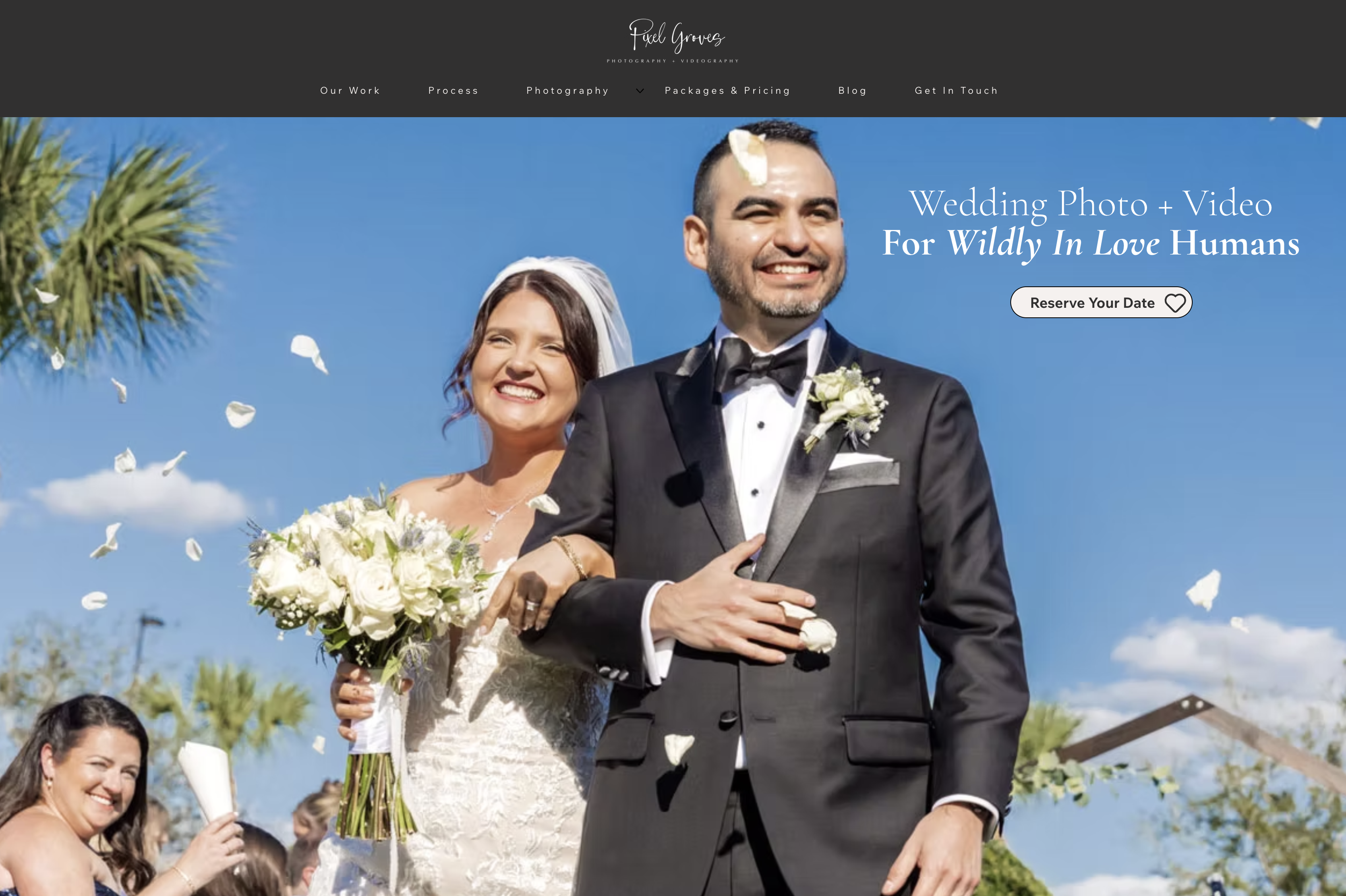
Pixelgroves publishes uncurated full galleries alongside curated highlights, so you can apply the portfolio evaluation steps from this article directly. Every package includes a clear delivery timeline and contract terms that cover file ownership and contingency planning. If you want to see the wedding photography styles and read the testimonials for yourself, the portfolio is open. When you are ready to check availability and review pricing, that information is straightforward and public.
Useful sources for further reading
The sources below are worth bookmarking as you vet photographers and read through review platforms:
Small Hour Wedding Photography: How to Choose a Wedding Photographer — Detailed guidance on reading full galleries critically, spotting red flags, and evaluating consistency across multiple weddings. One of the more honest practitioner perspectives available.
Brides: 42 Questions to Ask Your Wedding Photographer Before Booking — A thorough list of interview questions covering logistics, experience, and communication style. Useful for structuring your consultation call.
Bespoke Bride: How to Choose a Wedding Photographer — Covers warning signs, portfolio evaluation, and how to use Instagram tags to find real client work beyond curated grids.
The Knot and WeddingWire — The two largest wedding-specific review platforms in the United States. Both use verified-couple badges that tie reviews to real bookings, making them more reliable than general review sites for this category.
Google Business Profile reviews — Useful for a second-platform cross-check, particularly for punctuality and communication signals that surface more often in shorter, unguided review formats.
A note on mixing platforms: wedding-specific sites and general review platforms surface different kinds of feedback. Reading both gives you a more complete behavioral picture than relying on any single source.
Recommended
Comments