What Is a Wedding Photography Questionnaire?

A wedding photography questionnaire is a structured intake form that captures your preferences, must-have moments, and logistical details so your photographer can tell your wedding story without gaps or guesswork. Think of it as the blueprint your photographer uses to plan every shot, from the quiet moment you see each other for the first time to the last dance of the night. Without this form, even the most talented photographer is working blind. Tools like ShootProof and Google Forms make it easy to complete these forms digitally, and platforms like Canva let couples and photographers build custom templates that reflect the exact coverage they need. The questionnaire is also called a wedding photography client questionnaire or a client intake form in professional photography workflows.
What is a wedding photography questionnaire and why does it matter?
A wedding photography questionnaire is an intake form couples complete before the wedding to give their photographer preferences, must-have moments, and logistics so coverage runs without repeated back-and-forth. This single document replaces dozens of emails and prevents the most common wedding day photography failures: missed shots, wrong family groupings, and timeline chaos.
The form covers far more ground than most couples expect. Style preferences come first. Do you want documentary-style coverage that captures raw emotion as it unfolds, or a more traditional approach with posed portraits at every stage? Sharing an inspiration board from Pinterest or Instagram directly inside the questionnaire gives your photographer a visual reference that words alone cannot match. Pixelgroves uses these style inputs to align every shooting decision with the couple’s actual vision rather than a generic wedding template.
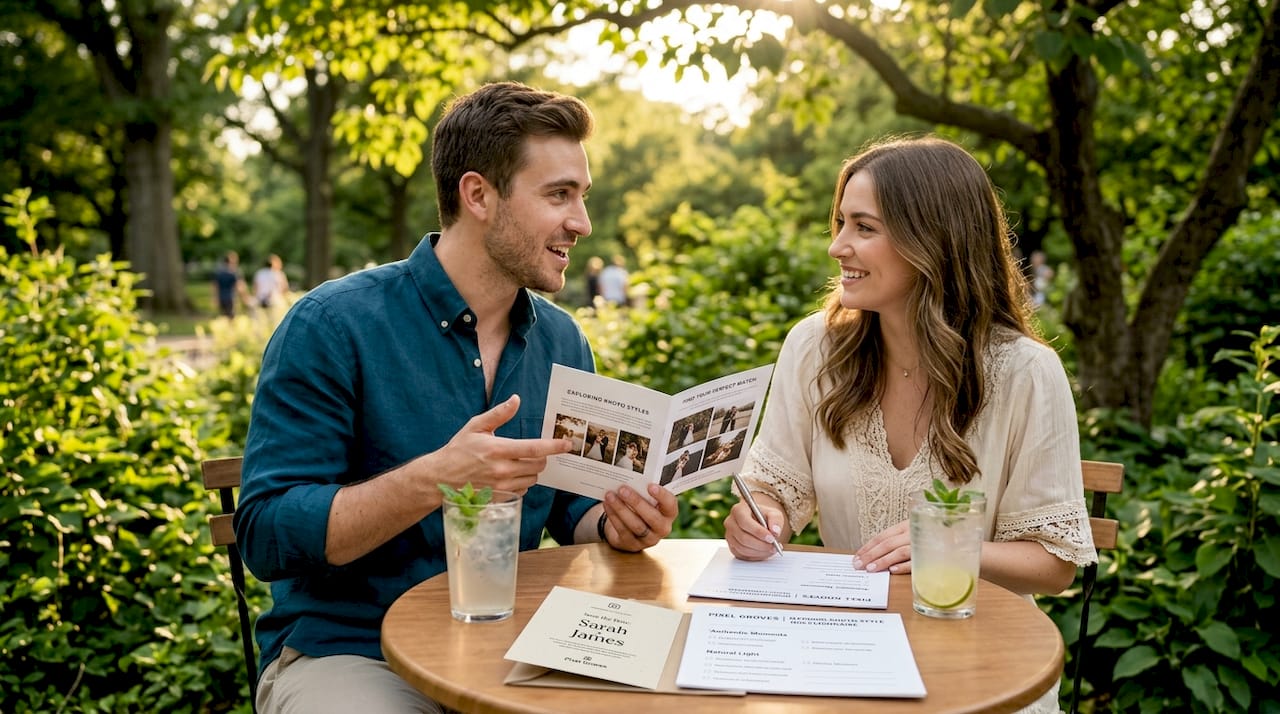
Must-have shots are the second critical layer. These are the non-negotiable moments: a grandmother’s reaction during the ceremony, a specific group photo with college friends, or a quiet portrait with a parent before the reception. Photographers cannot read minds, and questionnaires clarify must-have shots so nothing is left to chance on the day.
Logistics round out the form. Venue addresses, ceremony start times, reception order, vendor contacts, and accessibility needs all belong here. Wedding packets require detailed info on event times, venues, ceremonies, and contingencies because weddings are longer and more complex than any other photography session type.
What key information should a wedding photography questionnaire collect?
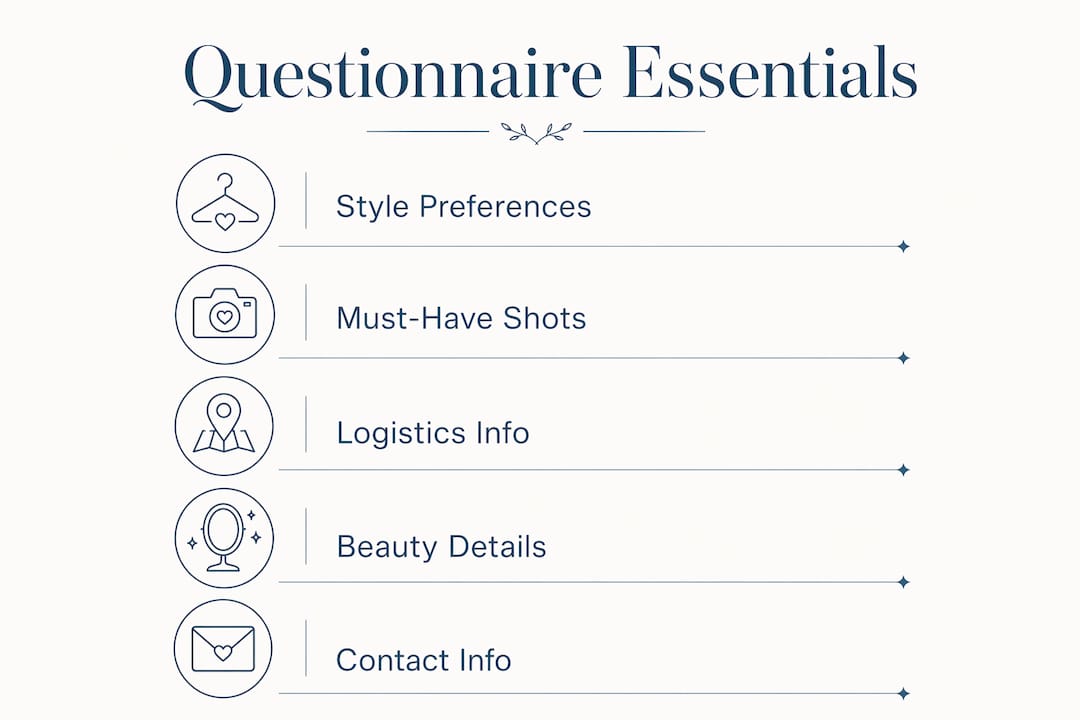
The most effective wedding photography questionnaire organizes its questions into clear categories so nothing slips through. Here is what every form should cover:
Contact and event details: Full names, wedding date, ceremony and reception venue names and addresses, start and end times, and emergency contact numbers for both families.
Photography style preferences: Documentary, traditional, fine art, or editorial. Include space for inspiration images or links to mood boards.
Must-have shots and special moments: List specific people, interactions, and scenes that are non-negotiable. Name names. “A photo with Aunt Rosa and my grandmother together” is far more useful than “family photos.”
Shot list for family formals: Group combinations listed in the order you want them photographed. This saves significant time during the formal portrait session.
Timeline and schedule: Getting-ready location and time, first look preference, ceremony timeline, cocktail hour, reception program order, and departure time.
Vendor contacts: Planner, florist, DJ, officiant, and caterer names and phone numbers so your photographer can coordinate logistics directly.
Family and guest dynamics: Divorced parents who should not be photographed together, guests with mobility limitations, or anyone who is camera-shy. This protects relationships and prevents awkward moments.
Contingency plans: Weather backup plans, accessibility needs, and allergy information belong in every questionnaire to build risk management directly into the shoot plan.
Pro Tip: When listing must-have shots, include the names and a brief description of each person involved. “My maid of honor, Sarah, and I have a tradition of doing a specific toast” gives your photographer context that a generic shot list never could.
Bridal beauty details also deserve a dedicated section. Knowing when hair and makeup begin, who the stylist is, and what bridal hair inspiration the bride is working from helps photographers plan getting-ready coverage with intention rather than scrambling to catch moments as they happen.
How do wedding photography questionnaires improve planning and communication?
A completed questionnaire transforms the planning process from reactive to proactive. Here is how that plays out in practice:
Early capture prevents forgotten details. Sending a detailed questionnaire 60 days before the wedding allows collection of venue addresses, start times, family dynamics, vendor contacts, and weather backup plans while there is still time to adjust. Waiting until the week before means corrections are nearly impossible.
Photographers build precise timelines from your answers. Instead of estimating how long family formals will take, a photographer who knows you have six group combinations can allocate exactly the right amount of time. This precision protects every other part of your wedding day schedule.
Second shooters and coordinators get aligned. When Pixelgroves deploys a second shooter, the questionnaire becomes a shared reference document. Both photographers know the priority shots, the family dynamics, and the timeline without needing a lengthy briefing on the day.
Day-of confusion drops dramatically. ShootProof integrates customizable questionnaires directly into booking workflows so the information is captured and organized before the first planning call even happens. This means your photographer arrives on your wedding day already knowing your story.
Vendor coordination becomes smoother. A photographer who has your planner’s phone number and knows the florist’s setup timeline can work around other vendors without interrupting the flow of your day.
The practical result is a wedding day where your photographer moves with confidence and purpose rather than stopping to ask questions at critical moments. That confidence shows in the final images.
What are best practices for creating an effective questionnaire?
The most common mistake couples make is treating the questionnaire as a formality rather than a creative collaboration. These practices produce better results:
Customize for your wedding type. Wedding questionnaires demand heavier onboarding packets than portrait sessions because of longer duration and greater complexity. A full-day coverage questionnaire should be significantly more detailed than one for a two-hour elopement. Ask your photographer to tailor the form to your specific coverage level.
Use open-ended questions alongside checklists. Checkboxes capture preferences efficiently, but open-ended questions capture personality. “Describe the feeling you want your photos to evoke” produces answers that no checklist can generate. These answers are the inputs photographers use to make creative decisions throughout the day.
Go digital. Google Forms and tools like Doc2Form convert questionnaires into easy-to-complete online forms that improve response rates and keep answers organized. Paper forms get lost. Digital forms get referenced on a phone at the venue.
Organize questions into labeled sections so completion feels manageable, not overwhelming.
Keep each question focused on one topic. Compound questions produce incomplete answers.
Review your completed form before submitting and add any details that feel missing, even if no question specifically asked for them.
Schedule a planning call after submission to discuss your answers in depth and clarify anything ambiguous.
Pro Tip: Do not skip the contingency section even if your wedding is indoors. Accessibility needs, dietary restrictions for the catering team, and backup lighting plans for dark venues all belong in a thorough questionnaire.
Avoid overly generic questions like “What style do you prefer?” without providing examples or context. Generic questions produce generic answers, and generic answers produce generic photos. The more specific your inputs, the more personalized your coverage.
How can you use questionnaire responses to plan your wedding day?
Questionnaire answers are the raw material for every planning decision that follows. Here is how to put them to work:
A detailed wedding day photography schedule is built directly from your questionnaire inputs. Getting-ready start time, first look location, ceremony length, and reception program order all feed into a minute-by-minute timeline that your photographer, planner, and vendors all work from. Without these inputs, timelines are guesswork.
Family and group shot lists should be confirmed by name and order before the wedding day. Sit down with your questionnaire responses and write out each group combination in the sequence you want them photographed. Share this list with a family member who can help organize people during the formal session. This single step saves 20 to 30 minutes during what is already a time-pressured part of the day.
Questionnaire input | Planning output |
Venue address and setup time | Photographer arrival and scouting schedule |
Family formal combinations | Ordered shot list shared with family coordinator |
Ceremony and reception timeline | Minute-by-minute photography schedule |
Vendor contacts | Direct coordination calls before the wedding day |
Weather backup plan | Alternative location scouted and confirmed in advance |
Vendor and venue contacts from your questionnaire allow your photographer to make direct coordination calls in the weeks before the wedding. Knowing the venue’s lighting conditions, restricted areas, and setup timeline means your photographer arrives prepared rather than discovering limitations on the day.
A staged onboarding sequence with questionnaires sent months out, followed by planning calls, helps confirm and fine-tune the wedding day plan. Treat the questionnaire as the start of a conversation, not the end of one.
Key takeaways
A wedding photography questionnaire is the single most effective tool for aligning your photographer’s work with your personal vision before the wedding day begins.
Point | Details |
Define it early | A questionnaire is a structured intake form capturing style, logistics, and must-have moments before the wedding. |
Send it 60 days out | Submitting your completed form two months before the wedding leaves time to adjust plans and confirm details. |
Name names in shot lists | Listing specific people and group combinations by name prevents missed shots during family formals. |
Go digital for better results | Tools like Google Forms and ShootProof improve completion rates and keep answers organized and accessible. |
Treat it as a conversation starter | Follow up every completed questionnaire with a planning call to clarify answers and finalize the timeline. |
Why I think most couples underestimate this form
After working with hundreds of couples, I have seen the same pattern repeat: couples spend months choosing a venue and a dress, then fill out their photography questionnaire in 10 minutes the night before it is due. The photos from those weddings are technically fine. They are rarely extraordinary.
The couples whose galleries stop people mid-scroll are the ones who treated the questionnaire as a creative brief. They wrote paragraphs about what their relationship feels like. They named every person who mattered and explained why. They described the light in their grandmother’s kitchen and said they wanted that same warmth in their portraits. That level of detail is not extra work. It is the difference between a photographer who documents your wedding and one who tells your story.
One detail I see overlooked constantly is the family dynamics section. Photographers are not therapists, but knowing that two siblings are estranged or that a parent is recently widowed changes how we approach those moments. A questionnaire that asks these questions creates space for couples to share what they might never think to mention in a planning call.
The wedding photography styles section of the questionnaire also deserves more attention than it gets. Couples often circle “documentary” because it sounds modern, but then express disappointment when they do not have the posed portraits they actually wanted. Be honest about what you love. The questionnaire is the safest place to say it.
Questionnaires are not static documents either. The best photographers revisit them with you in a final planning call and update the details as the wedding day evolves. Treat your answers as a living document, not a one-time submission.
— Kellie
How Pixelgroves turns your answers into unforgettable images
[
Pixelgroves builds every wedding photography experience around the details couples share in their questionnaire. As the 2025 Best of Florida Wedding Photographer Award recipient, Pixelgroves uses your style preferences, must-have shots, and timeline inputs to craft a personalized shoot plan that leaves nothing to chance. Every couple receives a customizable questionnaire template designed to capture the full scope of their wedding day vision. From there, a dedicated planning call turns your answers into a precise, coordinated photography schedule. Explore Pixelgroves’ wedding photography services and review pricing and packages to find the coverage level that fits your day.
FAQ
What is a wedding photography questionnaire?
A wedding photography questionnaire is a structured intake form completed before the wedding that captures style preferences, must-have shots, timeline details, and logistical information. Photographers use these answers to plan coverage and build a personalized wedding day timeline.
When should you send a wedding photography questionnaire?
Sending the questionnaire approximately 60 days before the wedding gives both the couple and photographer enough time to review answers, schedule a planning call, and adjust any logistics before the day arrives.
What questions should be on a wedding photography client questionnaire?
A thorough questionnaire covers contact details, photography style preferences, must-have shot lists with named individuals, family formal groupings, vendor contacts, ceremony and reception timelines, and contingency plans for weather or accessibility needs.
How do you create a photography questionnaire that works?
Use a digital tool like Google Forms or ShootProof to build organized sections with a mix of checklist questions and open-ended prompts. Customize the depth of the form based on your coverage level, and always follow up the completed form with a planning call.
Do you need a questionnaire if you have already spoken with your photographer?
Yes. Verbal conversations miss details that a written form captures, and answers change as the wedding day approaches. Questionnaires prevent forgotten details and give both parties a shared reference document to consult on the wedding day itself.
Recommended
Comments