What Is a Photo Narrative? A Clear Guide for Photographers

A photo narrative is a deliberately ordered set of images that together tell a story or communicate a message no single frame could carry alone. Think of Dorothea Lange’s migrant mother sequence: one portrait shows a tired face, but the surrounding images of a roadside camp, children pressed against their mother, and empty tin cans build a story about the Great Depression that moved Congress to release emergency food aid. That is what sequencing does.
Use a photo narrative when:
You are producing an editorial essay, documentary project, or commercial brand story
A single image cannot convey cause, effect, or emotional arc
You want viewers to feel the passage of time, place, or relationship
Key Takeaways
A photo narrative is a sequenced set of images with a deliberate arc, and the edit and ordering choices are the primary storytelling tools, not the individual frames.
Point | Details |
Definition | A photo narrative is a deliberately ordered image sequence that tells a story no single frame can carry alone. |
Core components | Every strong narrative needs characters, setting, arc, motifs, pacing, and purposeful captions. |
Shot grammar | Use establishing, mid-range, detail, and closing shot types to create rhythm and emotional contrast. |
Leave visual gaps | Viewers fill in missing beats mentally, so implying action is often more powerful than documenting every step. |
Ethics first | Obtain consent, be transparent about staged vs. documentary work, and cut any image that harms without purpose. |
Table of Contents
What is a photo narrative, and what are the main types?
The vocabulary around photo narratives overlaps enough to cause real confusion. A quick glossary first:
Photo narrative: any intentional sequence of images structured to tell a story or convey a theme
Photo essay: a subset of photo narrative, typically 8–30 images with editorial intent and often published with captions
Photo story: a looser term for a short, self-contained image sequence, common in magazines and social media
Photo package: a journalistic bundle of images, captions, and text delivered together to an editor
The more useful distinction is between the three main types of narrative photography, as Conscientious Photography Magazine explains: the edit and sequence create a narrative even when images do not depict a literal story.
Type | How it works | Best used for |
Documentary narrative | Captures unfolding real events; authenticity is the currency | Journalism, social documentary, wedding photojournalism |
Staged narrative | Constructs scenes deliberately; viewer decodes symbols | Fine art, advertising, conceptual projects |
Conceptual narrative | Uses metaphor, abstraction, or motif rather than event | Gallery work, editorial illustration, brand campaigns |
One more distinction worth making: a single image can allude to a story (a child’s muddy boot on a doorstep implies an afternoon outside), but it cannot carry an arc. Sequences carry arc. A single frame is a sentence; a photo essay is a paragraph with a beginning, middle, and end.
How mid-20th-century magazines shaped the photo essay
The photo essay as a recognized form owes most of its conventions to two publications. LIFE magazine and Britain’s Picture Post popularized the format in the mid-20th century, using image sequences to inform readers and shape public opinion on everything from wartime sacrifice to civil rights. Editors at both titles developed a working grammar: open with an establishing wide shot, move through portraits and mid-range scenes, and close on an intimate detail or a quiet, resonant image.
That grammar became standard because it works. The establishing shot orients the viewer; the portrait creates emotional investment; the detail shot rewards close attention. Modern practitioners still follow this cadence, whether they are shooting a documentary in rural Appalachia or a wedding in coastal Florida.
Why does this history matter now? Because editorial expectations are baked into how viewers read sequences. Readers who have grown up with magazines, news sites, and photo books expect a certain rhythm. Violate it without purpose and the sequence feels random. Follow it with intention and the viewer barely notices the structure, only the feeling.
Core components every strong photo narrative needs
A photo narrative is built from six interlocking components. Miss one and the sequence usually feels thin, even if the individual images are technically strong.
Characters: At least one subject the viewer can follow. Without a human (or animal) anchor, sequences tend to read as landscape collections rather than stories.
Setting: Establishing the place and time grounds the viewer. A single wide shot early in the sequence usually handles this.
Arc: The classic structure maps directly onto photography: setup (who, where, when) → complication or conflict (the moment of tension, effort, or emotion) → resolution or closing image (the quiet beat after the peak). Your shot choices should serve each stage.
Motifs: A repeated object, color, or gesture that threads through the sequence. In a wedding essay, it might be the bride’s grandmother’s ring appearing in getting-ready shots, ceremony close-ups, and the reception toast. Motifs give viewers something to track.
Pacing: The rhythm of image types. Alternating wide, close, wide, close produces a heartbeat. Three close-ups in a row creates intensity. Pacing is an editorial decision, not a shooting one.
Captions: Context that shifts interpretation. Dorothea Lange’s documentary sequences showed how a single caption line could reframe a portrait entirely, turning a face into a symbol of a larger crisis.
The visual arc maps to shot choices this way: your establishing wide is the setup; your candid or action shots carry the complication; your final detail or quiet portrait is the resolution.
Pro Tip: Leave deliberate visual gaps. Research on viewer participation shows viewers actively fill in missing beats, meaning you can suggest rather than show every action and still produce a coherent arc. A sequence that explains everything exhausts the viewer; one that implies earns their engagement.
How to order images and which shot types create narrative rhythm
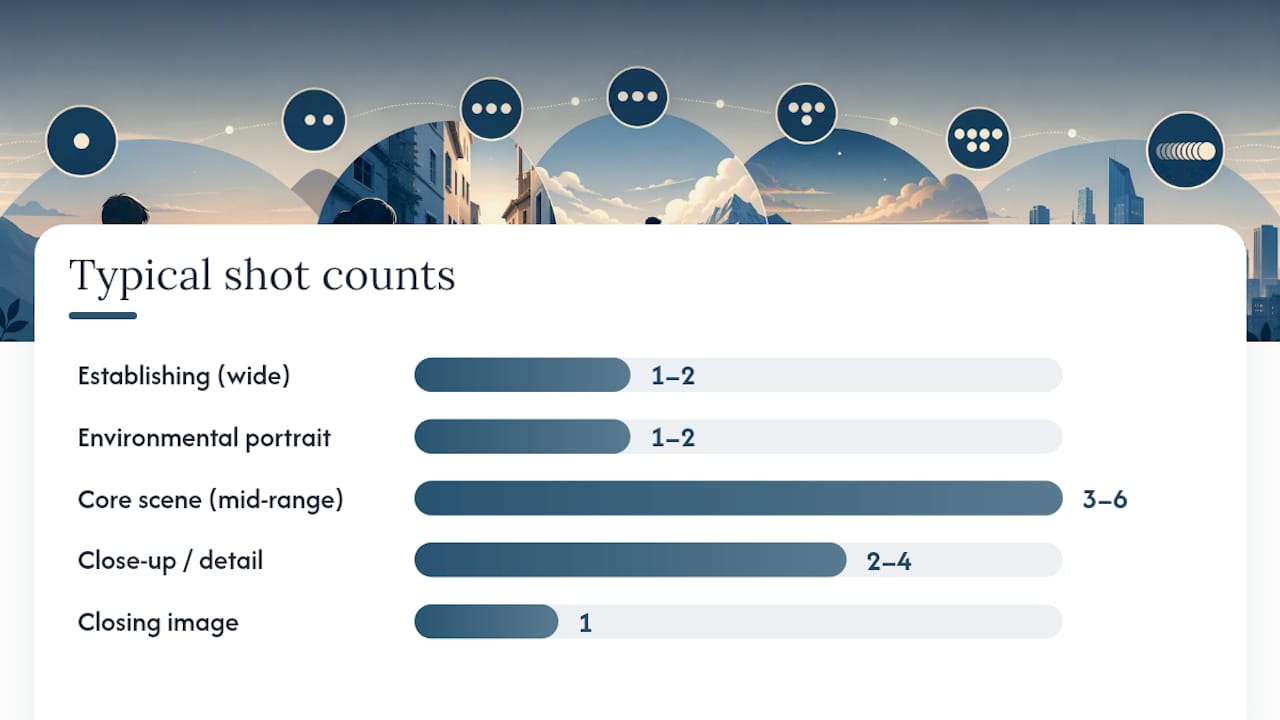
Shot variety is the backbone of pacing. A sequence built entirely from mid-range portraits has no rhythm; it has repetition. The table below gives a working shot grammar drawn from practical storytelling guides.
Shot type | Narrative role | Typical count |
Establishing (wide) | Orient viewer to place and scale | 1–2 |
Environmental portrait | Anchor character to setting | 1–2 |
Core scene (mid-range) | Carry the action or emotional arc | 3–6 |
Close-up / detail | Reward attention; add intimacy | 2–4 |
Transition | Bridge locations or time jumps | 1–2 |
Closing image | Resolve or echo the opening | 1 |
A sample 7-frame sequence for a short documentary essay: (1) wide establishing shot of the location → (2) environmental portrait of the subject in context → (3) mid-range action shot showing the subject at work → (4) close-up detail of hands or a key object → (5) candid reaction or emotional beat → (6) transition shot (doorway, path, window) → (7) quiet closing portrait or detail that echoes the opening.
The rationale for that order: you earn the close-up by first showing the viewer where they are and who they are watching. The transition shot at position six gives the viewer a breath before the emotional close.
Pro Tip: Pick one motif before you shoot and photograph it at least three times across the sequence. A repeated color, object, or spatial relationship creates subconscious cohesion. Negative space around that motif in the closing image signals resolution without a caption.
How to plan, shoot, and edit a photo narrative step by step
The six-step workflow
Concept: Write one sentence describing what the sequence is about and what emotion you want the viewer to feel at the end. If you cannot write that sentence, you are not ready to shoot.
Research and scouting: Visit the location, understand the light, and identify the moments most likely to carry your arc. For a wedding photography shot list, this means knowing the ceremony timeline and the reception floor plan before the day.
Shot list and storyboard: Map out your establishing, core, detail, and closing shots. A rough storyboard of six to nine frames is enough. Narrative photography requires choosing which moments to include and how to order them for impact, so deciding this before you shoot saves editing time.
Shoot with coverage rules: Get at least one establishing shot, two to three core scenes, and two to three detail shots before you move on. Do not leave a location without your closing image candidate.
Edit and sequence: Lay out all selects, then cut to the minimum number of images that still carry the arc. Reshuffling the sequence produces a new narrative from the same images, which is why the edit is a storytelling tool in itself.
Captions and publish: Write captions that add context the image cannot show (a name, a date, a fact), not descriptions of what is already visible. Then test the sequence on someone unfamiliar with the subject before publishing.
Ethical considerations checklist
Consent: Obtain informed consent from identifiable subjects, especially in documentary work. In the United States, editorial use in a news context has different legal standing than commercial use, but best practice is to ask regardless.
Dignity: Ask whether the image would embarrass or harm the subject if they saw it published. If yes, reconsider.
Representation: Check whether the sequence as a whole presents a fair picture of the community or situation, not just the most dramatic moments.
Transparency: If your work is staged, say so. Mixing staged and documentary images without disclosure risks reader distrust, as Conscientious Photography Magazine notes.
Exploitation: Emotional impact is not a license to photograph suffering without purpose. Ask what the viewer gains and what the subject risks.
Editing checklist
Cut any image that does not advance the arc or add new information
Test the sequence on a viewer who knows nothing about the subject
Caption for context, not description
Confirm the opening and closing images can stand as a pair
Examples that show narrative choices in action
Dorothea Lange and the power of portrait plus context
Lange’s 1936 Migrant Mother was not a single image. It was a sequence of six frames shot in roughly ten minutes at a pea-pickers’ camp in Nipomo, California. The final published image gained its power partly because of what surrounded it: the camp, the children, the empty plates. Lange understood that a portrait without context is a face; a portrait within a sequence is an argument.
Her work also demonstrated how captions shift meaning. The caption “Destitute pea pickers in California, a 32-year-old mother of seven children” turned a photograph into evidence. That lesson still applies: a caption is not decoration, it is a narrative instrument.
LIFE magazine and sequencing for public empathy
LIFE’s photo essays on the civil rights movement in the 1950s and 1960s used the established grammar of wide-to-intimate sequencing to build emotional investment before showing confrontation. Editors placed establishing shots of ordinary community life before images of violence, so readers experienced disruption rather than spectacle. The sequence created empathy that a single news photograph could not. The MoMA definition of the photo essay traces this editorial logic directly to LIFE’s influence on how practitioners still structure sequences today.
Gregory Crewdson and staged mise-en-scène
Crewdson’s Cathedral of the Pines demonstrates what staged-narrative photography can do when mise-en-scène is controlled completely. Every prop, light source, and figure placement is intentional. The viewer decodes symbols rather than witnesses events. What to copy from this approach: the discipline of pre-visualization and the use of recurring motifs across a series. What to avoid in documentary work: constructing scenes and presenting them as found reality, which is an ethical breach, not a stylistic choice.
Common mistakes that weaken a photo narrative
Do write your one-sentence concept before shooting; don’t start shooting and hope a concept emerges in the edit
Do vary shot types (wide, mid, close, detail); don’t shoot 40 frames at the same focal length and distance
Do test your edit on an unfamiliar viewer; don’t assume your knowledge of the subject compensates for a confusing sequence
Do caption for context; don’t write captions that describe what is already visible in the image
Do be transparent about staged vs. documentary work; don’t mix the two without disclosure
Do leave visual gaps for the viewer to fill; don’t over-document every transitional beat
Do obtain consent before publishing identifiable subjects; don’t assume editorial intent covers commercial use
Do use a motif to create cohesion; don’t introduce a recurring element and then abandon it before the closing image
Do cut ruthlessly in the edit; don’t include an image just because it is technically well-exposed
For pacing problems specifically: if a sequence feels slow, remove one of every two mid-range shots. If it feels disjointed, add a transition shot between the two frames that feel like a jump cut.
Pro Tip: Show your edited sequence to someone who knows nothing about the subject. Ask them to describe what they think the story is. Their answer tells you whether your arc is landing. If they describe a different story than you intended, the gap is almost always a missing establishing shot or a misplaced detail.
How Pixelgroves uses photo narratives to build wedding stories
Wedding photography is applied photo narrative at its most demanding. The story has a fixed timeline, unpredictable light, and emotional stakes that cannot be re-staged. The arc is already written: anticipation, ceremony, celebration. The photographer’s job is to find the images that carry each beat.
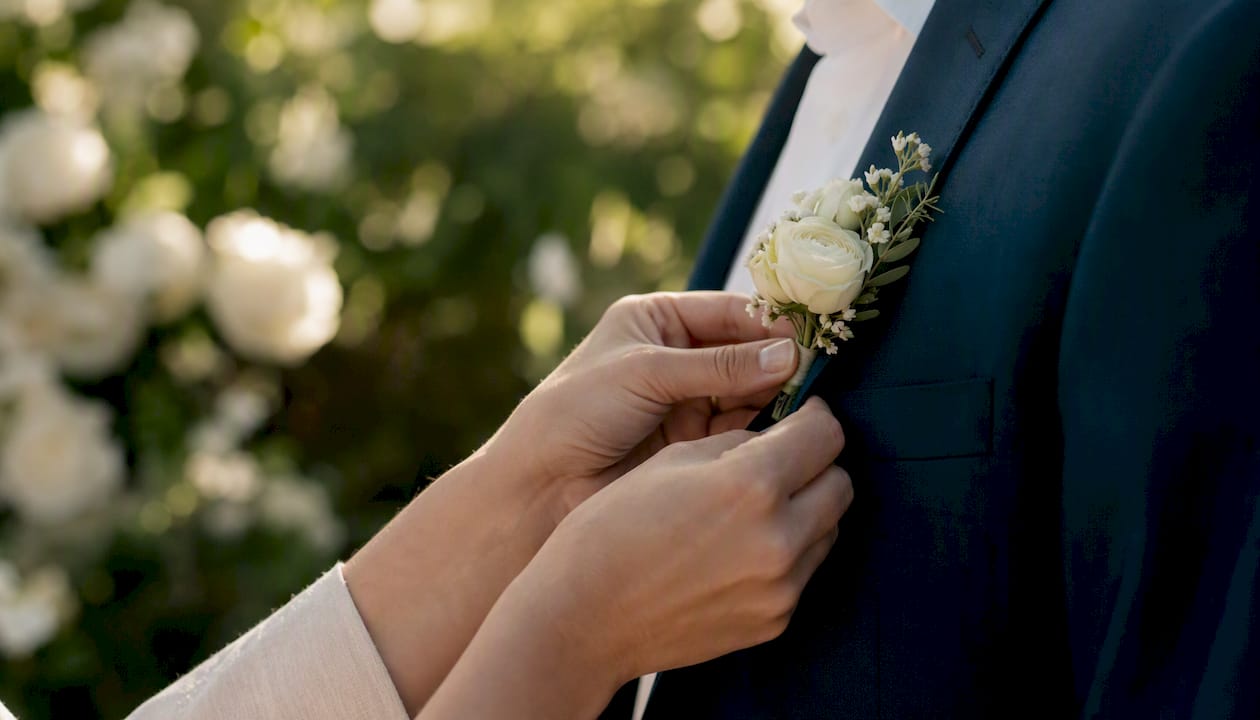
At Pixelgroves, the wedding narrative typically moves through five core beats:
Getting-ready details serve as the establishing sequence. Rings on a windowsill, a dress on a hanger, a parent adjusting a boutonniere. These images orient the viewer and introduce the motifs that will reappear later.
The first look is the complication beat, the moment of highest anticipation before the ceremony. A wide shot establishes the location; a close-up of the reaction carries the emotion.
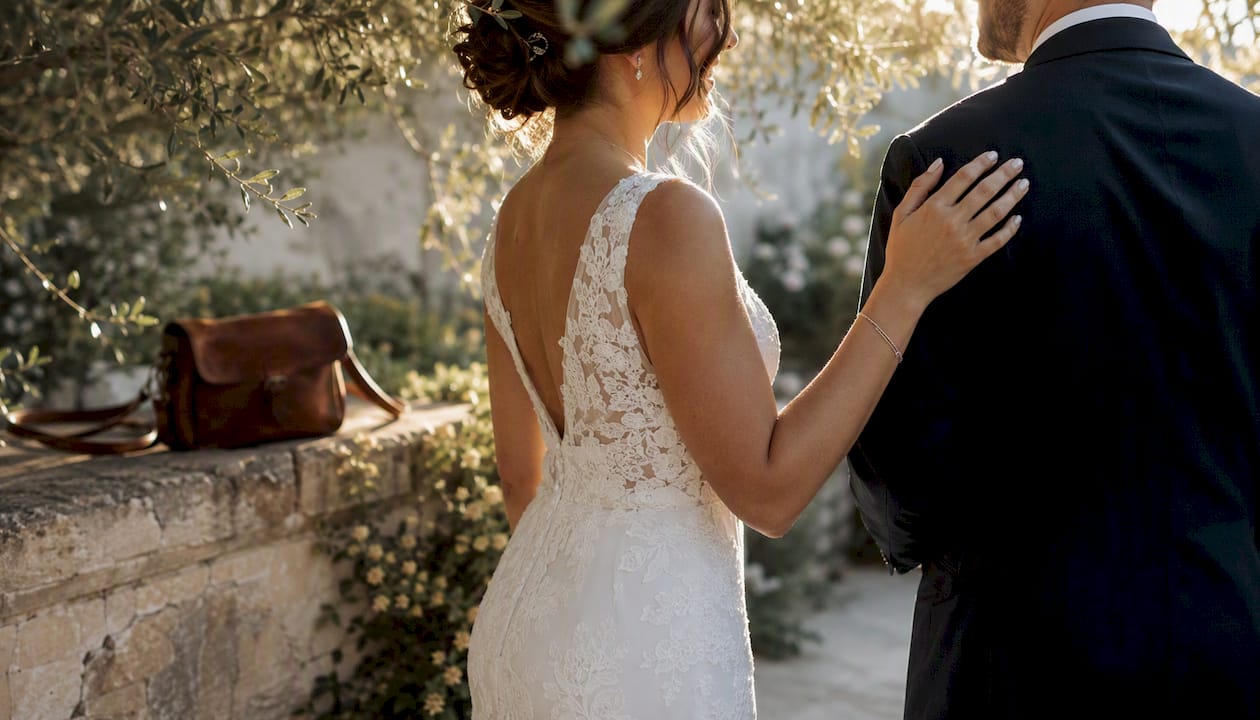
Ceremony establishing and candid vows form the arc’s peak. One wide shot of the full ceremony space, then tight candids of the exchange. The experience required to capture these moments is what separates a coherent narrative from a collection of well-exposed frames.
Reception details and candid moments provide the resolution sequence. Laughter, dancing, toasts. The emotional register shifts from reverent to joyful, and the pacing opens up.
The closing image should echo something from the getting-ready sequence. A detail shot of the rings worn now rather than laid out, or the couple walking away from the venue. That visual callback signals the end of the arc without a caption.
Selective captioning in a couple’s album works the same way it does in editorial work: name the moment, add the context the image cannot show (the location, the person speaking the toast), and then let the image carry the emotion. Over-captioning a wedding album is as much a mistake as under-captioning a documentary essay.
Why narrative matters more than any single perfect frame
Photography culture obsesses over the single great image. The decisive moment, the technically perfect exposure, the shot that wins the contest. That obsession is understandable, but it misses something.
A sequence of honest, well-sequenced images will move a viewer more reliably than one technically perfect frame surrounded by weak ones. The arc does the work. When I look at the wedding galleries that couples return to again and again, they are never the ones with the most technically impressive shots. They are the ones where the edit tells a story that feels true to the day.
The practice challenge: spend one afternoon shooting a 5-image sequence about a single ordinary subject, whether it is a neighbor’s garden, a coffee shop, or your own kitchen. Shoot one establishing wide, two mid-range scenes, one close detail, and one closing image. Edit nothing out. Then show it to someone and ask what story they see.
Sources
These are the most useful references for deepening your understanding of photo narrative theory and practice:
MoMA: Photo-essay — The museum’s collection term page gives a concise, authoritative definition and traces the photo essay’s editorial history. Start here for vocabulary and historical context.
Conscientious Photography Magazine: Photography and Narrative — A practitioner-focused essay that distinguishes narrative from story and explains why the edit and sequence are themselves storytelling decisions. Required reading before you attempt your first photo essay.
Shotkit: Narrative Photography — Practical guide covering ideas, examples, and techniques for narrative photography. Useful for the how-to workflow and shot-selection guidance.
Aperture: Gregory Crewdson — Cathedral of the Pines — Study this book to understand how staged-narrative photography uses mise-en-scène and symbol. Compare it with Lange’s documentary sequences to see how differently the two approaches build meaning.
Alatalo (2015) Pro Gradu thesis, University of Lapland — Academic research on viewer participation in photographic narratives. The key finding: viewers complete missing beats, which means photographers can imply rather than show every action.
To build your eye for sequencing, pull up a classic Dorothea Lange essay and study the order of images before reading any captions. Then read the captions and notice how your interpretation shifts. That exercise teaches more about narrative photography than most workshops.
For photographers applying these techniques to commercial and brand work, visual storytelling for product brands offers a useful parallel framework for adapting editorial sequencing to marketing contexts.
Recommended
Comments