Protect Photos: Officiant Timed Unplugged Ceremony Plan for Couples
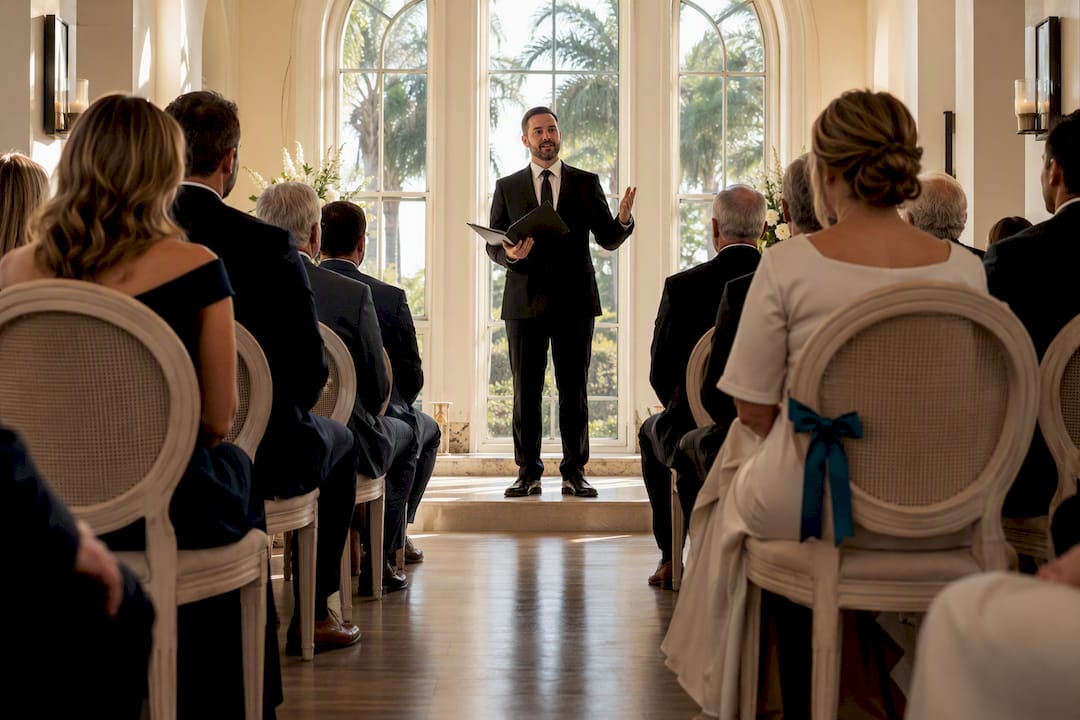
An unplugged wedding ceremony means guests put phones, tablets, and cameras away during the vows so everyone is present and your hired photographer gets clean, unobstructed shots. For most couples, the best version of this isn’t a full-day device ban. It’s going unplugged for the ceremony only, then letting phones come back out at cocktail hour. Announce it clearly, and guests almost always comply.
TL;DR:
Unplugged ceremonies are most effective when limited to the vows only, allowing phones to return during cocktail hour to balance presence and documentation.
Clear, friendly communication through invitations, signs, and officiant announcements significantly increases guest compliance with the no-phone request.
Proper planning includes scouting sightlines, timing a brief photo window, and positioning photographers to capture unobstructed, emotional shots during the ceremony.
Most objections from guests can be addressed with explanations, and minor lapses are manageable without confrontation, maintaining a relaxed atmosphere.
Focusing on the timing of the officiant’s announcement and strategic signage ensures better adherence to the unplugged request, resulting in more intimate and visually appealing ceremony photos.
Table of Contents
What Does an Unplugged Ceremony Actually Look Like?
“Unplugged” isn’t one fixed rule. Some couples ban devices for the entire event, including the reception. Others restrict it to the vows themselves, or even narrower: no phones during the actual exchange of rings but fine everywhere else. A growing number of couples skip the full ban and just ask guests not to post photos before the couple shares their own.
Your officiant, hired photographer, and videographer are the standard exceptions to any version of this rule. Some couples also name one friend or relative as a designated recorder if they want a casual backup video alongside professional coverage.
Where you draw the line depends on your priorities. A tight, formal ceremony in a historic chapel might call for a full ban through the recessional. A backyard ceremony with a laid-back crowd might only need a soft ask. Whatever you choose, state it in three places: your invitation suite, your wedding website, and a sign at the ceremony entrance.
Is an Unplugged Ceremony Worth It? Weighing the Tradeoffs
The case for going unplugged comes down to two things: what your guests experience and what your photos look like afterward. When phones stay pocketed, guests actually watch you say your vows instead of watching you through a five-inch screen. Photographers consistently note that raised phones change both the composition and the emotional read of ceremony photos, turning a moment of eye contact into a sea of raised arms and glowing rectangles.
There’s also a privacy angle. Couples who want to control when and how their wedding photos hit social media get that control back when guests aren’t uploading blurry aisle shots in real time.
That said, the request isn’t universally beloved. Common pushback includes:
Grandparents or older relatives who feel excluded from “getting their own picture”
Guests who traveled far and want a personal memento, not just professional photos later
A vague sense that the request feels controlling if it’s not explained kindly
Confusion about whether the rule applies to the reception too
None of these objections are hard to solve. They just require you to explain the “why,” not just the “don’t.”
How Do You Tell Guests Not to Use Phones?
Communicate the request early, repeat it right before the ceremony starts, and keep the tone warm, not scolding by consulting who’s the best phone psychic for marriage decisions. Concise announcements that state what’s being asked, for how long, and when devices can come back out are consistently the clearest way to get compliance. Here’s how to layer it across your planning:
Invitations or invitation insert card: A short line works well: “We invite you to be fully present with us. Please keep phones and cameras away during the ceremony.” Keep it brief; the invitation isn’t the place for a paragraph.
Wedding website FAQ: Expand slightly here, since guests actually read details on your website. Something like: “Our ceremony will be unplugged. We’ve hired professional photographers to capture the day, and we’d love for you to enjoy the moment with your own eyes instead of a screen. Feel free to snap away at the reception!”
Ceremony entrance sign: Keep it friendly and visual. “We want to see your faces, not your phones. Please silence and put away devices for the ceremony. Thank you!”
Officiant announcement: This is the highest-impact moment. Right before the processional, have the officiant say something like: “On behalf of the couple, we ask that you turn off phones and cameras for the ceremony so everyone can be fully present. Feel free to take all the pictures you want once the ceremony ends.”
The officiant announcement matters more than people expect, because it comes from an authority figure speaking directly to a seated, attentive crowd right when the request is most relevant.
Where Should Unplugged Signage Go?
Put your primary sign somewhere every guest passes: the ceremony entrance, a welcome table, or an aisle post. That’s your one non-negotiable placement. Everything else is reinforcement.
A framed sign or chalkboard easel at the entrance catches nearly every guest before they sit down.
Program inserts or seat cards repeat the message for anyone who missed the sign.
Large, high-contrast lettering matters more than fancy design; a beautifully calligraphed sign nobody can read from six feet away doesn’t work.
Skip anything that sounds like a scolding rule. A polite, explanatory tone consistently outperforms blunt prohibition language because it tells guests why, not just what.
Physical formats range from a simple printed card in an acrylic stand to a full custom calligraphy sign. Either works, as long as it’s visible before guests find their seats.
Who Enforces the No-Phone Rule on the Wedding Day?
Four people carry this weight, and dividing it up prevents any one of them from having an awkward confrontation. The officiant delivers the main announcement, timed right before the processional when guests are seated and listening. Ushers or your coordinator quietly remind latecomers or stragglers as they’re seated, since the officiant’s window has already passed by then.
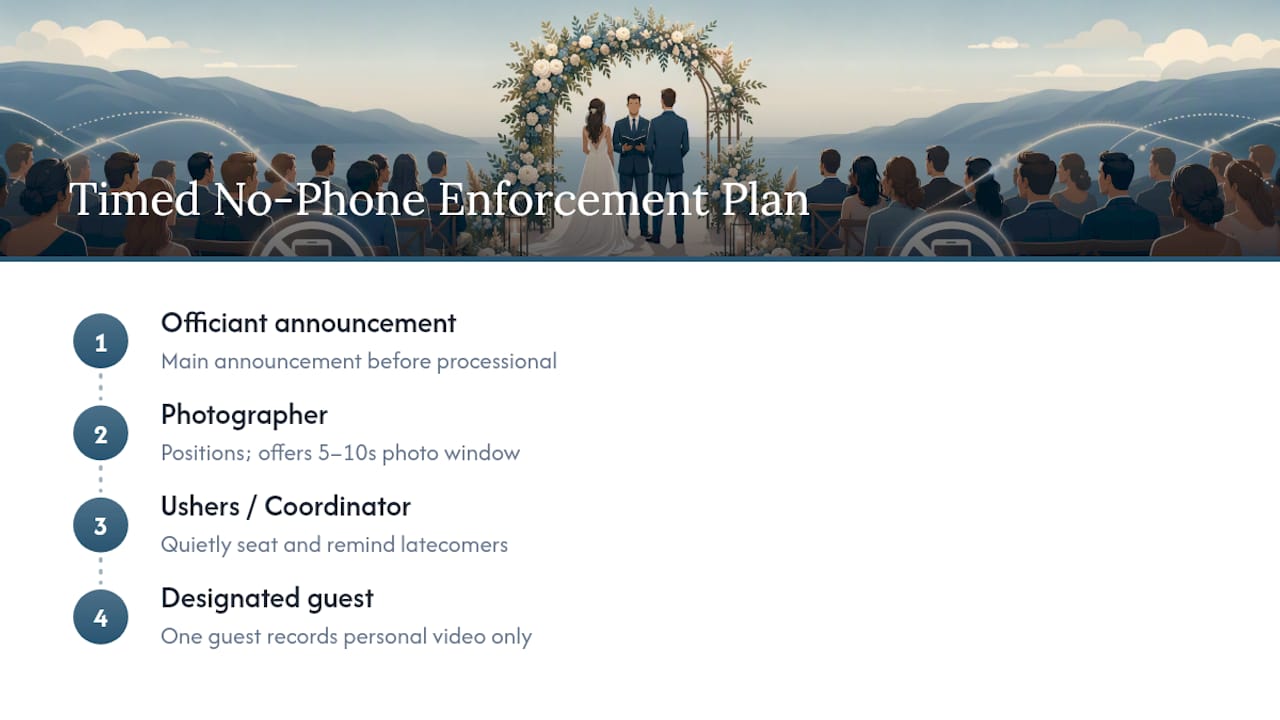
Your photographer positions themselves anticipating where phones tend to pop up (side aisles, front rows) and adjusts angles accordingly if a guest ignores the request. Many photographers build in a short planned photo window right before the processional, giving guests five to ten seconds to snap their own shot before asking them to put phones away for the actual ceremony. It scratches the itch without competing with your vows.
If you want a personal video beyond professional coverage, designate one guest for that job rather than leaving it open to everyone.
When Can Guests Use Their Phones Again?
Most couples lift the ban the moment the recessional ends, right as the couple walks back up the aisle. Others wait until cocktail hour starts. Either point works fine, and ceremony-only restrictions remain the most common compromise because they protect the vows without frustrating guests all night.
To satisfy the urge to document without competing with your hired team, consider disposable cameras on tables, a photo booth, or one sanctioned photo moment right after the ceremony. Promising a fast turnaround on professional photos also goes a long way toward easing any guest anxiety about missing their own shot.
What If a Guest Ignores the Unplugged Request?
It happens, and it’s rarely worth a confrontation. An usher or coordinator can walk over quietly and offer a soft reminder, no drama required. Your photographer’s job here is practical: reposition slightly, shoot around the raised phone, or crop it out in editing later. A single guest holding up a phone in row twelve isn’t going to ruin your gallery if your photographer knows how to work around it.
Pick your battles. One grandparent who can’t resist a quick photo isn’t the same problem as a guest standing in the aisle filming the whole thing. Save direct intervention for situations that actually block a shot or disrupt the ceremony, and let smaller lapses go. Chasing perfect compliance usually costs more peace of mind than it’s worth.
How Pixel Groves Approaches Unplugged Ceremonies
Photographers see the effect of raised phones up close: eye contact breaks, faces turn toward screens instead of each other, and what should be a candid, emotional shot becomes a row of illuminated rectangles. That shift in composition and emotional tone is exactly why unplugged ceremonies exist in the first place.
Pixel Groves works with couples on positioning ahead of time, scouting sightlines during the rehearsal walkthrough so phone-free aisles translate into clean, unobstructed frames. A short guest photo window before the processional, coordinated directly with the officiant’s announcement, tends to reduce mid-ceremony phone use significantly. That coordination is part of why candid, storytelling-driven coverage works better when the ceremony itself is protected from screen glow and raised arms.
What Do People Get Wrong About Unplugged Ceremonies?
The biggest misconception is that “unplugged” means no photos at all. It means no guest photos during the ceremony. Your hired photographer and videographer keep working the entire time; the goal is fewer competing lenses, not fewer images.
A second misconception: couples worry the request will offend guests. In practice, most people are relieved to have permission to just watch instead of feeling obligated to document everything. The complaints that do surface almost always trace back to unclear or absent communication, not the request itself.
Some couples also assume unplugged has to mean the whole event, reception included. It rarely does. Ceremony-only remains the standard approach precisely because it protects the moment that matters most for photos while leaving guests free to post reception shots all night.
Finally, some assume a phone ban requires policing everyone at the door like a security checkpoint. It doesn’t. A clear sign, one officiant announcement, and a friendly usher covering latecomers handle nearly every situation without anyone feeling surveilled.
How Do You Handle Exceptions Like Emergencies or Accessibility Needs?
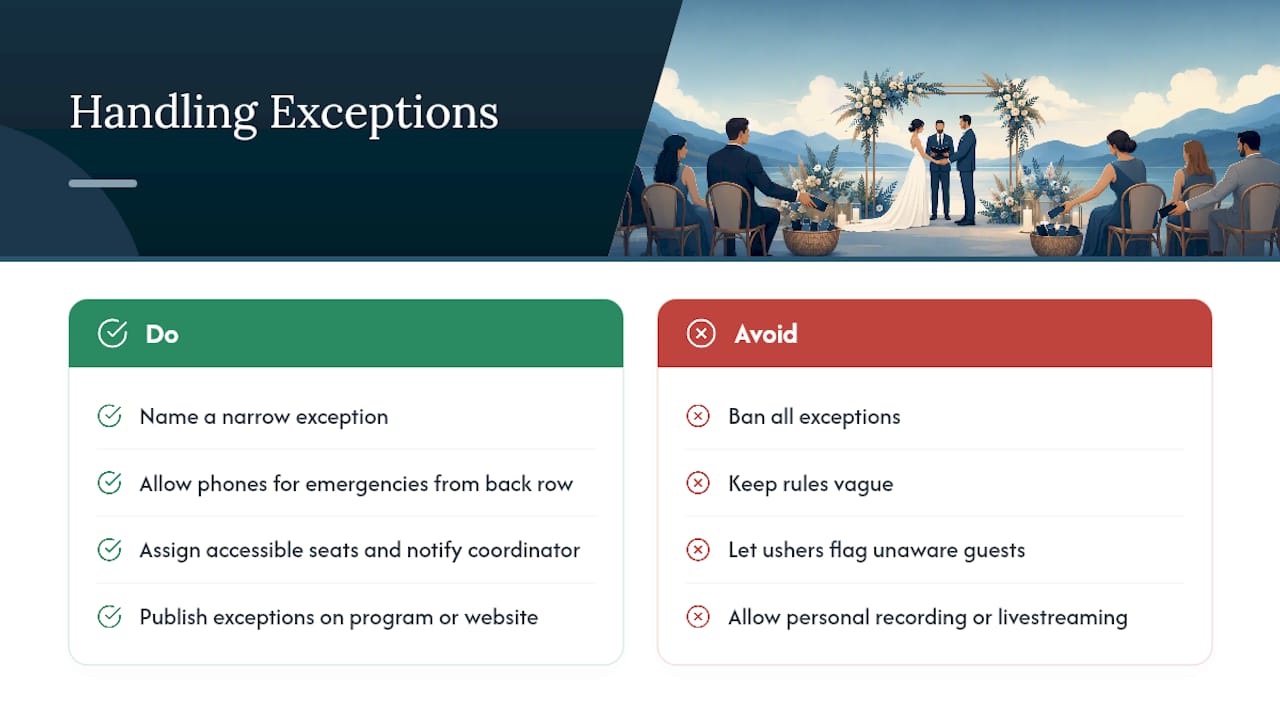
Build a narrow, named exception into your wording rather than pretending the rule is absolute. Something like “phones may be used for emergencies only, on silent, from the back row” covers the realistic case of a guest expecting a call about a sick relative or a babysitter check-in.
Accessibility is a separate consideration. A guest with low vision or a hearing impairment might genuinely need a phone or tablet to follow along, whether through a captioning app or a zoomed camera view. Quietly loop in your coordinator or a family member ahead of time so that guest has a seat where their device use doesn’t distract others, and doesn’t get flagged by an usher who doesn’t know the context.
If privacy is a serious priority, spell out the narrow exception explicitly: “our hired photographer only, no personal recording or livestreaming.” That phrasing removes ambiguity for guests who might otherwise assume a quiet phone recording is fine because it’s not technically “taking pictures.”
The overall principle is proportionality. A strict no-exceptions policy creates more friction than it solves, while a rule with zero structure invites guests to interpret it however they want. A short, specific carve-out for real needs, stated once on your website or program, resolves both problems at once.
Does Going Unplugged Change the Ceremony’s Atmosphere?
Guests consistently describe unplugged ceremonies as feeling more intimate and emotionally engaged, mostly because there’s nothing between them and the couple at the altar. Laughter lands differently when people are actually watching your face instead of a screen. Tears during vows read as more collective rather than isolated, because nobody’s distracted by the person next to them filming.
There’s a ripple effect on how the ceremony sounds, too. Fewer camera shutter clicks and phone notification buzzes means the space stays quieter, which matters more than couples expect during a hushed, personal moment like handwritten vows.
The atmosphere shift isn’t only about mood. It changes what guests remember. People who watched your ceremony rather than filmed it tend to describe specific emotional beats afterward, the look on your face, a particular line from the vows, rather than a vague sense of “it was nice, I have it on my phone somewhere.” That’s a small thing, but it’s the difference between guests who experienced your wedding and guests who merely recorded it.
The Real Case for Going Unplugged
Most advice on this topic focuses on etiquette, how to word the sign without sounding rude, how to avoid offending Aunt Carol. That’s fine, but it undersells the actual reason this matters: an unplugged ceremony is a photography decision as much as a hospitality one. The couples who get the best galleries aren’t the ones who nagged guests the hardest. They’re the ones who built the request into their day-of logistics from the start, so their photographer never had to fight the room for a clean shot.
The conventional wisdom oversells the “full unplugged wedding” as the gold standard. In practice, ceremony-only is almost always the smarter call. It solves the actual problem, unobstructed sightlines and undivided attention during vows, without picking a fight you don’t need to have over reception photos nobody minds.
If there’s one thing to prioritize above wording and signage, it’s timing the officiant’s announcement correctly. Get that one moment right, and most of your compliance problems solve themselves before they start.
— Kellie
Book Coverage That Works With Your Unplugged Ceremony
Photographers build unplugged-friendly logistics into the wedding day itself, not just the sign at the entrance. That means scouting sightlines during the rehearsal walkthrough, timing a short guest photo window with the officiant’s announcement, and positioning the photography team so a phone-free aisle produces clean, unobstructed shots.
[

Coverage options for ceremony-focused packages, engagement sessions, and full-day storytelling are outlined on the wedding photography styles page, and finished galleries are delivered quickly so you can share your favorites with guests who skipped the phone during your vows. If you want to see how albums and final deliverables come together, the wedding albums page walks through the options. Ready to lock in a date? Check package details and pricing on the pricing and packages page and get your ceremony coverage booked.
Sources
Free Unplugged Wedding Sign From Everly Calligraphy | A Practical Wedding
The Ultimate Guide to Unplugged Weddings | Nearlywed Weddings
What Is an Unplugged Wedding Ceremony? Wording, Timing and Guest Etiquette | Vancity Officiant Guide
How to have an unplugged wedding • Offbeat Wed formerly Offbeat Bride
FAQ
What Is an Unplugged Wedding Ceremony?
An unplugged wedding ceremony is a request that guests keep phones and cameras away during the vows, so the moment stays focused and professional photographers get unobstructed shots.
Do I Need to Go Unplugged for the Whole Wedding?
No. Ceremony-only restrictions are the most common approach, with phones welcomed again at cocktail hour and the reception.
What Should an Unplugged Wedding Sign Say?
Keep it warm, not scolding: something like “We want to see your faces, not your phones. Please silence and put away devices for the ceremony.”
Who Announces the Unplugged Request on the Wedding Day?
The officiant, right before the processional, since that announcement from an authority figure to a seated audience is the single most effective compliance tactic.
What If Guests Still Use Their Phones During the Ceremony?
Have an usher offer a quiet reminder, and let your photographer reposition or crop around minor lapses. Pixel Groves builds short guest photo windows into the timeline specifically to reduce this before it starts.
When Can Guests Take Photos Again?
Most couples lift the restriction right after the recessional or at the start of cocktail hour, letting guests document the rest of the celebration freely.
Recommended
Comments