Paper Culture: Eco-Friendly Cards, Invites & Photo Books
Updated: Aug 26

Paper Culture is an eco-first stationery brand, and it’s a strong pick for buyers who want premium cards, wedding invitations, and photo books backed by verifiable sustainability claims. The company holds B Corporation certification with an overall B Impact score of 90.4, against a median score of 50.9 for businesses that complete the same assessment. It also plants a tree with every order and sells across the categories eco-conscious shoppers actually need: holiday cards, wedding invitations, graduation announcements, and photo books.
Paper Culture makes sense if you want your stationery budget to double as a small climate action, without giving up the paper weight and print quality a wedding or holiday card deserves.
Who it fits best:
Couples ordering wedding invitations who want keepsake-quality paper with a documented environmental record.
Families sending photo holiday cards who care about matte print quality on recycled stock.
Anyone who wants to verify a “sustainable” claim rather than take a marketing page at its word.
One caveat: if you’re after raw paper stock for DIY origami or paper craft projects, look elsewhere. Paper Culture sells finished, customizable products, not craft supplies or paper-folding tutorials.
Key Takeaways
Paper Culture earns its eco-friendly reputation through a documented B Impact score, proprietary recycled paper, and a tree-planted-per-order model, making it a credible pick for sustainability-minded stationery buyers.
Point | Details |
Verified sustainability | Paper Culture’s B Impact score of 90.4 nearly doubles the 50.9 median for assessed businesses. |
Product range covers major life events | Holiday cards, wedding invitations, graduation announcements, and photo books all use the same recycled paper stock. |
Plan around proof timelines | Build in extra days for design proofing, especially during the November and December holiday rush. |
Reviews are broadly positive with known friction points | Thousands of positive reviews cite print quality, though some report holiday-season shipping delays. |
Pair printing with photography | Pixelgroves’ wedding photography can align image delivery with your stationery ordering schedule so proofs aren’t rushed. |
Table of Contents
What Does Paper Culture Sell?
Paper Culture’s catalog splits into a handful of clear categories, and each one is built around a specific moment. The site lists holiday and Christmas cards, wedding invitations and day-of stationery, graduation announcements, photo books, framed prints, and personalized gifts.
Holiday and Christmas cards: photo-driven designs suited to family updates, often the entry point for first-time buyers.
Wedding invitations and day-of stationery: save-the-dates, invitation suites, and reception signage meant to double as keepsakes.
Graduation announcements: a smaller but dedicated category with its own templates.
Photo books: printed on recycled matte stock, built for wedding albums or yearly family recaps.
Framed prints and personalized gifts: rounds out the catalog for buyers who want a single standout piece rather than a card run.
Customization runs through templates with photo upload, free design assistance, and a choice of paper weights. Wedding customers get the most flexibility here, since invitation suites often need coordinated fonts, colors, and envelope liners rather than a single fixed design.
Is Paper Culture Actually Sustainable?
The clearest proof point is the B Impact Assessment score of 90.4, nearly double the 50.9 median for companies that take the same test. That gap matters because the B Impact Assessment measures a company’s actual governance, worker treatment, and environmental impact, not just its marketing copy.
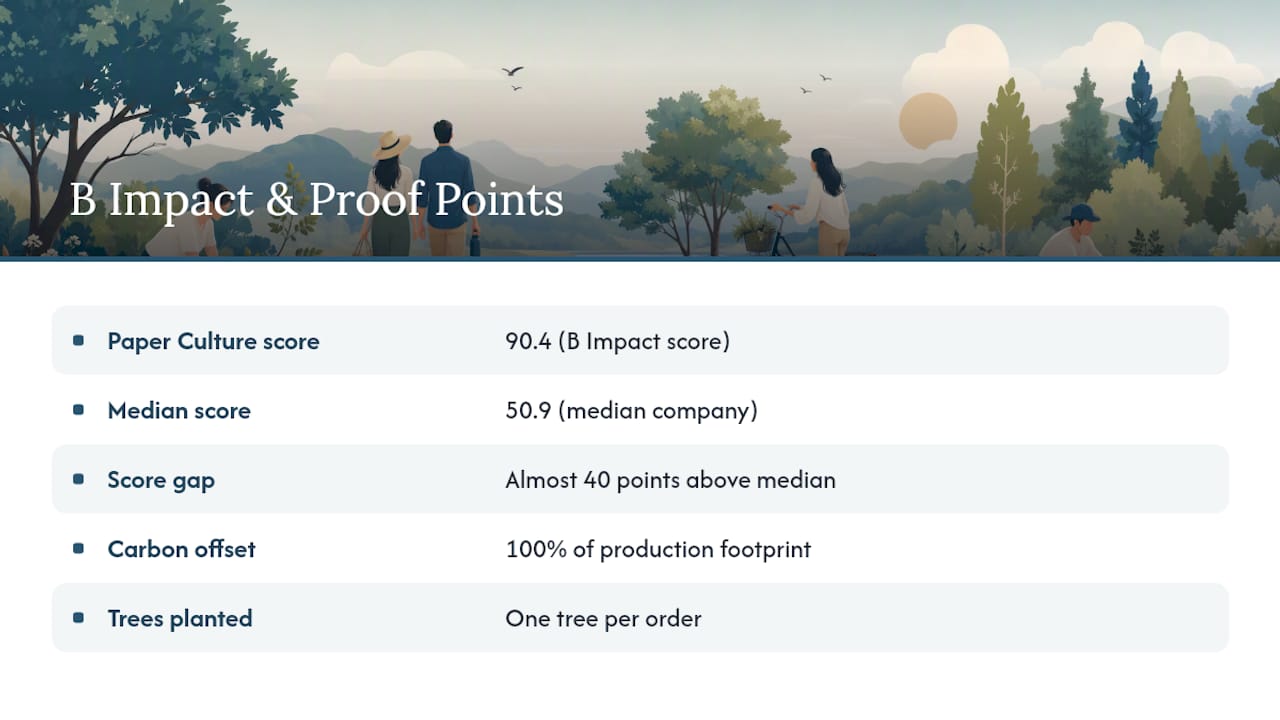
Statistic to remember: Paper Culture’s B Impact score sits almost 40 points above the typical business benchmark, one of the more concrete sustainability proof points a stationery brand can offer.
Beyond the score, Paper Culture plants a tree with every order and offsets 100% of its production carbon footprint, according to the company’s own mission page. Materially, the brand developed its own 100% post-consumer recycled paper by partnering with domestic manufacturers after concluding existing recycled stock didn’t meet its tactile standards. That local-manufacturing choice also cuts down on transportation emissions tied to shipping raw stock overseas.
Pro Tip: Before you order, search Paper Culture’s name directly on B Lab’s certified B Corp directory rather than trusting a badge image on the product page. Certification numbers and assessment scores are public and searchable, so you can confirm the claim in under a minute.
What Do the Paper and Print Quality Feel Like?
Paper Culture’s core material is its proprietary 100% post-consumer recycled paper, developed specifically because off-the-shelf recycled stock didn’t hold up for premium cards. That distinction matters for wedding buyers: recycled doesn’t have to mean thin or flimsy, and the brand’s decision to build its own paper supply chain suggests it treated tactile quality as a real requirement, not an afterthought.
Photo books print on 100% post-consumer recycled matte paper, which handles color and contrast well without the glare of glossy stock.
Premium tiers, including double and triple-thick paper, are available for buyers who want a heavier feel for wedding invitations.
Envelopes and addressing services are available as add-ons, useful if you’re mailing a large guest list and want a uniform look.
Matte recycled stock reproduces warm tones and skin colors more forgivingly than glossy paper, but it also softens harsh contrast, so a slightly brighter edit works better going in.
Matte stock absorbs more light and can mute an image that looked perfect on screen.*
When a card reaches the recipient, the paper and envelope are both recyclable through standard curbside programs, and uncoated stock like this breaks down in most municipal recycling streams without special handling.

How Does Ordering and Pricing Work?
Ordering follows a simple sequence, but the timeline matters more than most buyers expect, especially for wedding invitations tied to a fixed date.
Choose a product category and starting template, or upload your own photos.
Request free design assistance if you want a designer to adjust layout, fonts, or color matching.
Review a digital proof before anything goes to print.
Approve the proof and select a paper weight or premium envelope option.
Confirm shipping speed, since standard and expedited options carry different costs.
Design assistance and addressing services are typically included at no extra charge, while thicker paper stock and premium envelopes raise the price per unit. Discounts and shipping thresholds appear periodically on product pages, so check the current offer before finalizing a large order. Because proofs require your approval, build in a few extra days beyond the printer’s stated turnaround, particularly during the November and December holiday rush when order volume spikes.
What Do Customers Say About Paper Culture?
Reviewers consistently praise three things: print quality that reads as premium despite the recycled stock, modern designs that don’t look templated, and free design help that actually improves the final product. The sustainability story shows up often in reviews too, with buyers specifically calling out the tree-planting program as a reason they chose the brand over a conventional print shop.
The recurring complaints cluster around timing. Some customers report slower turnaround during peak holiday season, occasional shipping mix-ups, and color that doesn’t perfectly match what appeared on screen, a common issue with any print-on-demand paper good.
Reputation snapshot: Paper Culture has built a base of positive reviews numbering in the thousands, alongside recognition from outlets like Wirecutter for its card designs. Numbers like that reflect a large enough sample to trust the pattern, not just a handful of curated testimonials.
Quick pros and cons:
Pros: strong print quality, verifiable B Corp status, responsive design support, distinctive modern templates.
Cons: possible holiday-season delays, occasional shipping errors, screen-to-print color variance.
How Do You Know If Paper Culture Is Right for You?
Run through this checklist before placing an order, especially one tied to a wedding date or holiday deadline:
Do you have at least two to three weeks of buffer before your mailing deadline, accounting for proofing time?
Does your budget allow for premium paper weight if you want a heavier, more formal feel?
Do you want free design assistance, or do you already have finished artwork ready to upload?
Are recycled content and carbon offsets a priority you’re willing to verify, not just take on faith?
Are you ordering internationally, where shipping rules and timelines shift?
Ask customer service directly about paper samples and current proof turnaround before committing to a large wedding order. A red flag worth noting: any stationery vendor, Paper Culture included, that can’t commit to a firm proof-and-print window ahead of a fixed event date deserves a follow-up question before you pay.
How Does Paper Culture Handle Labor and Operations?
Sustainability claims often stop at the materials. Paper Culture’s stated practices go further into how the company runs day to day. The brand reports choosing office locations that make public transit practical for employees, a small but deliberate operational decision rather than a marketing line.
It also runs building-wide recycling programs at its own facilities, extending the recycled-paper story from the product into the workplace itself. Partnering with domestic manufacturers for its proprietary recycled paper serves a second purpose beyond quality control: shorter supply chains typically mean fewer emissions from transport and more direct oversight of production conditions, since the company isn’t relying on an overseas vendor several steps removed from its own standards.
None of this is independently audited labor reporting in the way a large public company might disclose. But paired with third-party B Corp certification, which does evaluate worker treatment as part of its scoring criteria, the operational choices read as consistent with the brand’s public commitments rather than contradicting them. For a stationery company, that combination, matching material sourcing with facility-level practices, is a more complete sustainability picture than a tree-planting badge alone.
Why This Matters for Wedding Stationery Specifically
Wedding planning runs on tight sequencing, and stationery is usually the piece couples underestimate. Paper Culture’s paper weight options and photo book quality hold up well for keepsakes meant to last decades, not just a mail run.
The sustainability angle lines up naturally with how a lot of couples already think about their wedding day, choosing vendors and materials that reflect their values, not just their aesthetic. If you’re ordering photo cards or a wedding photo book, the imagery matters as much as the paper. Coordinating with your wedding photography timeline so final images are delivered before you need to upload them avoids a rushed, low-resolution substitute in your proof.
One planning note: build your invitation and photo-card ordering around your photographer’s delivery schedule, not the other way around. A proof delay caused by missing final images is one of the most avoidable holdups in the whole process.
A Complementary Way to Plan Your Wedding Timeline
Paper Culture solves the printed side of your wedding story. Pixelgroves solves the photographed side, and the two work best when they’re planned together instead of separately. Couples booking Pixel Groves get full-day wedding photography and videography across documentary, editorial, and light-and-airy styles, plus engagement shoots that can supply the exact images a save-the-date or photo card needs.
[
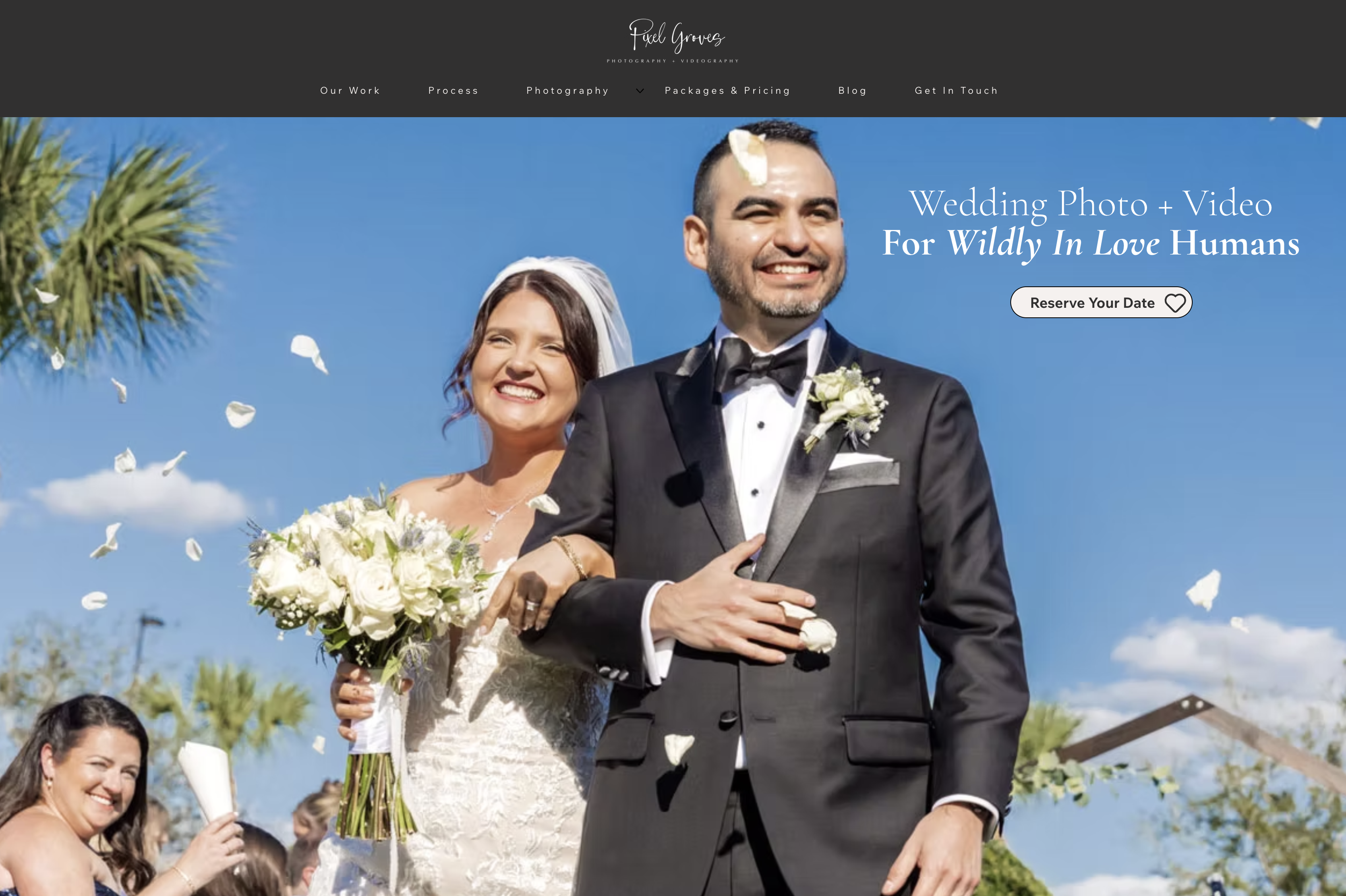
Where a lot of couples lose time is ordering invitations before they know what their final gallery will look like, then scrambling to fit a rushed photo into a proof deadline. Pixel Groves works from your event timeline backward, so image delivery lines up with your printing schedule instead of fighting it. If you’re planning a Florida wedding and want photography that’s timed to support your stationery choices, not just your album, check Pixel Groves’ pricing and packages and get a quote that fits your date.
Frequently Asked Questions
Is Paper Culture actually a B Corp? Yes. Paper Culture holds active B Corporation certification with a B Impact score of 90.4, well above the 50.9 median for companies that complete the assessment.
Does Paper Culture really plant a tree with every order? The company states this as part of its mission, pairing tree planting with a claim of offsetting 100% of its production carbon footprint. You can review the specifics directly on its mission page rather than relying on a badge alone.
Is Paper Culture good for wedding invitations specifically? It suits couples who want keepsake-quality paper with a documented sustainability record, particularly with premium paper weight options for a more formal feel. Just build proofing time into your wedding timeline so a fixed event date isn’t at risk.
What paper does Paper Culture use for photo books? Photo books print on 100% post-consumer recycled matte paper, which handles color reproduction well and avoids the glare that comes with glossy stock.
Does Paper Culture sell craft supplies or origami paper? No. Paper Culture is a finished-product stationery brand. If you’re looking for raw paper stock or paper-folding technique guides, that falls outside its catalog.
Sources
Paper Culture LLC - Certified B Corporation - B Lab
Our Mission | Paper Culture
Recommended
Comments