How Interview Footage Transforms Your Wedding Film
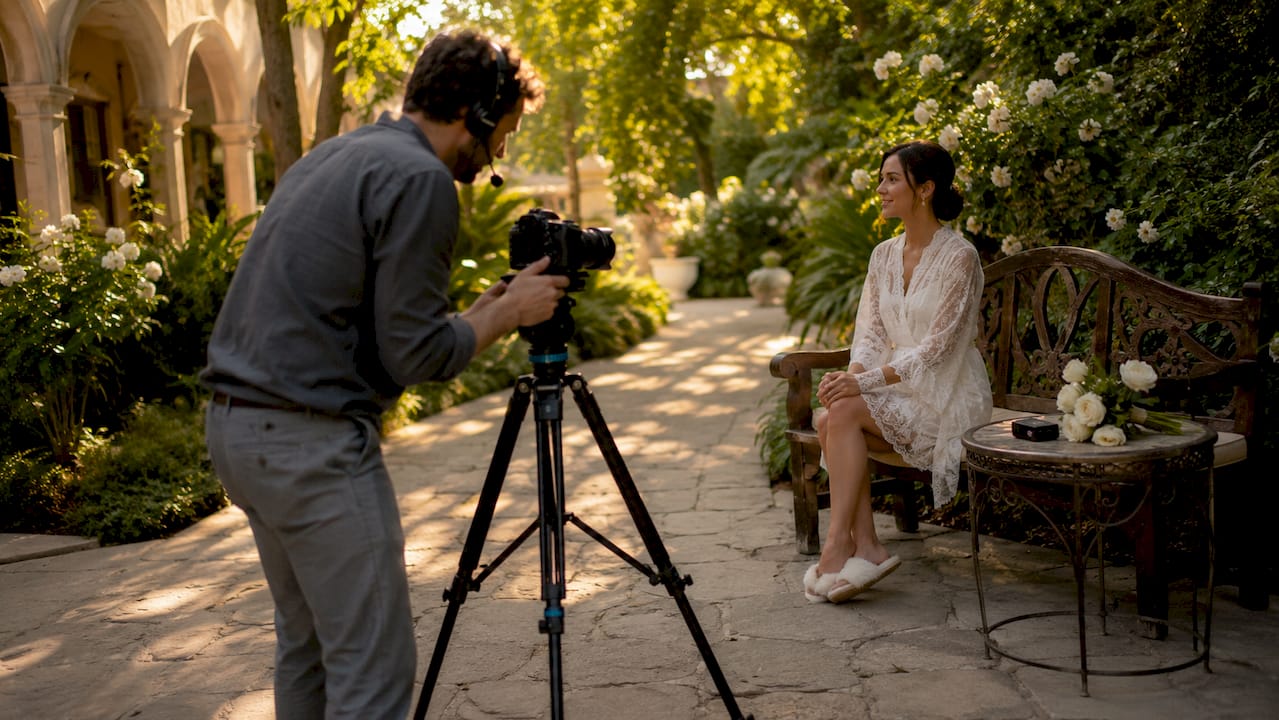
Interview footage in wedding films is defined as intentional, on-camera conversations with the couple, family members, and guests that capture voices, emotions, and personal stories no camera angle alone can preserve. The role of interview footage in wedding films goes far beyond a simple talking head. It is the difference between a film that shows your wedding and one that tells your story. Interview-style films uniquely preserve emotions, laughter, and the small details that time eventually changes, making them a storytelling tool every couple should understand before booking their videographer.
What makes interview footage different in wedding films?
Traditional wedding coverage follows movement. The camera tracks the processional, captures the first dance, and documents the cake cutting. Interview footage does something entirely different. It records the why behind every moment, in the words of the people who lived it.
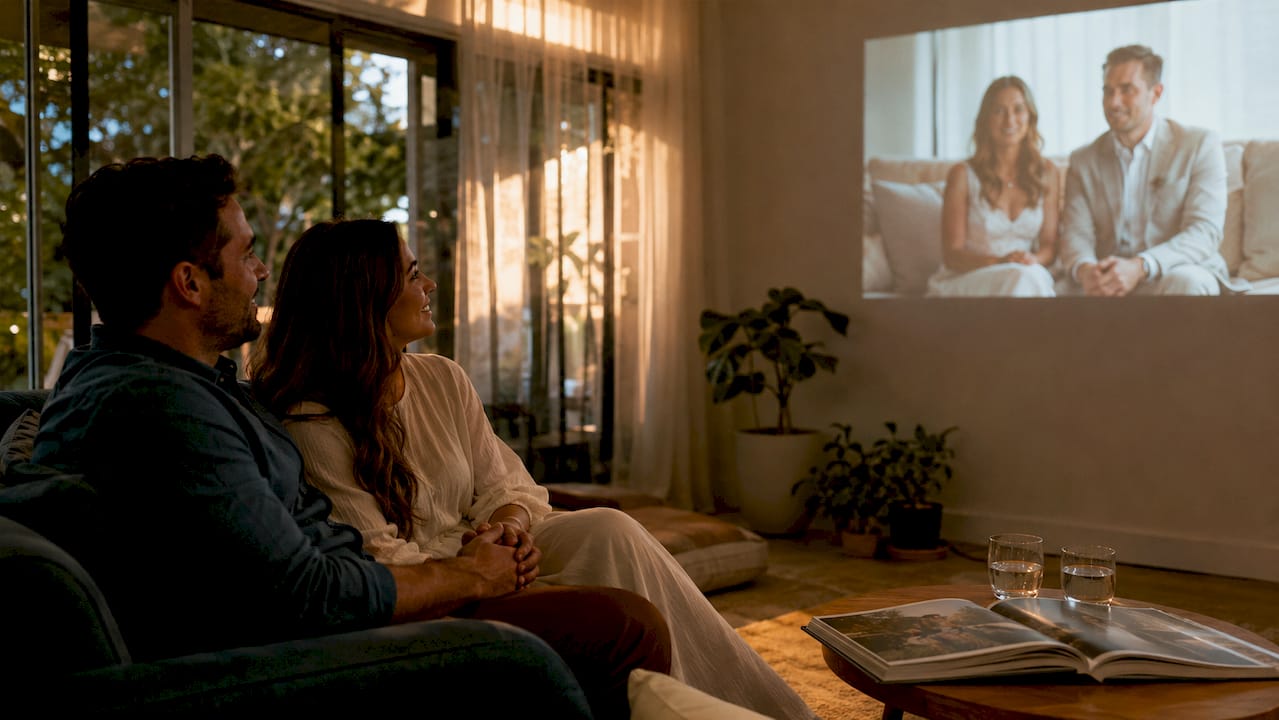
The distinction matters because visuals fade in memory. A shot of your father walking you down the aisle is beautiful. Your father describing how he felt in that moment, in his own voice, is irreplaceable. Interview clips preserve voices and stories that photos and standard footage simply cannot hold.
Here is what sets interview segments apart from conventional wedding coverage:
Emotional authenticity: Interviews capture unscripted reactions, nervous laughter, and genuine tears that staged shots rarely produce.
Personality preservation: A guest’s sense of humor, a grandmother’s accent, a best friend’s inside joke all live in interview footage and nowhere else.
Narrative context: Interviews explain relationships, history, and meaning that a viewer watching the film years later would otherwise miss.
Timeless voice capture: Voices and laughter fade from memory faster than faces. Interview footage locks them in permanently.
Story diversity: Multiple interviewees create a composite portrait of the day from several perspectives, not just one camera’s point of view.
Pro Tip: Ask your videographer to show you a sample film that includes interview segments before you book. If their portfolio only shows movement and music, they may not have experience directing meaningful on-camera conversations.
The wedding film interview significance becomes clear when you watch a film five or ten years later. The dress, the flowers, and the venue will look familiar. The voices of people who may no longer be with you will feel like a gift.
How does interview footage enhance emotional impact?
Interview footage enables storytelling techniques like voiceover narration and first-person perspective that give a wedding film its narrative spine. Without these elements, even a beautifully shot film can feel like a highlight reel. With them, it becomes a story with a beginning, middle, and end.
Consider a common cinematic structure used by skilled videographers. The film opens with the groom describing the moment he knew he wanted to marry his partner. That audio plays over footage of him getting ready, hands shaking slightly as he buttons his shirt. The viewer is immediately inside the story. No title card or narration from an outside voice is needed.
“The best wedding films I have ever watched all share one thing: you hear the couple’s voices before you see their faces. That choice alone tells you the filmmaker understands what a wedding film is actually for.”
How interview footage enhances films goes beyond the opening sequence. Interviews create bridges between chronological scenes. A clip of the maid of honor laughing about a shared memory can transition the film from the ceremony to the reception without a jarring cut. The emotional thread stays intact.
Specific moments that benefit most from interview integration include:
Father or mother of the bride or groom reflections: These short clips carry enormous emotional weight and often become the most-watched moments in a final film.
The couple’s first impressions of each other: Hearing both partners describe the same memory from their own perspectives creates a natural, cinematic contrast.
Officiant commentary: Officiants often know the couple’s full story and can articulate it in ways that even close friends cannot.
Guest tributes: A 30-second clip from a college roommate or a childhood neighbor adds texture and warmth that no B-roll footage can replicate.
The impact of interviews in weddings is also measurable in how couples engage with their films over time. Films with interview segments get rewatched at anniversaries, shared with children, and played at milestone gatherings. Films without them are often watched once and archived.
Who should you interview and when?
Key interview subjects include the bride and groom, parents, close friends, and the officiant. Each person brings a different layer to the story. The couple provides the emotional core. Parents offer historical context. Friends deliver personality and humor. The officiant connects the spiritual or ceremonial meaning.
Timing matters as much as subject selection. Here is a practical sequence for incorporating interviews throughout your wedding day:
Morning preparation: Interview the bride or groom separately while getting ready. Nerves and excitement produce the most honest answers at this stage.
Pre-ceremony window: A quiet five minutes with each set of parents before the ceremony yields reflective, emotional responses without the distraction of guests.
Cocktail hour: Guests are relaxed, drinks in hand, and genuinely happy. This is the ideal window for short, candid clips from friends and extended family.
Post-ceremony glow: Capture the couple immediately after the ceremony while emotions are still raw. These clips often become the emotional centerpiece of the final film.
Reception downtime: Brief interviews during dinner or between dances work well for anyone who was too busy or nervous earlier in the day.
Questions that produce meaningful answers focus on specifics, not generalities. “What do you love about them?” produces a generic answer. “Tell me about the moment you knew they were right for each other” produces a story. Your videographer should come prepared with a short list of prompts tailored to each subject.
Pro Tip: Brief your key interview subjects the week before the wedding. Let them know they may be asked a few questions on camera. Unprepared guests freeze up. Prepared guests tell stories.
How do you work with your videographer on interview footage?
Interviewing your videographer upfront sets clear expectations and builds the working relationship you need for interview footage to succeed. The conversation should happen before you sign any contract.
Requesting unedited ceremony footage from a prospective videographer is one of the most revealing things you can do. A confident professional shares complete, unedited sequences willingly. Reluctance signals either quality concerns or a lack of transparency about their actual work.
Use this comparison when evaluating how different videographers handle interview footage:
Factor | Interview-Focused Videographer | Standard Videographer |
Pre-wedding planning | Discusses interview subjects and questions in advance | Focuses only on shot lists and logistics |
On-the-day approach | Directs interviewees with specific prompts | Records speeches and toasts only |
Editing integration | Weaves interview audio throughout the film | Places interviews as standalone segments |
Final deliverable | Narrative film with emotional arc | Chronological highlight reel |
Transparency | Shares unedited samples on request | Provides only finished edits for review |
Questions to ask your videographer before booking include:
How do you direct guests and family members who are uncomfortable on camera?
Will interview audio be used as voiceover or only as standalone clips?
How do you handle interview footage in the final edit versus the teaser?
Can I see a full film, not just a highlight reel, that includes interview segments?
Understanding your videographer’s wedding videography process before the wedding day removes guesswork and produces a far stronger final film. The best outcomes happen when couples and videographers discuss interview goals together, not after the fact.
How does interview footage compare to drone and other footage?
Drone footage complements interview footage by providing sweeping aerial visuals that establish the venue, setting, and scale of the day. The role of drone footage in wedding videos is cinematic and contextual. Interview footage is intimate and personal. Both are necessary for a complete film.
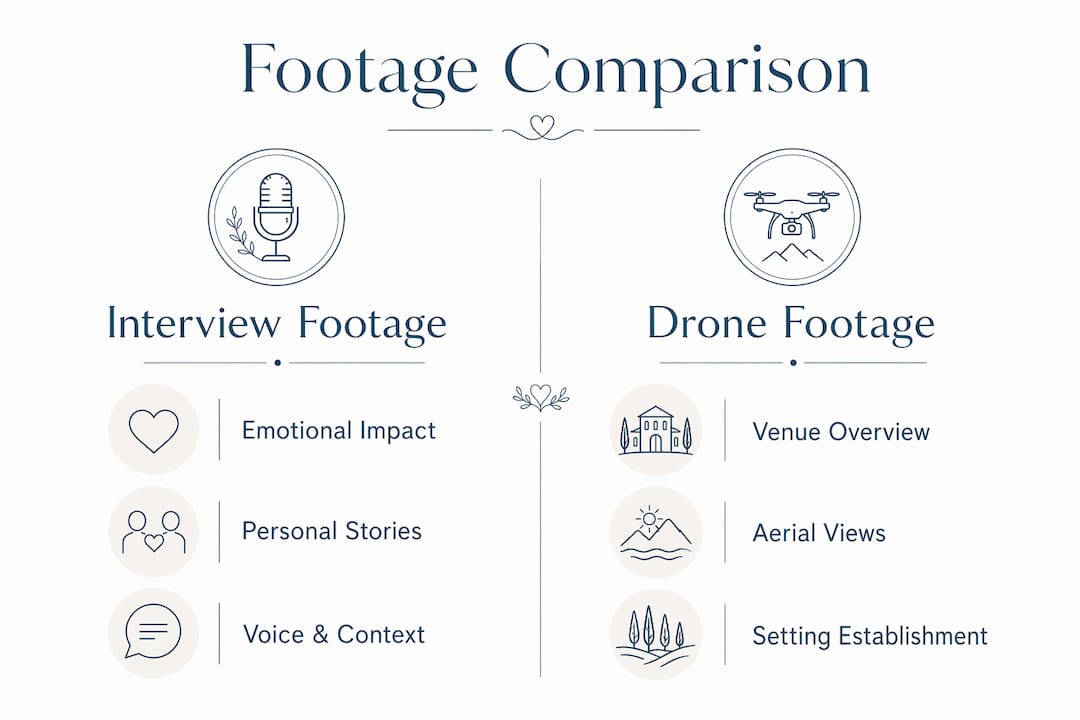
Think of it this way. Drone footage answers “where.” Interview footage answers “why.” Traditional ground-level coverage answers “what happened.” A wedding film that uses all three creates a layered, cinematic experience that holds up for decades.
Footage Type | Primary Role | Emotional Impact | Technical Requirement |
Interview footage | Narrative and voice | High, personal, timeless | Lavalier mic, quiet space |
Drone footage | Venue and scale | Cinematic, atmospheric | FAA license, clear weather |
Traditional coverage | Event documentation | Moderate, event-driven | Multi-camera setup |
Candid footage | Authentic moments | High, spontaneous | Skilled observational eye |
AI video editing tools can now transform long interview recordings into shorter, emotionally resonant clips optimized for different formats. This means your videographer can capture longer conversations on the day and then select the most powerful 20–30 second segments for the final film. You are not limited by the length of the original recording.
The couples who end up with the most memorable films are those who treat interview footage, drone coverage, and candid moments as equal priorities rather than ranking one above the others. Each type of footage serves a different function. Together, they create something that no single approach can achieve alone.
Key takeaways
Interview footage is the single most powerful storytelling tool in a wedding film because it preserves voices, personalities, and emotions that no visual footage can replicate on its own.
Point | Details |
Interview footage defined | On-camera conversations that capture voices and stories beyond what traditional video records. |
Best interview subjects | Include the couple, both sets of parents, close friends, and the officiant for full story coverage. |
Timing is strategic | Morning prep, post-ceremony, and cocktail hour produce the most authentic and emotionally rich responses. |
Videographer alignment | Ask about interview style, prompts, and editing approach before signing any contract. |
Footage types work together | Combine interview clips with drone and candid footage for a layered, cinematic wedding film. |
Why i think most couples underestimate interview footage
I have watched hundreds of wedding films over the years, and the ones that make people cry at their tenth anniversary screening all share the same quality. You hear someone’s voice say something true. Not a scripted toast. Not a rehearsed vow. A real, unguarded sentence from someone who loved the couple and said so in their own words.
Most couples focus their energy on the visual side of their film. They want golden-hour portraits, aerial drone shots of the venue, and slow-motion footage of the first dance. All of that matters. But the couples who tell me their film still gives them chills five years later are almost always describing an interview moment, not a visual one.
The uncomfortable truth about incorporating interviews in wedding films is that they require more planning than most videographers offer by default. You have to ask for them. You have to brief your guests. You have to give your videographer the time and space to make them happen. That coordination is worth every minute of effort.
Treat interview footage as a time capsule. The voices you capture on your wedding day are the voices of people at a specific moment in their lives. Some will change. Some will be gone. The film holds them exactly as they were, and that is something no photograph can do.
— Kellie
Capture your story with Pixelgroves
Pixelgroves brings award-winning storytelling to every wedding film, with a process built around the moments that matter most, including the voices, laughter, and personal stories that make your day yours alone.
[
Every Pixelgroves wedding film is built around your story, not a template. The team works with you before your wedding day to identify the right interview subjects, plan the timing, and craft questions that draw out genuine emotion. Whether you are looking for a full narrative film or a short teaser that leads with your voices, Pixelgroves has a package designed for it. Explore pricing and packages to find the right fit, or browse the wedding portfolio to see interview-driven storytelling in action.
FAQ
What is interview footage in a wedding film?
Interview footage is intentional, on-camera conversation recorded with the couple, family members, or guests during the wedding day. It captures voices, personal stories, and emotional reflections that traditional event coverage cannot preserve.
How does interview footage improve wedding film storytelling?
Interview segments create narrative cohesion by providing voiceover, first-person perspective, and emotional context that connects visual scenes into a complete story rather than a highlight reel.
Who should be interviewed in a wedding film?
The couple, both sets of parents, the officiant, and two or three close friends make the strongest interview subjects. Each person adds a different emotional layer and perspective to the final film.
When is the best time to film wedding interviews?
Morning preparation, the post-ceremony window, and cocktail hour produce the most authentic responses. Guests are relaxed during cocktail hour, and the couple is most emotionally open immediately after the ceremony.
How does interview footage work alongside drone footage?
Drone footage establishes the venue and visual scale of the day, while interview footage delivers personal narrative and emotional depth. The role of drone footage in wedding videos is cinematic context. Interview footage is the story itself. Both together create a complete, layered film.
Recommended
Comments