Client Testimonial Red Flags Every Couple Should Spot
- 2 days ago
- 8 min read

The fastest way to catch a fake wedding photography testimonial is to check three things: whether reviews arrived in an unnatural cluster, whether the reviewer profiles look real, and whether the photographer will hand over a full wedding gallery when you ask. If any of those fail, slow down before you sign anything.
Here’s what tends to expose the fakes:
A wall of five-star reviews posted within days of each other, with no gap in between
Reviewer accounts with no photo, no history, and a name that doesn’t match anywhere else online
Testimonials that praise “amazing photos” and “best day ever” without naming a date, venue, or single specific moment
A portfolio full of polished highlight reels but zero full galleries from real weddings
Glowing reviews on one platform and dead silence everywhere else
Do these two things right now, before you book anyone: ask for a complete gallery from one named wedding, and open three reviewer profiles and check their account age and photo. Ten minutes of checking can save you a deposit.
Key Takeaways
Genuine wedding photography testimonials show specific, event-linked details and consistent activity across platforms, while fake ones cluster in bursts and hide behind thin, generic profiles.
Point | Details |
Watch for review spikes | A sudden burst of five-star reviews in days rather than months usually signals purchased feedback. |
Inspect reviewer profiles | Click reviewer names to check for account history, a real photo, and plausible location. |
Demand full galleries | A complete wedding gallery from a named date and venue reveals consistency a highlight reel can’t. |
Cross-check every platform | Compare review volume on Google, Facebook, and WeddingWire before trusting any single page. |
Choose vendors who welcome scrutiny | Pixel Groves offers full galleries, cross-platform reviews, and references so couples can verify before booking. |
Where to keep checking
Google, Facebook, and WeddingWire — cross-check the same photographer across all three rather than trusting one page alone.
How to evaluate wedding photographer portfolios — a deeper guide to judging full galleries versus highlight reels.
Questions to ask before booking — a longer script for your consultation call.
Pixel Groves — an example of a studio presenting its verification proof upfront.
Table of Contents
How to spot client testimonial red flags in under 10 minutes
Run this list while you’re scrolling a photographer’s site on your phone. Green means keep going, amber means dig deeper, red means stop and ask questions.
Reviewer has a full name and photo — Green if yes. Amber if it’s initials only. Red if it’s a generic username with no avatar.
Account has other reviews besides this one — Green if the profile reviews restaurants, shops, other vendors. Red if this is the account’s only post, ever.
Review mentions a date, venue, or specific detail — Green if it names “our reception at [venue] in October.” Red if it’s just “highly recommend, amazing work!”
Reviews are spread out over time, not clustered — Green if they trickle in across months matching a normal booking calendar. Red if ten appeared in one week.
Photographer will share a full gallery, not just favorites — Green if they offer one immediately. Red if they stall or redirect you to the same 20 highlight images every time.
Same couples show up tagged on Instagram or Facebook — Green if you can find the actual bride and groom tagged in real posts.
Screenshot this and text it to your partner or planner before your next consultation call.
Why these red flags actually matter
Each of these signals points to a specific kind of manipulation, and understanding the mechanism helps you trust your own judgment when something feels off.
Review spikes are the easiest fake to spot once you know to look. A photographer who books six to ten weddings a year should show reviews trickling in roughly around each event, not thirty five star ratings landing over a single weekend. That kind of burst usually indicates purchased or incentivized feedback rather than organic client experiences, and it contradicts the natural rhythm of a wedding business where clients leave reviews weeks or months after their event, not all at once.
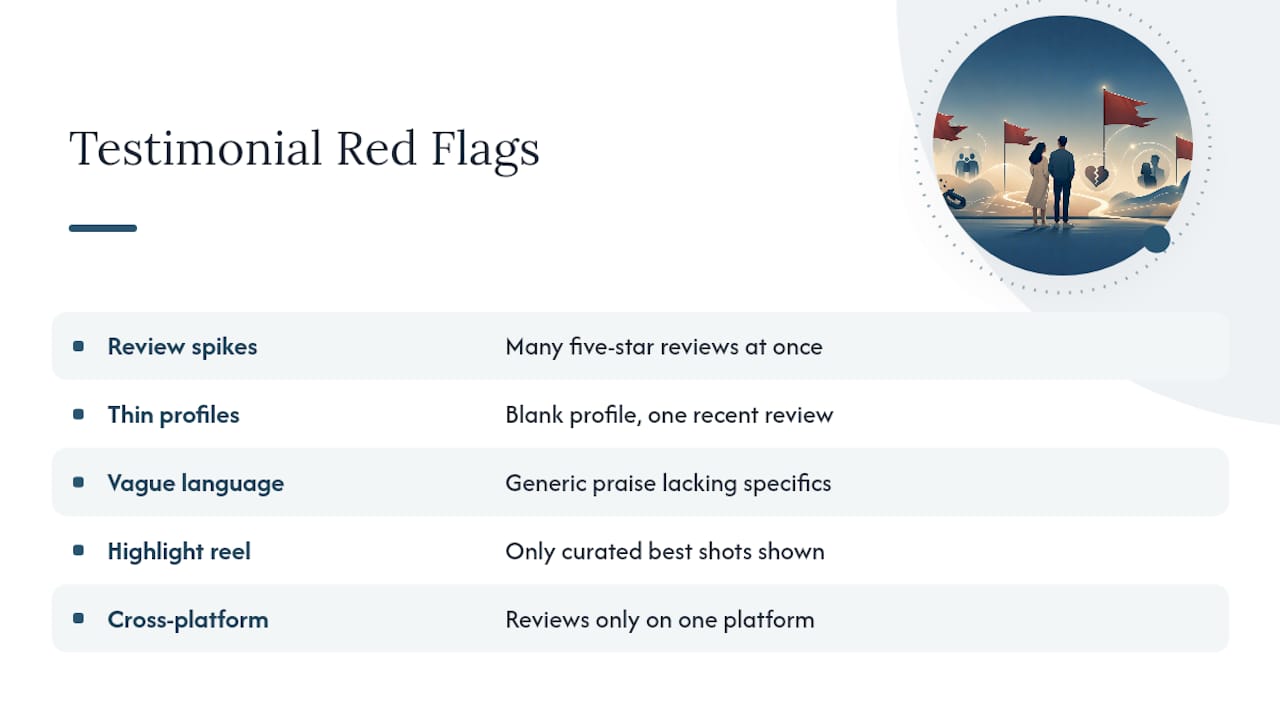
Thin reviewer profiles are the second tell. Click on the reviewer’s name. Real people who write wedding reviews usually have a history: they’ve reviewed a restaurant, a dentist, a hardware store. A blank profile with one single glowing review, created recently, with no photo, is one of the clearest signals of a fake Google review.
Vague, templated language is where a lot of couples get fooled because the words sound nice. “Best decision we made!” feels warm, but it says nothing. Compare that against a review that names the specific bridal suite shot, mentions the officiant ran twenty minutes late and the photographer adapted, or references a first look at a specific beach. Genuine testimonials include names, dates, venues, and specific details that a person writing from memory naturally includes.
Highlight reel only, no full galleries deserves its own warning. A photographer confident in their consistency will show you an entire wedding day, including the average shots between the perfect ones. Refusing to do that, or only ever pointing back to the same curated set, is a pattern worth taking seriously.
Cross-platform mismatches round out the list. A studio with numerous reviews on Google but none on WeddingWire, Facebook, or their venue partner pages should raise an eyebrow. Verification works best when you check multiple signals together rather than trusting a single glowing page.
Pro Tip: If a testimonial makes you feel something specific, like picturing the exact moment described, that’s usually a good sign. Fake reviews rarely earn an emotional reaction because they were never written from a real memory.
Ten to thirty minutes of verification that actually works
Run these checks before you send a deposit anywhere.
Open the reviewer’s full profile history. On Google, click their name and scroll their other reviews. A person who only ever reviewed one wedding photographer, ever, is worth a second look.
Reverse image search the reviewer’s photo. If it appears on a stock photo site or an unrelated Facebook account, that review is not real.
Check timestamps for clustering. Sort reviews by date. A run of ten in one week, with nothing before or after, is the review-spike pattern to distrust.
Search tagged photos on Instagram or Facebook. Look for real couples tagging the photographer in their own wedding posts, not just the studio’s curated feed. Checking who’s tagged in a photographer’s posts gives you a direct line to a past client you can message.
Request a full gallery tied to a named date and venue. Not a highlight reel. A real wedding, start to finish.
Beyond the digital checks, ask for:
A short video call or in-person meeting before booking
Direct contact information for a recent past client
A sample contract you can read before paying anything
Pro Tip: A real photographer usually answers a gallery request within a day or two, without hesitation. Hesitation, deflection, or an offer to “send a few favorites instead” is itself a signal.
What to ask the photographer and their past clients
Copy these scripts and use them as written or adjust the details.
Requesting a full gallery: “Could you send a link to a complete gallery from a recent wedding, similar in size or venue type to ours? I’d love to see the full day, not just the highlights.”
Requesting references: “Would you be able to connect us with two or three couples you photographed in the past year? We’d like to ask a few quick questions before booking.”
Questions to ask a referenced past client by phone or text:
Did the photographer show up on time and stay for the full agreed hours?
How quickly did they respond to messages during planning?
Did the final gallery match what you expected based on your consultation?
Would you book them again?
If a photographer refuses both requests, a fair reply is: “We understand galleries can be personal, but full-day proof and a reference are part of how we’re vetting every vendor. We’ll need that before moving forward.”
What to do if a testimonial looks fake
Document everything before you act. Screenshot the suspicious reviews, note the account names, and save timestamps before a business has a chance to delete or edit them.
Then verify further:
Ask the photographer directly about the reviews you’re questioning and watch how they respond
Request the contract and a reference list before sending any deposit
If they won’t produce either, that alone is grounds to walk away
To report what you find, flag the review on the platform itself (Google, Facebook, or WeddingWire all have reporting tools for suspicious content), and consider a heads up to the venue if the vendor was referred through them.
One vague testimonial alone isn’t a dealbreaker. Multiple strong indicators stacked together, review spikes plus thin profiles plus refusal to share galleries, is your signal to move on.
The checklist matters more than any single review
Couples fixate on star ratings because they’re the easiest thing to scan, but a 4.9 average tells you almost nothing about whether the photographer will show up and deliver. The number is easy to manufacture. A consistent pattern across platforms, over years, tied to real named events, is not.
Where I’d push back on the usual advice: most guides tell you to “read the reviews carefully,” which is passive and doesn’t actually catch anything. Reading isn’t verifying. You have to click through to reviewer profiles, request the gallery, and make the phone call. The couples who get burned are almost always the ones who trusted the testimonial page at face value and skipped the ten minutes of digging that would have shown the gaps.
Prioritize the full gallery request above everything else on this list. A photographer with nothing to hide sends it without friction. That single ask filters out more bad actors than any amount of review reading ever will.
How a real photography studio proves its testimonials are genuine
Reputable wedding vendors don’t just collect five-star reviews and hope you don’t check further. They make verification easy: full wedding galleries available on request, consistent review activity across Google, Facebook, and WeddingWire rather than a pile on just one site, real couples tagged in their own social posts, and a written contract you can review before paying a deposit.
[
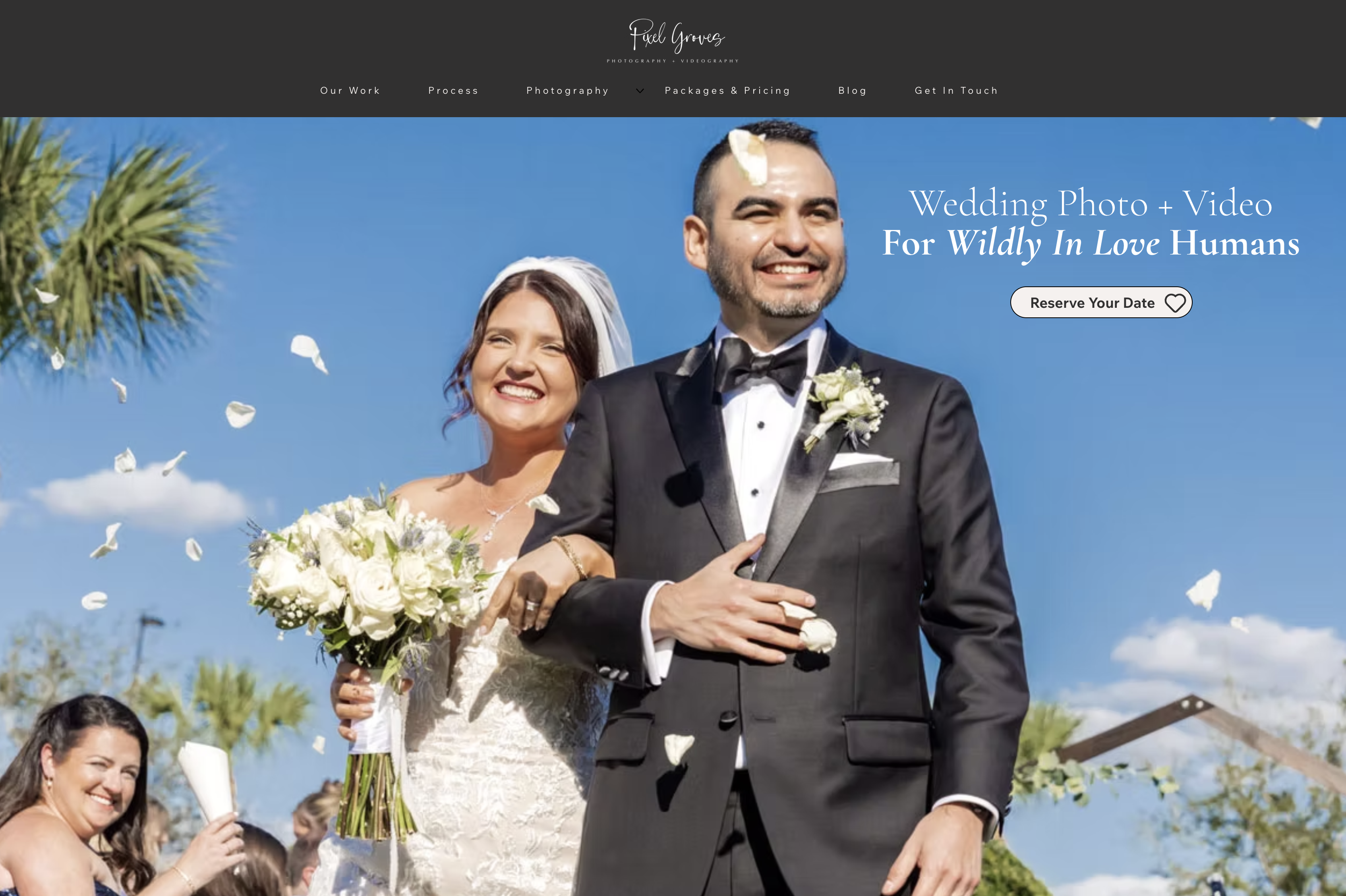
Pixel Groves builds its reputation around exactly those proofs, backed by recognition like the 2026 Best of Florida Wedding Photographer Award and a track record couples can actually confirm. If you want to see what a full, unedited wedding day looks like rather than a curated highlight reel, you can review the available photography and videography styles or check current packages and pricing before reaching out. Ask for a full gallery and a couple of references as part of your booking checklist. If a studio hands both over without hesitation, that’s the kind of transparency worth booking on.
Sources
Fake Google Reviews: How to Detect, Report, and Protect Your Business in 2026
5 tips how to Spot Fake Reviews - Wedding Photographers - Bride Guide - DK Photography
How to Avoid Disaster When Hiring a Wedding Photographer | Fstoppers
How to Avoid Getting Scammed by a Wedding Photographer in an AI World
FAQ
What’s the single biggest client testimonial red flag? A cluster of five-star reviews posted within days of each other, especially from reviewer accounts with no history or photo. That pattern is the strongest sign of purchased or incentivized feedback.
Should I trust a photographer with only highlight reel photos on their site? Be cautious. Ask directly for a full gallery from one real wedding. A studio confident in its consistency will send it without pushback.
How many references should I ask for before booking? A few couples married recently are usually enough to get a clear read on punctuality, communication, and whether the final product matched what was promised.
Is it rude to ask a photographer to verify their reviews? No. A professional vendor expects this kind of question and should welcome it as a normal part of the booking process, not treat it as an insult.
What if the photographer refuses to provide a gallery or references? Treat that as a serious warning sign on its own. Document your request, and consider it grounds to keep looking rather than sending a deposit.
Recommended
Comments