The Role of Photographer During Ceremony Explained
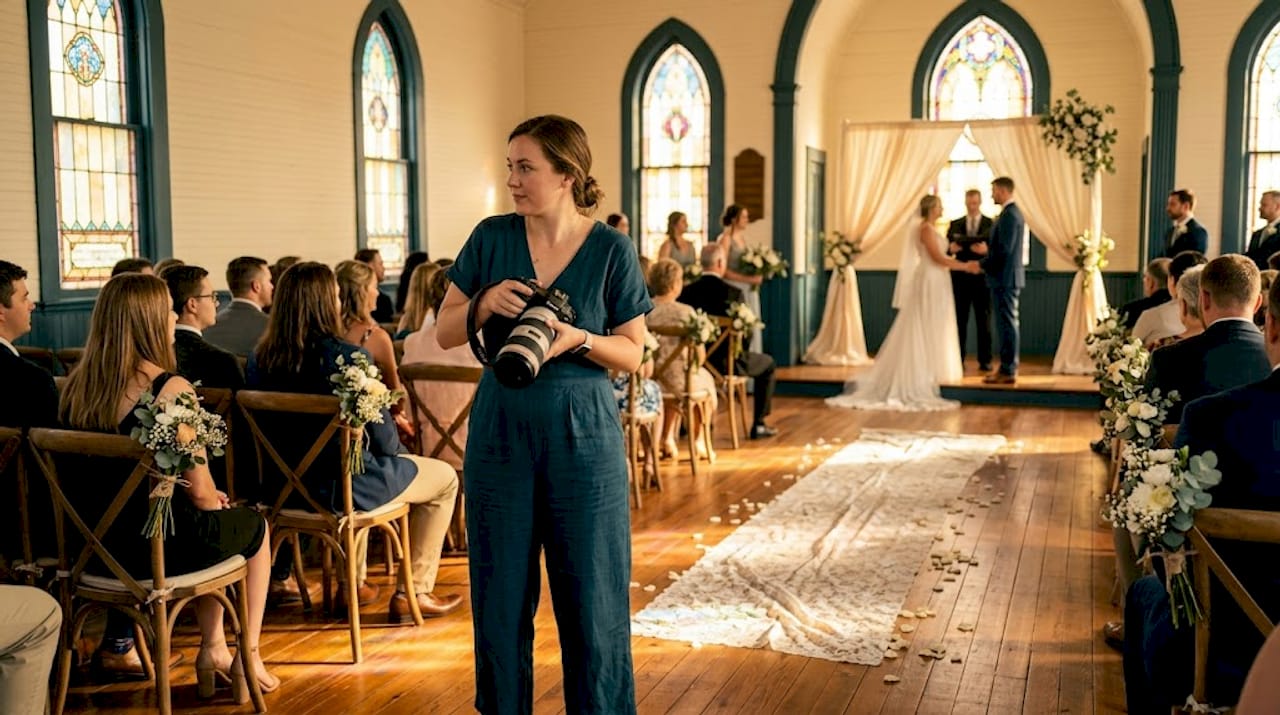
Most couples assume their wedding photographer will simply show up, point a camera at the altar, and press a button a few hundred times. The reality is far more demanding. The role of photographer during ceremony is closer to a live sports broadcaster than a portrait artist. You have one shot at every moment, no retakes, and a ceremony that typically lasts just 20 to 30 minutes. Understanding what your photographer is actually doing during those minutes will help you make smarter hiring decisions and walk away with images that genuinely move you.
Table of Contents
Key takeaways
Point | Details |
Ceremony time is short | Most ceremonies last 20 to 30 minutes, so photographers must plan every move in advance. |
Positioning is choreographed | Photographers rotate through multiple positions to capture the ceremony from different angles without disrupting guests. |
Communication is critical | Briefings with the couple and officiant before the ceremony help photographers anticipate every key moment. |
Backup gear is non-negotiable | Professional photographers carry duplicate equipment because ceremony moments cannot be re-shot. |
Candid moments matter most | The most memorable images often come from emotional reactions, not posed portraits. |
The role of photographer during ceremony: a full breakdown
The moment your photographer arrives at the venue, the job is already in motion. Long before guests take their seats, a professional is walking the space, checking light conditions, identifying obstacles, and confirming the ceremony timeline with your coordinator or officiant.
Here is what that pre-ceremony window looks like in practice:
Timeline review: Your photographer will confirm the order of events, from the processional to the recessional, so there are no surprises.
Officiant briefing: Knowing the officiant’s cues for moments like the first kiss announcement allows the photographer to pre-position rather than scramble.
Gear check: Cameras, lenses, memory cards, and batteries are all tested and ready. A second camera body is loaded and within reach.
Team coordination: If a second shooter is present, the team agrees on who covers which angles and who moves when.
Lighting assessment: Whether you are indoors under chandeliers at a venue like The Omni Resort at Champion’s Gate or outside in Florida afternoon sun, the photographer adjusts settings before the first guest walks down the aisle.
Once the ceremony begins, the photographer shifts into a mode that blends stillness with constant micro-movement. The goal is to be present everywhere without being noticed anywhere.
Pro Tip: Ask your photographer to share the specific moments they plan to prioritize during your ceremony. A photographer who can name five or six key shots before your wedding day has clearly thought through the coverage, and that preparation shows in the final gallery.
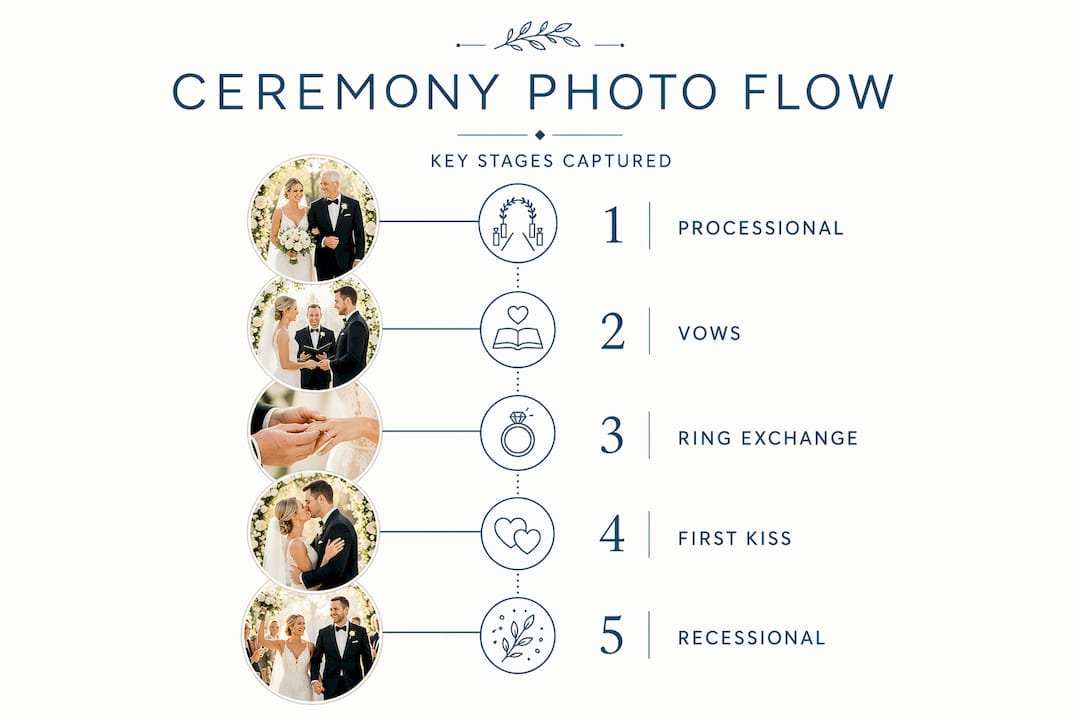
The recessional is often overlooked, but it is one of the richest moments of the entire day. Pure joy, relief, and celebration hit all at once. A skilled photographer is already repositioning before the officiant says “I now present” so they are ready to capture that first burst of emotion as you walk back up the aisle together.
How photographers manage positions and angles
One of the least visible parts of the photographer’s job is the physical choreography happening throughout the ceremony. Photographers rotate through three core positions: center aisle, outside the left seating area, and outside the right seating area. Each position tells a different part of the story.
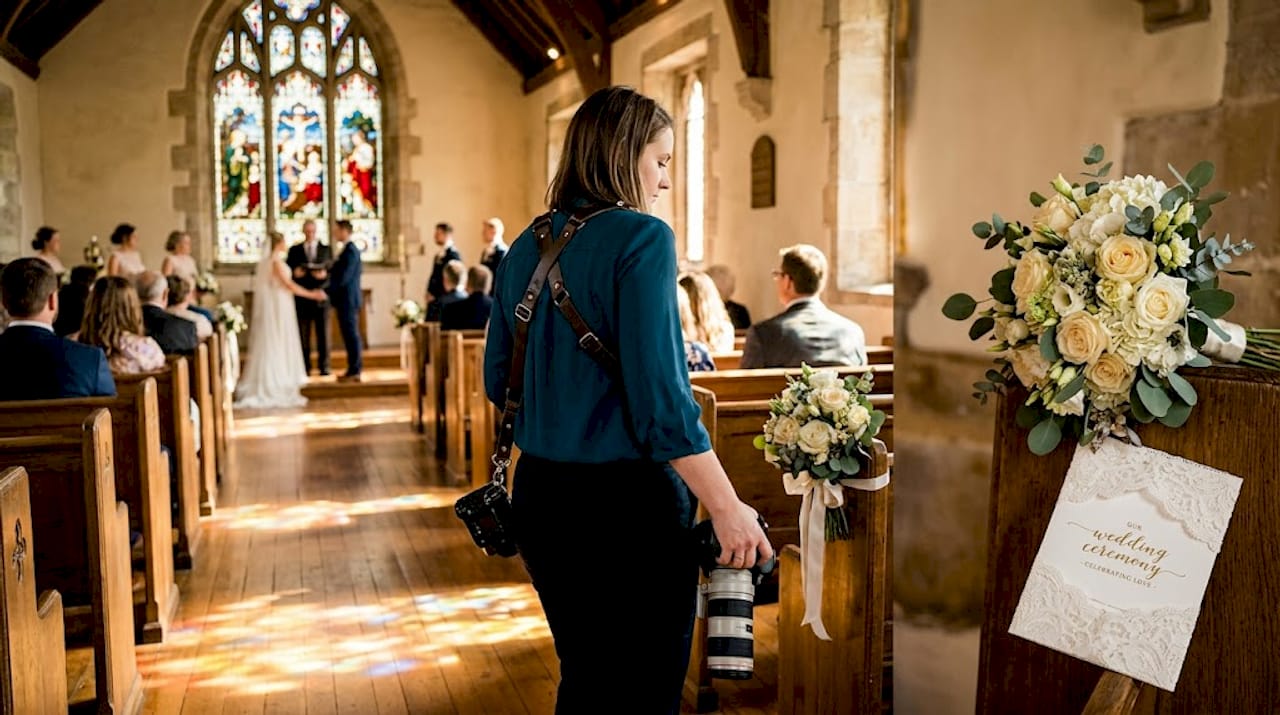
The center aisle gives you the classic processional shot and the direct eye-line view of vows. The left and right positions capture guest reactions, the officiant’s expressions, and profile angles of the couple that feel intimate and cinematic. At Clarisse and Carlos’s wedding at The Omni Resort at Champion’s Gate, the grand ballroom aisle created a natural runway that made center-aisle shots dramatic, while the side positions revealed guests wiping tears and parents squeezing each other’s hands.
Position | Best for | Lens choice |
Center aisle | Processional, vows, first kiss | 24–70mm wide to mid-range |
Left seating area | Guest reactions, profile of couple | 70–200mm telephoto |
Right seating area | Officiant, alternate couple angle | 70–200mm telephoto |
For the first kiss specifically, many photographers use a stacking technique. Lead and second shooters position at the center aisle using different focal lengths simultaneously. One captures the wide environmental shot showing the full altar and guests. The other zooms in tight to catch the raw emotion on both faces. You get the epic and the intimate in a single moment.
Pro Tip: When touring venues, share the floor plan with your photographer ahead of time. Knowing the layout of a space like The Omni Resort at Champion’s Gate allows them to map out their rotation before the wedding day, which means zero wasted movement during the ceremony itself.
Rotating assigned positions among team members also prevents photographers from crossing each other’s shots or accidentally appearing in the background of images. That kind of coordination is invisible to guests, but it is the difference between a gallery that flows and one that feels disjointed.
Challenges photographers face and how they handle them
The ceremony is the highest-pressure window of the entire wedding day. There is no pause button, no second take, and no way to recreate the look on a groom’s face when he sees his partner walk through the doors for the first time.
Here are the most common challenges professional photographers prepare for:
Equipment failure: Camera failure mid-ceremony is a real risk. Professionals carry a fully loaded backup body so a malfunction never costs you a moment.
Unpredictable guests: A well-meaning uncle stepping into the aisle with his phone can block a critical shot. Experienced photographers anticipate this and adjust position in real time.
Changing light: Florida ceremonies often shift from bright afternoon sun to golden-hour warmth within minutes. Photographers adjust exposure continuously without breaking their visual focus.
Ceremony deviations: Sometimes an officiant adds an unplanned reading, or a couple surprises everyone with a song. Photographers who adapt when plans change protect your coverage even when the script goes out the window.
Venue restrictions: Some venues limit where photographers can stand or prohibit flash. A professional researches these rules in advance and builds a plan around them.
The thread connecting all of these challenges is preparation. Ceremony photography is more about anticipation than improvisation. The photographers who deliver exceptional results are the ones who have already solved most problems before they happen.
Capturing emotional and candid moments that matter
The images couples return to most often are rarely the posed ones. They are the groom’s face the moment he sees you. The flower girl forgetting what to do and looking back at her mom. Your grandmother dabbing her eyes in the third row.
Ceremony photography involves capturing emotional reactions that tell a story no posed portrait can replicate. Here is how skilled photographers approach that storytelling:
Watch the groom first. The processional is about you walking down the aisle, but the most powerful image is often the groom’s face at that moment. Photographers position themselves to capture his reaction before turning to follow you.
Scan the crowd during vows. While the couple exchanges words, a second shooter sweeps the guests for unguarded emotional moments. Parents, siblings, and close friends often produce the most genuine reactions of the day.
Stay low and still. Moving during quiet moments draws attention and disrupts the atmosphere. Photographers use longer lenses to stay back and shoot without intruding on intimate exchanges.
Frame with intention. The arch, the altar candles, the stained glass at The Omni Resort at Champion’s Gate chapel. These elements become part of the story when a photographer composes with them in mind rather than shooting straight on.
Shoot through the moment. The first kiss lasts two seconds, but the emotion continues for ten. Photographers keep shooting through the applause, the hug, the laughter that follows, because that sequence tells the full story.
You can explore how creative ceremony framing transforms ordinary moments into images you will want on your wall for decades.
What to ask your ceremony photographer before booking
Knowing what your photographer does during the ceremony is only half the equation. The other half is knowing the right questions to ask before you sign a contract. Here is what couples should cover:
Do you carry backup equipment? Backup gear is mandatory for any professional worth hiring. If the answer is vague, keep looking.
Have you shot at my venue before? Familiarity with a space like The Omni Resort at Champion’s Gate means the photographer already knows the light, the layout, and the restrictions.
Will you have a second shooter? Multi-angle coverage during the ceremony requires at least two people. Ask how they coordinate and who covers what.
How do you handle posed family photos after the ceremony? This transition is often chaotic. A photographer with a clear system keeps it from eating into your portrait time.
What does your contract cover? Your agreement should spell out hours of coverage, deliverables, backup plans, and what happens if the photographer has an emergency. A resource like questions to ask before booking can help you walk into that conversation prepared.
Understanding what to expect from your photographer before the wedding day removes a significant source of stress from your planning process.
My take on what couples get wrong about ceremony photography
I’ve had countless conversations with couples who think the ceremony is the “easy” part of the wedding day for a photographer. It is the hardest part. Every other moment on a wedding day has some flexibility. Portraits can be rescheduled if light fails. Reception shots can be retried. The ceremony gives you one window, and it closes fast.
What I’ve learned from watching experienced photographers work is that the best ones are running a mental script the entire time. They know the officiant’s language, they know which guests are likely to react emotionally, and they have already decided where they will be standing when the first kiss happens. That level of preparation looks effortless from the outside, which is exactly why couples underestimate it.
The uncomfortable truth is that a photographer’s technical skill matters less during the ceremony than their communication and planning. I’ve seen technically gifted photographers miss the groom’s reaction because they were not in position. And I’ve seen photographers with modest gear deliver breathtaking galleries because they spent an hour with the couple and officiant the week before.
Choosing a photographer who treats the ceremony as a live-event production, not a photo session, is the single most important decision you will make for your coverage. Your peace of mind on the day depends on it.
— Kellie
Let Pixelgroves protect every moment of your ceremony

At Pixelgroves, the ceremony is never treated as a backdrop. It is the centerpiece of your entire wedding story, and every position, lens choice, and timing decision is made with that in mind. The Pixelgroves team brings multi-shooter coordination, full backup equipment, and deep experience with Florida venues to every wedding they cover. Recognized with the 2025 Best of Florida Wedding Photographer Award, Pixelgroves has built a reputation for being the team couples trust when the moments that matter most cannot be missed. Browse wedding photography styles to see the range of coverage available, or review pricing and packages to find the right fit for your wedding day.
FAQ
What does a ceremony photographer do before the wedding starts?
Before the ceremony begins, a photographer reviews the timeline with the couple and officiant, checks lighting conditions, tests all equipment, and coordinates positions with any second shooters. This preparation is what separates consistent coverage from missed moments.
How long does a typical wedding ceremony last for photography purposes?
Most wedding ceremonies last 20 to 30 minutes, which means photographers have a very tight window to capture every key moment. Pre-planning and fast decision-making are non-negotiable.
Why do photographers need backup cameras at a wedding ceremony?
Camera failure mid-ceremony can happen to any photographer, and ceremony moments cannot be re-shot. A professional always carries a second camera body loaded and ready to go.
How do photographers capture candid moments without disrupting the ceremony?
Photographers use longer telephoto lenses to shoot from a distance, move only during natural transitions in the ceremony, and stay low to avoid drawing attention. The goal is to be present without being felt.
What is the stacking technique photographers use for the first kiss?
Stacking means two photographers position at the center aisle with different focal lengths at the same time. One captures the wide scene with guests and altar in frame, while the other zooms in for a close emotional shot, giving couples both perspectives from a single moment.
Recommended
Comments