6 Shot Ideas That Nail Surprise Proposal Photos for Couples
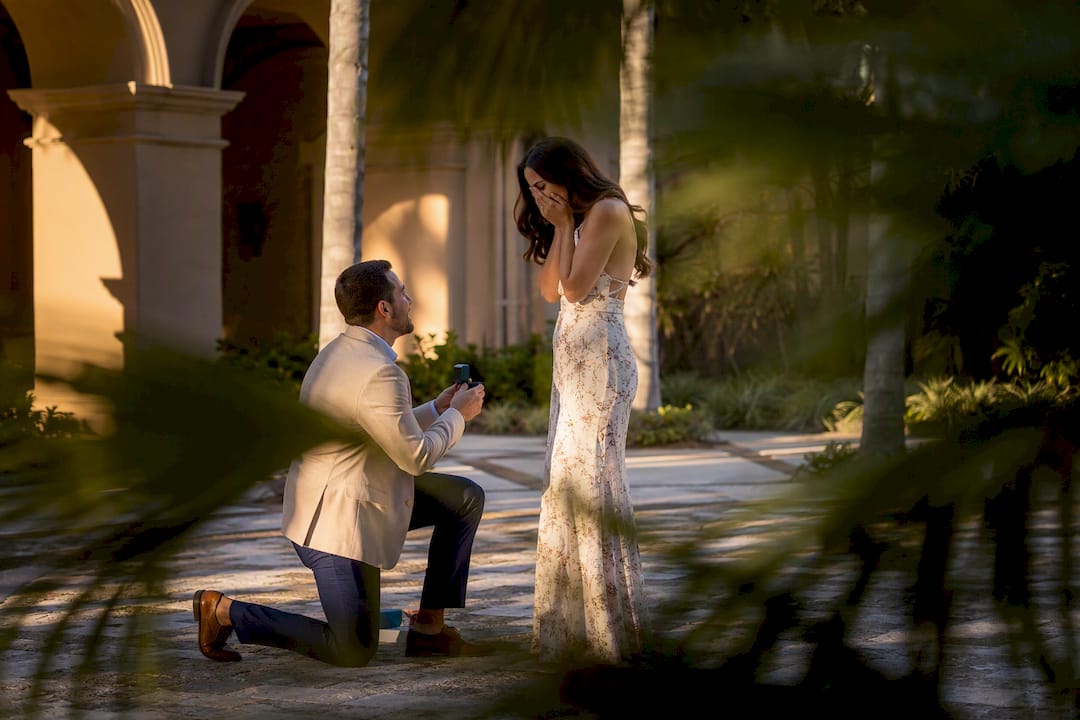
Proposal photography means hiring a photographer to capture the exact moment someone says yes, shot candidly and in secret rather than posed. If the reaction matters to you as much as the ring does, hire a specialist rather than relying on a friend’s phone. Pixel Groves has built its proposal work around exactly this: staying hidden until the question is asked, then documenting what happens next.
TL;DR:
Proposal photography requires discreet, expert planning to avoid spooking the couple and capture genuine reactions without staged elements.
Effective proposal photos focus on specific emotional shots such as wide scenic reveals, close-up reactions, and ring details, often during golden hour or in low light.
Scout locations thoroughly beforehand and establish clear communication cues to ensure perfect timing and positioning during the actual proposal.
Choose a photographer with a dedicated proposal portfolio who understands how to remain hidden and capture unrepeatable moments without relying on elaborate setups.
The best images come from minimal intervention, emphasizing natural emotion over complicated choreography or high-tech tricks.
Table of Contents
Surprise Proposal Photos vs. Engagement Photos: Which Do You Need?
These two services get lumped together constantly, but they solve different problems. Proposal photography captures the moment of the question itself, hidden and candid, focused on raw reactions rather than composed frames. Engagement photography is the opposite: planned in advance, posed, and shot with both partners fully aware of the camera.
Most couples end up wanting both, just in a different order than they expect.
Proposal shoot: secret, candid, a short period of actual coverage around the moment itself
Post-proposal mini-session: a brief period immediately after, once the surprise is over and adrenaline is still high
Engagement session: booked weeks later, fully planned outfits and locations, typically a longer session
Photographers who specialize in proposals typically fold that second item into the package, offering helpful bridesmaid accessory ideas to coordinate the visual details for a polished proposal party. It makes sense: you have two people dressed nicely, standing in a beautiful spot, glowing from what just happened. Skipping it wastes some of the best natural expressions you might get. A checklist for preparing an engagement session still applies loosely here, minus the part where anyone knows it’s coming.
Shot Ideas That Actually Photograph Well
Not every proposal setting produces a strong photo, even when the moment itself is perfect. Certain frames come up again and again in the strongest proposal galleries because they work with how emotion and light actually behave in the field.
The wide scenic reveal. A shot that pulls back to show the couple small against a beach, skyline, or overlook gives the moment context and scale. It’s usually the cover image of the gallery.
The close-up reaction. Faces mid-gasp, hands over mouths, tears. This is the frame people share first, and it depends entirely on the photographer being close enough without being noticed.
The ring detail shot. A tight frame on the ring, hands, or the box itself, often captured seconds after the yes while everyone is still catching their breath.
The hidden family reveal. Friends or family stepping out from a car, behind a tree, or around a corner adds a second wave of emotion the still photo can freeze.
Golden-hour silhouettes. Late afternoon light turns a simple kneel into a dramatic outline. It’s forgiving of imperfect angles and flattering for every body type.
Low-light and fireworks moments. Night proposals need a photographer comfortable pushing ISO and using available light instead of a flash, since flash usually kills the surprise.
Each of these works because it isolates one emotional beat instead of trying to capture everything at once.
How to Plan a Surprise Proposal Without Blowing the Secret
Good planning is almost entirely logistics, not romance. Start with the location. Scout it in person, ideally at the same time of day you plan to propose, so you know where the light falls and how many strangers are usually around. Photographers preparing for a shoot do the same scouting days ahead, checking sun position, crowd patterns, and hiding spots for themselves.
Cover stories matter more than people expect. A convincing reason for the outing (a “just because” hike, a friend’s birthday photo session) keeps your partner relaxed instead of suspicious. Small decoy actions work too. Pretending to ask a stranger for a photo is one of the oldest tricks, and it still works because it gives the photographer a natural reason to be pointing a camera at you.
Tell as few people as possible; every extra person is a leak risk
Confirm ring sizing well ahead, not the night before
Keep the ring in a jacket pocket, never a bag your partner might open
Build a simple backup plan for rain or an unexpected crowd
Pro Tip: Pick a nearby rain plan location close to your main spot. Switching plans entirely on the fly is where most surprises fall apart.
Hiring a Proposal Photographer: Questions, Red Flags, and Pricing
Ask any photographer you’re considering how many proposals they’ve shot, not just weddings. Proposal work has its own rhythm: long stretches of waiting, then seconds that can’t be redone. A dedicated proposal portfolio is the clearest proof they’ve handled the pressure before.
Questions worth asking directly:
How do you stay hidden until the moment happens?
Can I see full galleries from past proposal shoots, not just highlight reels?
What’s your turnaround time for edited images?
Do you include a short portrait session right after?
Red flags are usually easy to spot once you know what to look for: no proposal-specific examples, vague answers about positioning, or a price so low it suggests one quick drive-by shoot rather than real coverage. Package pricing generally reflects time on location, number of edited images, travel distance, and whether prints or albums are included. A photographer with proposal-specific experience tends to charge more than a general portrait shooter, and it’s usually worth it. Preparation and instinct matter more here than heavy editing after the fact.
Day-of Checklist: The Cues That Get the Decisive Shot
Timing is everything on the day itself. The photographer should arrive at least 30 minutes early to confirm the exact spot and lighting. Phones go on silent. Both proposer and photographer should agree on a landmark, not just a vague area, so there’s no confusion in the moment.
Proposer arrives at the agreed spot 5 to 10 minutes before the partner
Photographer confirms sightline and hides at a distance that keeps the whole scene in frame
Proposer uses a subtle prearranged cue (a hand signal, a specific phrase) to tell the photographer “now”
Kneel at an angle that faces the camera, not away from it
After the yes, hold the embrace a few extra seconds before checking the ring, since photographers need that beat
Move into a short 15 to 20 minute portrait set once everyone’s caught their breath
Photographers who direct a few simple poses right after the yes get noticeably more usable images without breaking the mood.
Why Trust Pixel Groves With Your Proposal
Pixel Groves built its proposal process around one idea: preparation beats improvisation. Every shoot starts with scouting the exact location for light and crowd patterns, then a hide-in-plain-sight setup so the couple never spots the camera until it’s over. A short portrait session follows immediately, while the emotion is still fresh.
Kellie leads this work as a photographer and storyteller with years of experience specializing in candid, story-driven wedding and proposal coverage. That focus helped earn Pixel Groves the 2025 Best of Florida Wedding Photographer Award, alongside a track record of client testimonials praising how little couples noticed the camera until the moment itself.
A proposal only happens once. The job isn’t to make it look staged. It’s to disappear completely until the second it matters, then make sure nothing about that second gets lost.
Camera Gear and Settings for Candid Proposal Moments
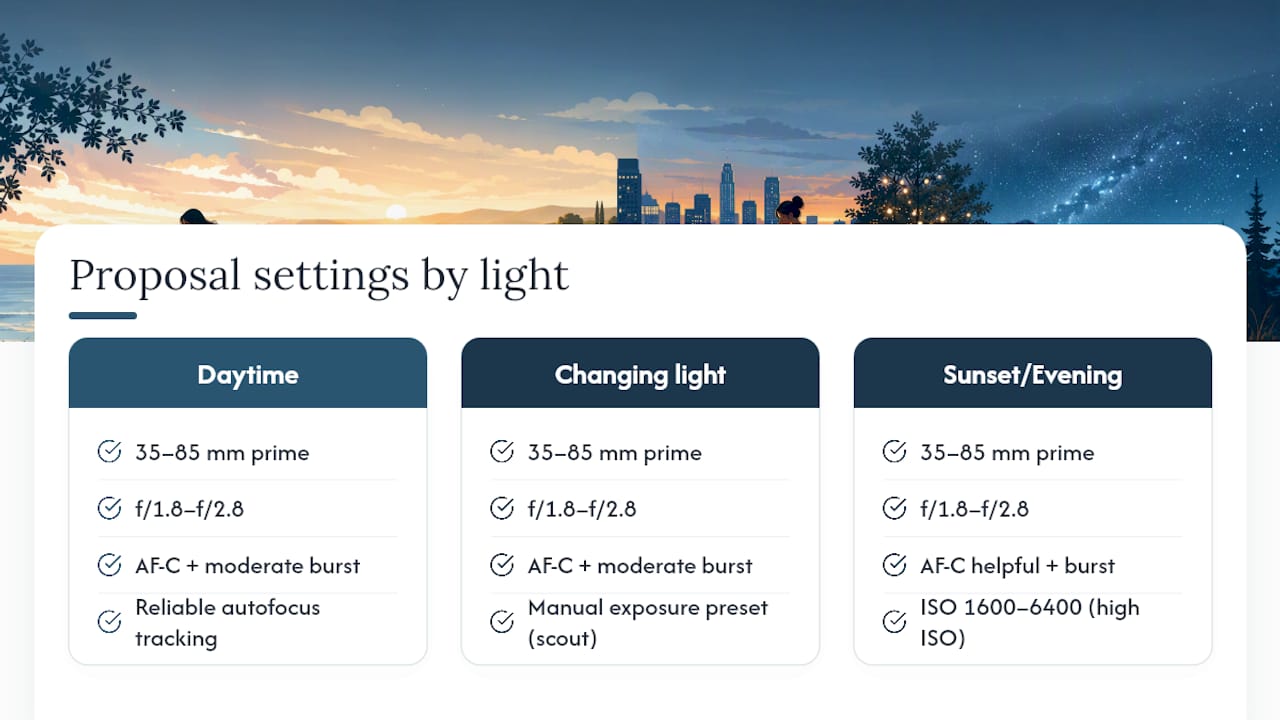
Lighting conditions change fast during a proposal, so gear choices matter more than they would in a controlled studio session. A fast prime lens, something in the 35mm to 85mm range with a wide aperture around f/1.8 to f/2.8, lets a photographer stay far enough away to remain unnoticed while still isolating faces sharply from the background.
For daytime outdoor proposals, a camera with reliable autofocus tracking is the priority. People move unpredictably in the seconds before and after a kneel, and a photographer can’t ask for a retake. Continuous autofocus modes (AF-C on most systems) paired with a moderate burst rate catch the exact instant of reaction instead of the half-second before or after.
Low light changes the math entirely. Sunset and evening proposals call for a camera body that handles higher ISO settings without heavy noise, often ISO 1600 to 6400 depending on the sensor. Flash is usually off the table since it announces the camera’s presence and kills the surprise, so photographers lean on wide apertures and available light instead, sometimes bracing against a rail or tripod point instead of using it as a full setup. Manual exposure, dialed in ahead of time during scouting, saves precious seconds compared to relying on auto modes once the moment starts.
The Part Most Proposal Guides Get Wrong
Most advice on this topic treats the proposal like a performance to be staged. It isn’t. The best proposal galleries come from photographers who plan obsessively and then get out of the way completely, letting an unscripted moment happen in front of a camera that might as well not exist.
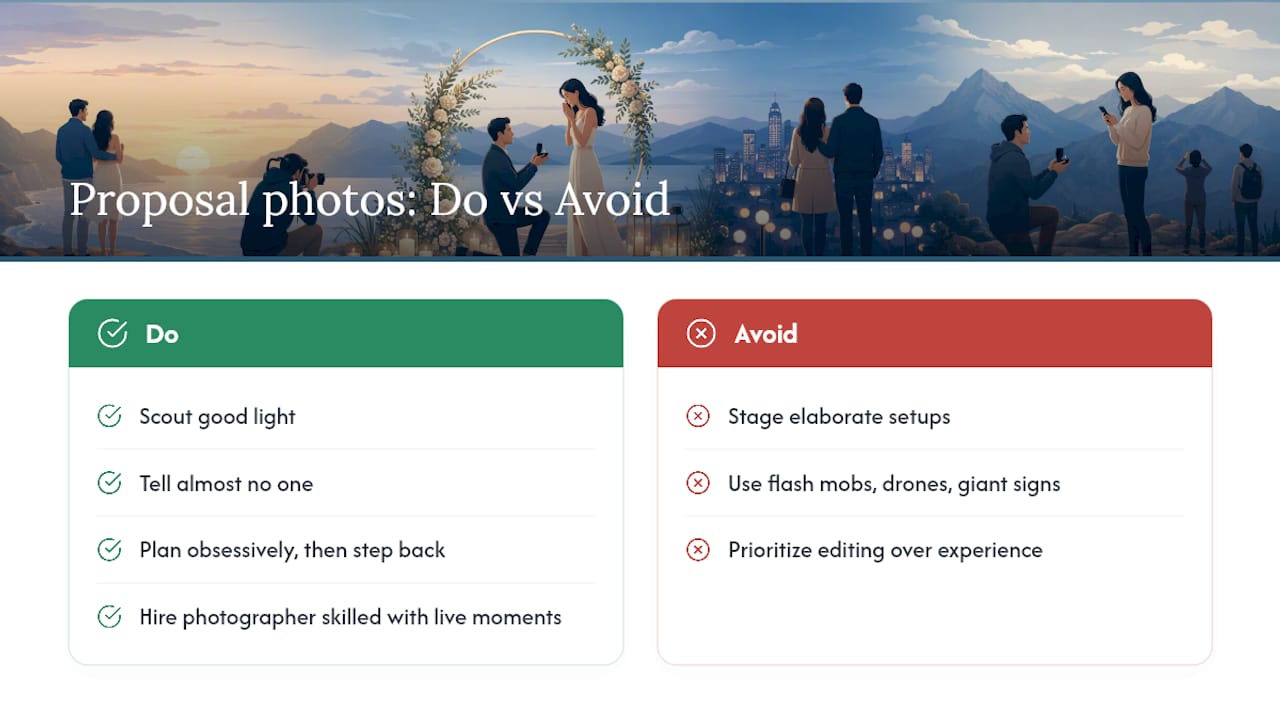
Where conventional advice falls short is in overselling elaborate setups: flash mobs, drone reveals, giant signs. Those add more failure points, not more emotion. The couples with the strongest galleries usually did the simplest thing well: scouted good light, told almost no one, and trusted a photographer who knew where to stand.
If you take one thing from this, prioritize the photographer’s experience with live, unrepeatable moments over their editing style. Anyone can make a photo look pretty in post. Far fewer people can stay invisible for twenty minutes and still nail the framing when it counts. That’s a completely different skill, and it’s the one that actually determines whether you get the shot at all.
— Kellie
Book Pixel Groves for Your Proposal
Pixel Groves plans and shoots proposals the same way it shoots weddings: full scouting, a discreet setup, and coverage that doesn’t stop the second the ring comes out. Once you book, expect an initial consultation to walk through your location and cover story, a scouting visit if the spot needs it, day-of coordination so you’re not left guessing where to stand, and a delivered gallery that includes both the hidden reveal shots and the portraits taken right after.
[
Every proposal is different, so pricing depends on location, travel, and how many edited images and prints you want included. You can review wedding photography styles to see how Pixel Groves approaches candid versus posed work, then check pricing and packages for proposal-specific options. If you’re still deciding on outfits or want visual inspiration before the day itself, three outfit formulas worth copying can help both of you photograph well without overthinking it. When you’re ready, reach out to schedule a discovery call and lock in a date before your ideal light and location window closes.
Sources
Recommended
Comments