Photo Booth Backdrops: What to Buy or Rent in 2026
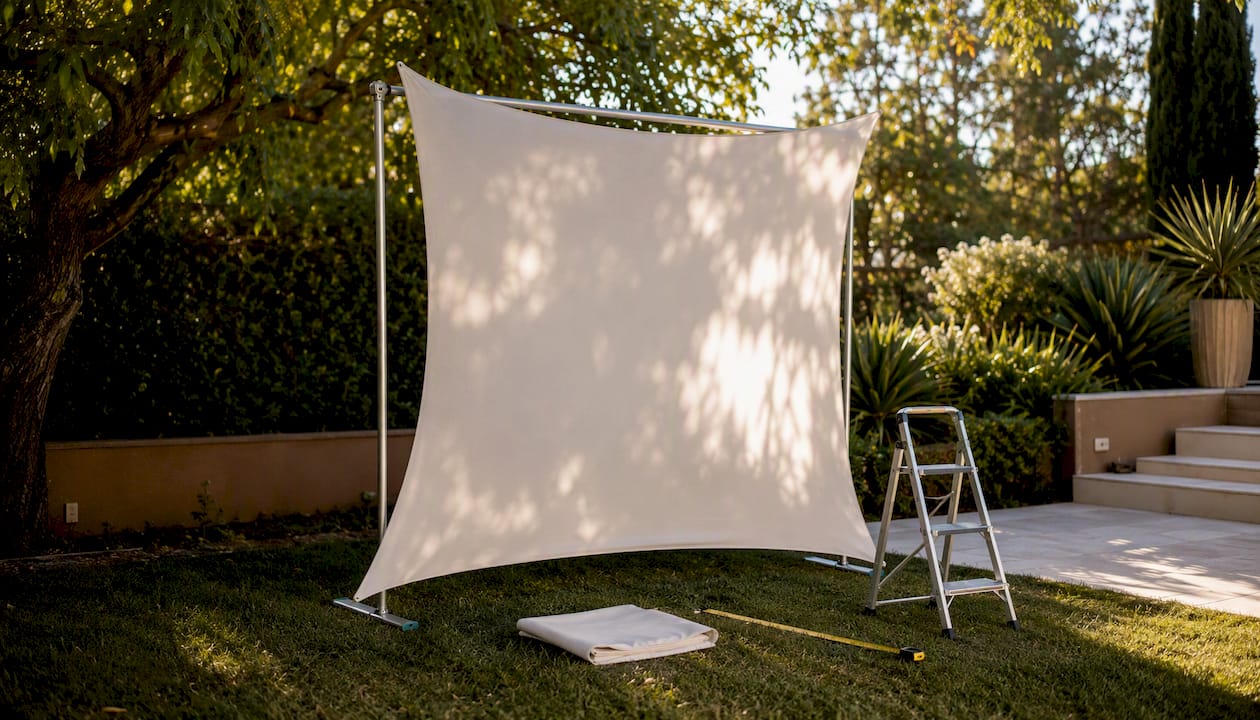
For most events, rent a professionally printed tension-fabric or faux-floral photo booth backdrop rather than buying one outright. The cost is lower, setup is handled, and you avoid storing a bulky frame between events. Before you book anything, confirm your booth type (open-air, 360, or mirror), measure the venue spot (width x depth), and check the lighting at reception time. Placement and lighting often matter more than the backdrop itself, so scout the room before you commit to a style.
If you do need to buy, tension-fabric pillow-cover systems are the most practical starting point. They ship flat, assemble in minutes, and print vividly without the wrinkle problems that plague loose draped fabrics.
Key Takeaways
Renting a professionally printed tension-fabric or faux-floral backdrop beats buying for most single events, but the backdrop’s placement and lighting matter more than the style you choose.
Point | Details |
Rent vs. buy | Rent for single events; buy only when you need the backdrop more than three or four times a year. |
Sizing rule | An 8x8 backdrop covers most open-air booth setups; go 10x10 for groups of six or more. |
Material choice | Matte tension fabric is the safest all-around pick — no glare, wrinkle-resistant, and vivid under any lighting. |
Vendor red flags | No written damage policy, no mockup proof, and pricing that changes after the initial quote are all reasons to walk away. |
Pixelgroves rental | Pixelgroves offers done-for-you photo booth rentals in Florida, including backdrop, lighting, attendant, and setup. |
Table of Contents
What type of photo booth backdrop works best for your event?
The right backdrop depends on your booth type, venue lighting, and how formal the event is. Here is a quick breakdown of the main categories.
Tension fabric / pillow-cover: Fits over a frame like a pillowcase. Wrinkle-resistant, vivid, and fast to assemble, these work well under flash and daylight alike. Best all-around choice for open-air booths.
Vinyl / printed step-and-repeat: Durable and sharp for logos and branded patterns. Glossy vinyl can create hot spots under direct flash, so matte laminate is worth the small upcharge for photography.
Sequin / shimmer curtains: Dramatic under evening lighting and phone cameras. Avoid them with 360 booths or mirror booths — the reflective surface creates lens flare and overexposed streaks.
Faux flower / greenery walls: Among the most requested wedding backdrops, they photograph consistently across devices. Premium to rent, but the visual payoff at cocktail hour is hard to match.
Balloon walls: High-impact for parties and sweet-16 events. Bulky to transport and not reusable, so rental or a florist build is the practical route.
Fringe / tinsel curtains: Inexpensive and festive. They move in air conditioning, which can blur photos, so position them away from vents.
Textured panels (velvet, plaster-look): Sophisticated and matte, which means zero glare. Heavier to ship but excellent for editorial-style corporate events.
AI / digital backgrounds: A genuine breakout in 2026. Many operators now report that AI background removal is reliable enough to skip a physical backdrop entirely, cutting setup time and freeing up venue space. Works best when booth software supports it and venue lighting is consistent.
Pro Tip: For 360 booths and mirror booths, stick to matte tension fabric or solid-color panels. Sequins, tinsel, and anything reflective will bounce light back into the lens and ruin the shot.
How to size your backdrop for solo shots, couples, and groups
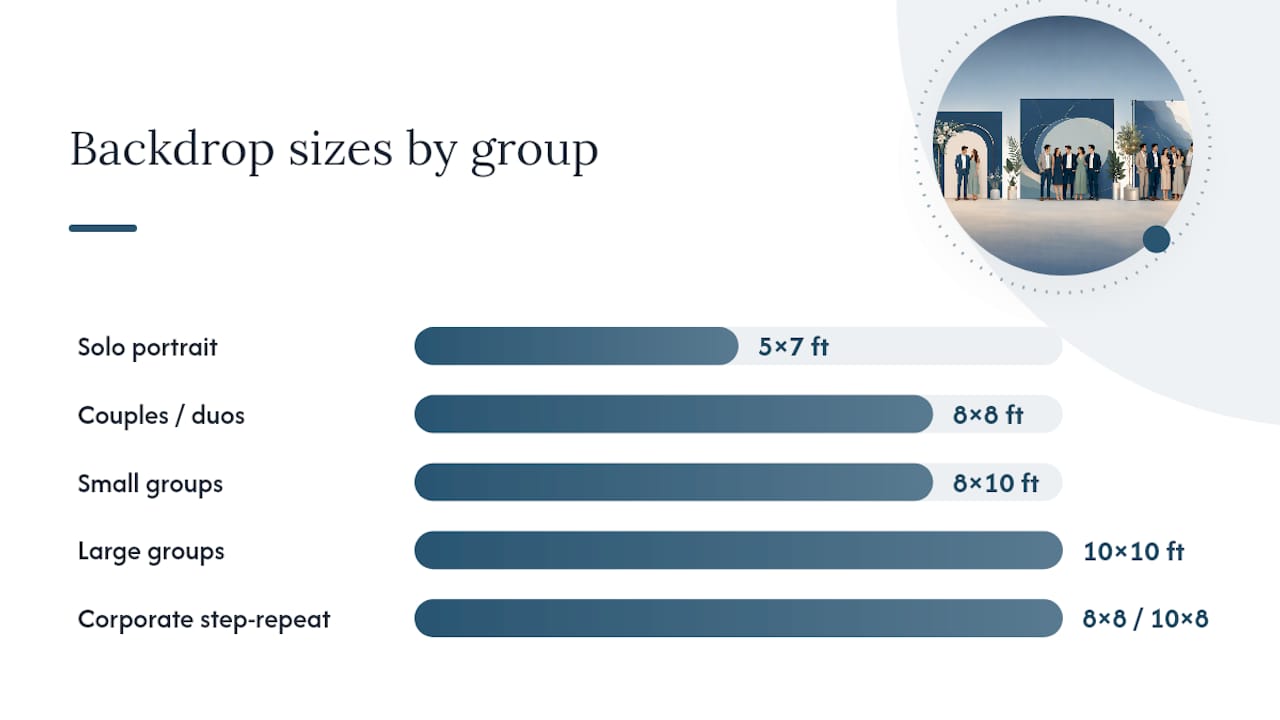
An 8x8 backdrop is the standard all-purpose size for open-air booths, covering solo portraits through groups of four comfortably. Go wider for larger groups or 360 rigs.
Setup | Recommended size | Who it fits |
Solo portrait | 5x7 ft | One person, tight crop |
Couples / duos | 8x8 ft | Two people with props |
Small groups | 8x10 ft | 3–5 people |
Large groups / 360 rig | 10x10 ft | 6+ people or wide-angle rigs |
Corporate step-and-repeat | 8x8 or 10x8 ft | Branded events, press lines |
Beyond the backdrop itself, budget for depth. A camera on a standard tripod needs roughly 6–8 feet of clearance from the backdrop to frame a group shot without distortion. Add another 2–3 feet if you are using a ring light or prop table. A 10x10 backdrop in a 12-foot-deep alcove leaves almost no room for guests to move, which kills the fun fast.
For step-and-repeat banners at corporate events, the standard is an 8-foot height so logos stay visible behind tall guests. Width scales with the number of logos you need to repeat — most vendors recommend at least three full logo repetitions across the face.
Which materials actually photograph well?
Material choice shapes every photo taken in front of your backdrop, so it is worth thinking through before you order.
Tension fabric (pillow-cover polyester): Matte finish, no glare, prints in full color. The go-to for rental fleets because it folds small and resists wrinkles.
Vinyl: Sharp detail and high contrast for logos. Glossy vinyl reflects flash; matte vinyl does not. Always specify matte for photography use.
Sequins: Sparkle beautifully under warm ambient light and phone cameras. Under direct flash, they overexpose. Best used at candlelit receptions, not bright cocktail hours.
Faux florals: Dimensional and photogenic from any angle. Heavier than fabric, so the frame needs to be rated for the weight. Dust them between events or petals look flat in photos.
Wood / panel systems: Zero light absorption issues. Heavy and expensive to ship, but nearly indestructible for permanent or semi-permanent installations.
Mirrored / reflective surfaces: Avoid as a primary backdrop. They reflect the camera, the guests, and every light in the room back into the shot.
For storage, tension fabric folds into a carry bag and stays wrinkle-free. Vinyl rolls onto a tube and needs a hard case to avoid cracking. Faux florals need a rigid box or they arrive crushed.
Backdrop frames, stands, and what setup actually looks like
Most professional backdrop systems fall into a few categories, and the one you choose affects how long setup takes and how much you need to carry.
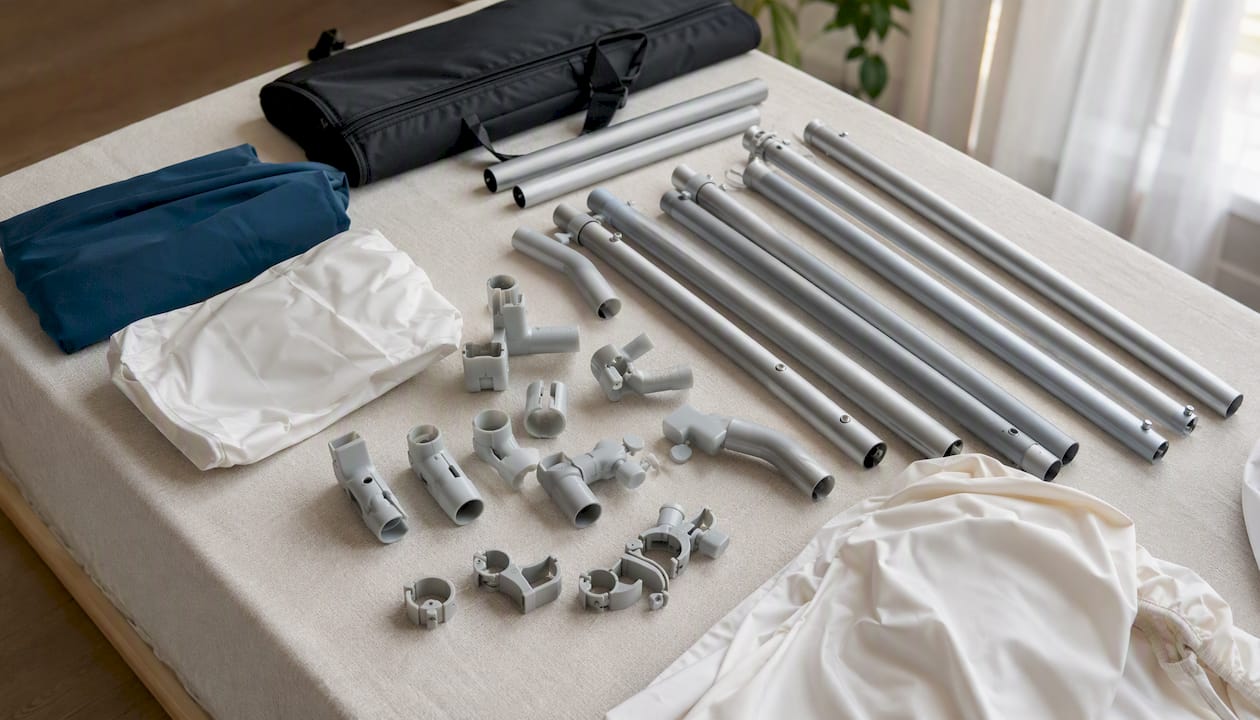
Pillow-tension frames are the fastest. Slide the fabric over the frame like a pillowcase, lock the corners, and you are done in under 10 minutes. Pop-up frames fold accordion-style and open in seconds, though they are less stable in outdoor settings. Pole-pocket frames thread the fabric onto horizontal poles and are common for budget rentals, but they require more adjustment to hang evenly. Modular 3-panel systems and free-standing walls are the heaviest option, built for flower walls and hard panels that need structural support.
For transport, pillow-tension systems typically ship in a carry bag under 15 pounds. Flower walls and modular panels often require a cargo van or SUV. Confirm vehicle requirements with your vendor before the event day.
Most vendors supply sandbags and clamps as part of a rental. If you are buying a frame, purchase sandbags separately. A frame without ballast is a liability, especially near a dance floor.
Pro Tip: For any outdoor setup, stake or sandbag every leg and add a crossbar brace if wind is possible. A 10x10 fabric backdrop acts like a sail in a 15 mph breeze. If the venue is exposed, a weighted hard-panel system is safer than fabric on a stand.
What customization options are worth ordering?
Custom printing is where most planners either get exactly what they want or waste money on a proof they did not review carefully enough.
Full-bleed prints: The image covers the entire fabric face with no border. Requires a high-resolution file (at least 150 dpi at print size) and a color profile of sRGB or CMYK depending on the vendor’s press.
Step-and-repeat logos: Repeat a logo or pattern across the face in a diagonal or grid layout. Standard for corporate events and sponsor walls.
Double-sided prints: Two different designs on one backdrop, useful for events with a ceremony and a reception in the same space. Custom and double-sided printing adds days or weeks to production versus stock backdrops, so order early.
Custom shapes: Arched tops, circular cutouts, and irregular silhouettes are possible with hard panels or shaped frames. Lead time is longer and cost is higher.
Neon / LED additions: Mounted neon signs or LED strips integrated into the backdrop frame add drama. Confirm power access at the venue before ordering.
Before approving any print, request a soft mockup at actual scale and check the bleed area (typically 1–2 inches beyond the visible edge). Colors on screen read differently than on fabric, so ask whether the vendor offers a physical color proof for high-stakes events. Turnaround for stock backdrops is typically 3–5 business days; custom art runs 7–14 days, and rush fees apply when you compress that window.
Rent vs. buy: realistic price ranges and lead times
The math usually favors renting for one-night events and buying only when you need the backdrop more than three or four times a year.
Turnkey rental packages typically include backdrop choice, lighting, an attendant, and setup and tear-down, which removes the logistics burden entirely. Confirm in writing what is included: delivery radius, setup time, attendant hours, and what happens if a panel is damaged.
Buying makes sense when you run events regularly, need a permanent installation, or want a branded backdrop that will appear at dozens of activations. For a single wedding or party, the rental math is almost always better.
How to choose the right backdrop and vendor
Work through this checklist before you sign anything.
Confirm specs in writing. Get the exact size, material, finish, and weight of the backdrop you are renting or buying. Vague listings (“large fabric backdrop”) are a red flag.
Request a mockup proof. For any custom print, ask for a scaled digital proof before production starts. Check logo placement, bleed, and color.
Verify delivery and setup details. Confirm the delivery window, who sets up, and how long setup takes. A vendor who cannot give you a setup time estimate has not done enough events.
Ask about the damage policy. What counts as damage? What is the fee? Is there a security deposit? Get it in writing.
Review event photos, not just product shots. Ask for photos of the backdrop in use at a real event. A well-placed simple backdrop outperforms an elaborate one in a dark corner, so look at how the vendor stages their setups.
Check references or reviews. One or two recent reviews from similar events (wedding, corporate, party) tell you more than a portfolio page.
Scout the venue at reception time. Visit the venue when the event lighting will actually be on. A backdrop that looks great under overhead fluorescents can disappear under warm amber uplighting.
Red flags to stop a booking: no physical address or portfolio, no written damage policy, inability to provide a mockup, and pricing that changes after the initial quote.
Pro Tip: Ask the vendor to send you a phone photo of the backdrop under the same lighting conditions as your event. It takes them five minutes and tells you immediately whether the colors and texture will hold up.
Backdrop bundles and starter kits worth knowing about
If you are buying rather than renting, starter kits from marketplace retailers and specialty suppliers bundle a frame, fabric panel, and carry bag into a single purchase. Amazon listings for photo booth backdrops surface sequin curtains, vinyl panels, and tension stands in standard sizes, typically in the $50–$150 range for entry-level kits.
Specialty suppliers offer multi-backdrop bundles that include two or three interchangeable fabric panels on one frame, which is useful for planners who run multiple events with different themes. Some vendors sell a base frame separately and let you add panels over time, which keeps the upfront cost lower.
For DIY builds, wall decor tutorials can help you adapt panel and frame techniques to a custom backdrop build at a fraction of the rental cost. The trade-off is time and the risk of a finish that does not hold up under photography lighting.
The part most planners get wrong about backdrops
The conventional advice is to pick a backdrop that photographs well. That is not wrong, but it misses the bigger variable: where you put it and when guests actually use it.
A flower wall in a hallway corner will sit empty all night while guests crowd the dance floor. A simple tension-fabric panel next to the bar, lit with two warm uplights, will generate a hundred photos before dinner is over. The backdrop is almost secondary to the traffic pattern.
The second thing planners underestimate is the gap between a vendor’s product photo and what shows up on event night. A sequin backdrop photographed in a studio with a professional strobe looks completely different under a venue’s amber wash lighting. Always ask for real event photos, not catalog shots, and match the backdrop finish to the venue’s actual light source.
The third mistake is over-customizing too early. Order a stock backdrop for your first event with a new vendor. Once you have seen how they handle delivery, setup, and communication, then invest in a custom print. Discovering a vendor’s communication problems after you have paid for a custom double-sided print is an expensive lesson.
Pixelgroves photo booth rentals: done-for-you backdrop and booth service
Pixelgroves delivers a complete, event-ready photo booth experience for Florida weddings and events, so you skip the vendor-vetting checklist entirely. Every rental includes backdrop selection, professional lighting, on-site attendant, delivery, and tear-down. For custom prints, Pixelgroves walks you through a proof-approval process before anything goes to production.
[
What sets Pixelgroves apart is the combination of award-winning photography expertise and booth staging knowledge. The team behind the 2025 Best of Florida Wedding Photographer Award understands how light, placement, and backdrop texture interact in real venues, not just in a showroom. You get a backdrop that actually performs on the night, not one that looked good in a catalog.
Check pricing and packages or browse the full photobooth rental service to see what is available for your event date.
Sources
Recommended
Comments