Build Your Wedding Photography Shot List: A Couple's Guide

A usable wedding photography shot list is a prioritized, phase-based document of 20–30 non-negotiable shots you hand your photographer before the wedding day. Not a long wish list. Not a script. A focused roadmap that protects the moments you’ll regret missing while leaving room for the spontaneous ones you can’t plan.
Your minimal must-have checklist:
Rings and detail flat-lay (invitations, florals, heirlooms)
Getting-ready candids (bride and groom separately)
First look (optional but worth considering)
Ceremony processional, vows, ring exchange, first kiss
Family formals (pre-written groupings by full name)
Wedding party portraits
Couple portraits and golden-hour shots
Reception: grand entrance, first dance, parent dances, toasts, cake cutting, send-off
Pro Tip: Label every shot as either “must-have” (star it) or “nice-to-have.” Your photographer can work through the starred shots first and fill in the rest as time allows. That single habit turns a list into a real working tool.
Table of Contents
Why does a shot list matter to your photographer?
A shot list works as a collaborative roadmap, not a rigid script. Its real job is to protect unrepeatable moments and communicate your priorities before the day gets chaotic. A photographer who knows your top 20 shots can stay present and read the room instead of stopping mid-ceremony to scroll through a 120-item document.
Professional photographers prefer phase-based, prioritized lists for exactly this reason. Over-populating a shot list reduces effectiveness; a focused list with clear priorities outperforms an overlong list where everything is marked urgent. For an 8-hour coverage day, plan 50–70 named shots and highlight 20–30 must-haves so your photographer has breathing room for candid moments too.
Pro Tip: Use a simple two-tier system: a star (★) for must-haves and a circle (○) for nice-to-haves. Color-coding works too. Either way, your photographer sees priorities at a glance without reading every line.

Your phase-by-phase shot-list template
Follow this phase order and star your must-haves within each block. Reverse-engineer the timeline from your ceremony start time so every phase has a buffer.
Getting ready (60–90 min before ceremony)
★ Dress/suit hanging, shoes, rings, invitations flat-lay
★ Bride/groom getting dressed candids
○ Hair and makeup close-ups
○ Gifts or notes exchanged with wedding party
First look (optional, 30–45 min before ceremony)
★ Groom waiting, bride’s approach, first reaction
○ Quiet moment together before guests arrive
Ceremony (full duration + 10-min buffer)
★ Processional, vows, ring exchange, first kiss, recessional
○ Guest reactions, officiant, wide venue shot
Family formals (30–45 min post-ceremony)
★ Pre-written groupings by full name (see table below)
○ Extended family additions
Wedding party (15–20 min)
★ Full group, bride with bridesmaids, groom with groomsmen
○ Fun candid group shots
Couple portraits + golden hour (30–45 min)
★ Classic portraits, romantic candids, golden-hour silhouettes
○ Veil movement, walking hand-in-hand
Reception (full duration)
★ Grand entrance, first dance, parent dances, toasts, cake cutting
○ Dance floor candids, table details, bouquet toss, send-off
Sample family groupings chart:
# | Grouping | Names | Notes |
1 | Couple + Bride’s parents | Jane & Tom Smith | — |
2 | Couple + Groom’s parents | Maria & David Lee | David uses cane |
3 | Couple + both sets of parents | All four parents | — |
4 | Couple + Bride’s siblings | Sarah, Mike Smith | — |
5 | Couple + Groom’s siblings | Anna Lee | — |
6 | Full family group | All of the above | Wide shot |
Note any mobility limitations in the Notes column so your photographer can choose an accessible location.
How do you prioritize and personalize your shot list?
Mark your 20–30 non-negotiables first, then group everything else as nice-to-haves. That split keeps the list functional without cutting the moments that matter to you personally.
A simple priority matrix:
Must-have: Missed = no second chance (first kiss, family formals with elderly relatives, cultural rituals)
Nice-to-have: Missed = disappointing but recoverable (detail close-ups, venue architecture)
Optional: Only if time allows (creative experimental shots, extra candid groups)
Cultural traditions and unique rituals belong in the must-have column, not buried at the bottom. If your ceremony includes a unity candle, handfasting, tea ceremony, or any cultural exchange, flag it explicitly and explain it briefly so your photographer understands the sequence. Venue restrictions matter here too: some churches prohibit flash or movement during vows, and some outdoor venues limit where photographers can stand. Note those constraints directly on the list.
Pro Tip: For family formals, pre-write 10–15 groupings by full name and assign one family wrangler per side. Each grouping takes roughly 2–3 minutes to shoot, so 12 groupings runs about 30 minutes. Without a wrangler, that easily doubles.
How to reverse-engineer your photography timeline
Build the photography timeline working backward from your ceremony start time. That single discipline keeps every phase protected and puts golden hour where it belongs: on the schedule, not left to chance.
Write down your ceremony start time.
Subtract 30–45 minutes for family formals immediately after the ceremony.
Subtract another 30–45 minutes for couple portraits and golden hour. Block 15–30 minutes starting roughly one hour before sunset for the best light.
Subtract 60–90 minutes for getting-ready coverage before the ceremony.
Add 10–15 minute buffers between each phase for transitions and unexpected delays.
Example timeline (relative to ceremony start):
Phase | Start | Duration |
Getting ready coverage | Ceremony −90 min | 60 min |
First look (optional) | Ceremony −30 min | 20 min |
Ceremony | — | Varies |
Family formals | Ceremony +15 min | 30–45 min |
Wedding party portraits | Ceremony +60 min | 15–20 min |
Couple portraits | Ceremony +80 min | 20–30 min |
Golden hour | Sunset −60 min | 15–30 min |
Reception coverage | Venue open | Full duration |
For contingency planning, build a 15-minute weather buffer into outdoor portrait blocks. If rain forces you inside, your photographer needs a pre-scouted indoor alternative. Communicate that backup location to your planner and photographer in advance. For a detailed wedding day photography schedule, map each block against your venue’s specific layout.
What detail shots should you include, and how do you style them?
Use items that are naturally part of the wedding for detail shots: stationery, florals, heirlooms, perfume bottles, shoes. Imported props that have nothing to do with your day tend to look exactly like that.
Detail shot checklist:
Rings (together in a dish, on the invitation, or in the bouquet)
Invitation suite, vow books, menu cards
Bouquet, boutonnieres, floral arrangements
Shoes, jewelry, something borrowed or blue
Heirloom items (grandmother’s brooch, family photo tucked in the bouquet)
Styling notes: Flat-lays photograph best on a fabric-backed surface (linen, velvet) near a window. Avoid direct sunlight; soft, diffused morning light is ideal. Lay out all detail items the night before so nothing gets buried in a bag on the morning of the wedding. If you’re getting ready before a bridal shower, pre-wedding beauty prep is worth thinking about for close-up ring and smile shots.
Pro Tip: Ask your florist to set aside one small arrangement specifically for detail photography. It keeps the main bouquet intact and gives your photographer a fresh, unhandled piece to work with.
Who gets the shot list, and when do you send it?
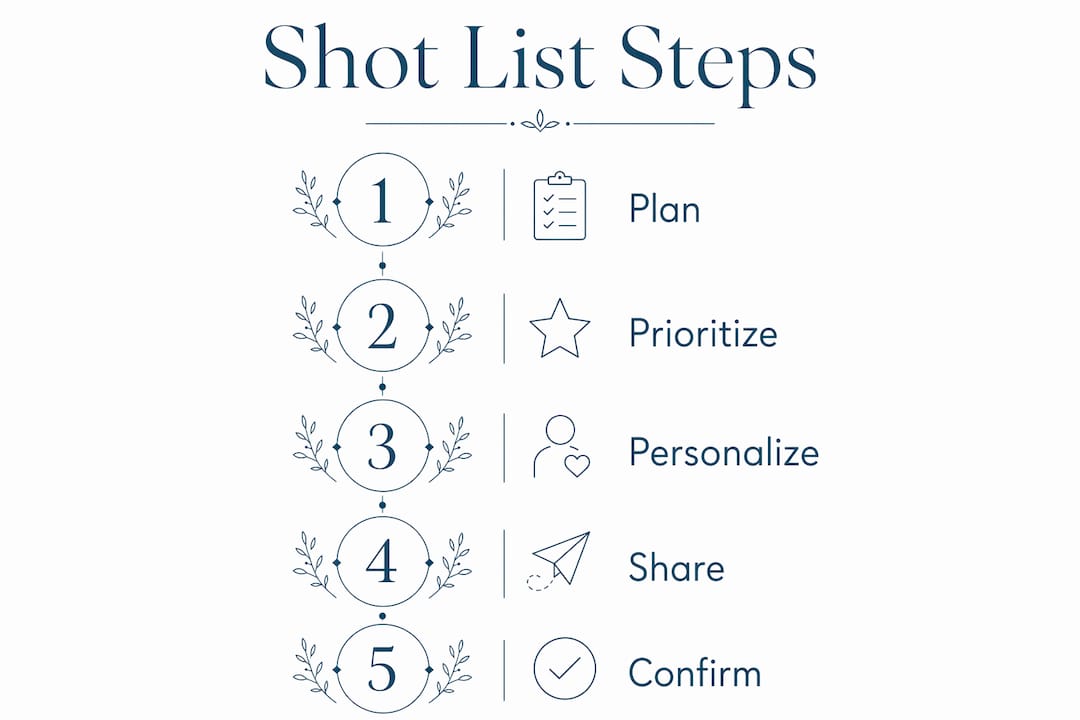
Send a marked 1–2 page shot list to your photographer at least two weeks before the wedding, then a final clean 1-page version one week out.
Who gets what:
Photographer: Full phased list with star-marked must-haves, family groupings by full name, and venue restriction notes
Family wranglers: 1-page groupings sheet with names and assembly order only
Planner/venue contact: Timeline version with phase start times
Videographer: A copy of the ceremony and reception must-haves so they can coordinate positions
Pro Tip: Schedule a 10–15 minute call with your photographer after sending the list. Walk through the must-haves, flag any venue restrictions, and confirm the golden-hour window. That call surfaces logistical issues before the day, not during it.
Day-of etiquette: what to avoid so your photographer can do their job
Keep the shot list accessible but let your photographer read the room. The list is a pre-wedding communication tool, not a day-of script to recite.
Common mistakes to avoid:
Interrupting the photographer during the ceremony or emotional moments
Crowding the couple during portraits with guests offering pose suggestions
Phone flashes firing during the first kiss or vows (ask your officiant to make a no-phone announcement)
Blocking sightlines with guests holding up tablets
Family wranglers and ushers should know their one job: assemble each grouping quickly and step back. The photographer calls the shot; the wrangler gets the people there.
Pro Tip: If you have a videographer, confirm camera positions with your photographer the week before. Coordinating with your videographer prevents both teams from blocking each other during the ceremony and first dance.
Three copyable shot-list templates
Pick the template that matches your coverage hours: the Top 10 for short coverage, the Compact 30 for a half-day, and the Full 60 for a full-day package.
Top 10 must-haves (any coverage length):
Detail flat-lay (rings, invitation, florals)
Getting-ready candid (bride or groom)
First kiss
Processional (bride walking the aisle)
Ring exchange close-up
Couple portrait (full length)
Family formal (couple with both sets of parents)
First dance
Toast/speech moment
Send-off
Compact 30-item template (by phase):
Phase | Shots |
Getting ready | Dress hanging, detail flat-lay, getting-dressed candid, first look with parent |
Ceremony | Processional, vows, ring exchange, first kiss, recessional, guest reactions |
Family formals | 6–8 pre-written groupings by full name |
Couple portraits | Full length, romantic candid, golden-hour silhouette |
Reception | Grand entrance, first dance, parent dance, toast, cake cutting, send-off |
Full 60-item template follows the same phase order with additional shots starred: ★ marks must-haves, ○ marks nice-to-haves. Copy the Compact 30 into Google Docs, then add a second row per phase for the ○ shots from the phase-by-phase template above. Print the family groupings sheet separately for your wranglers.
To adapt any template: add cultural rituals to the ceremony block, note venue restrictions at the top of the document, and flag any guests with mobility needs in the family formals section. StudioBinder’s wedding shot list tool lets you export a single-page PDF for day-of use.
Key Takeaways
A focused shot list of 20–30 starred must-haves, shared with your photographer at least two weeks before the wedding, protects every unrepeatable moment while leaving room for the candid shots that make an album feel alive.
Point | Details |
Keep it focused | Plan 50–70 named shots for a full day; star 20–30 as non-negotiables. |
Reverse-engineer the timeline | Work backward from ceremony start; block 15–30 min for golden hour one hour before sunset. |
Family formals need a wrangler | Pre-write groupings by full name; each takes 2–3 min with a dedicated wrangler per side. |
Share early, then confirm | Send the list 2+ weeks out; schedule a 10–15 min call to walk through must-haves. |
Pixelgroves | Offers timeline-first wedding photography in Florida with shot-list planning built into every final meeting. |
A note from Kellie on how shot lists actually work in real weddings
The couples who get the most out of their shot list are almost never the ones with the longest list. They’re the ones who sat down, argued a little about what actually mattered, and came out with around 25 starred shots and a clear family groupings sheet. That document does something an overlong list can’t: it gives a photographer permission to put the clipboard down and just watch.
At Pixelgroves, the 2025 Best of Florida Wedding Photographer Award reflects something we’ve built over years of timeline-first planning. Shot lists come up in every final meeting, not as a formality but because they change how the day flows. When a photographer knows your non-negotiables cold, they spend the ceremony looking at your faces, not their notes. The candid moments, the ones you didn’t think to ask for, tend to show up in the gallery right next to the ones you did.
Pixelgroves makes shot-list planning part of the process
Most couples spend hours building a shot list and then hand it to a photographer they’ve never talked timing with. Pixelgroves does it differently. Every wedding photography package includes a pre-wedding planning session where your shot list, family groupings, and golden-hour window get mapped against your actual venue and timeline before the day arrives.
[
Pixelgroves covers full-day and half-day weddings across Florida, with options for a second shooter, videography, and photo booth rentals. The result is a day-of team that already knows your must-haves, your family wrangler names, and where the light hits best at your venue. Check pricing and packages to find the coverage that fits your day, or reach out to start building your timeline together.
Useful sources
These resources are worth bookmarking for cross-checking timing, downloading printable templates, and exploring sample shot lists:
Brides: A Complete Wedding Photography Shot List — solid overview of photographer etiquette and prioritization principles
Paperlust: Wedding Photography Shot List (120+ shots by phase) — detailed timing estimates and a printable family combo chart
Plan A Wedding: Wedding Photo Shot List Guide — recommended shot counts for different coverage lengths and sharing timelines
StudioBinder: Wedding Photo Checklist — exportable PDF templates and phase-based checklist tools
Recommended
Comments